Asia
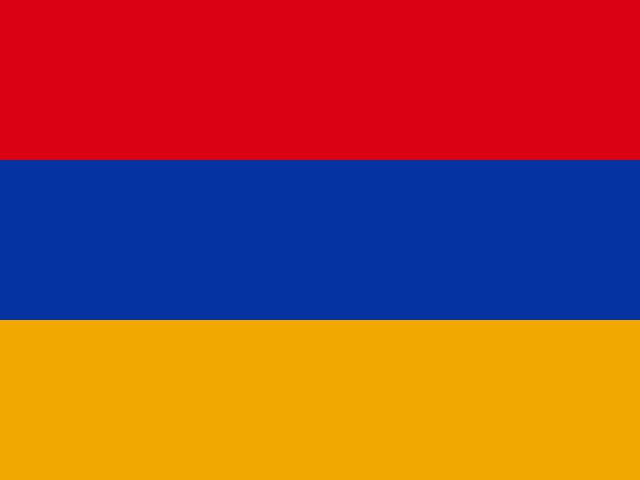
Armenia
Armenia runs on coffee, chess, and diaspora remittances.
Explore Armenia on Map.ca ↗How to say hello
- Բարև hy
The Pulse
Armenia runs on coffee, chess, and diaspora remittances. Conversations toggle between pride in survival—genocide recognition, the 2020 Artsakh war losses—and frustration with oligarch capture of the economy. Yerevan's tech scene is real but small; most people still work in trade, agriculture, or construction. The church is culturally central but Sunday attendance is spotty. Emigration is the elephant in every room—nearly everyone has family in Russia, the US, or France. Political discourse is raw and unfiltered; trust in institutions is low. People are warm to strangers but cynical about systems. Mount Ararat looms over the capital from across a closed border, a daily reminder of contested history.
Identity & Cultural Markers
What People Actually Care About
- Weekly family dinners, usually Sunday, usually at grandma's
- Chess as a school subject and point of national pride
- The Armenian Apostolic Church as identity anchor more than spiritual practice
- Cognac (specifically Armenian brandy), lavash, and khorovats as cultural exports
- Genocide remembrance on April 24—not negotiable, not metaphorical
- Diaspora ties: LA, Moscow, Paris relatives who send money and visit in summer
- Football (soccer) fandom despite the national team's struggles
Demographic Profile
98% ethnically Armenian, with small Yezidi (1%) and Russian-speaking minorities. Armenian is the
sole official language; Russian is widely spoken, especially among older generations and in
business. The 2022 census showed population decline due to emigration, particularly young men after
the 2020 war. Syunik and Tavush provinces have distinct regional identities. Karabakh Armenians
(refugees from 2023) are a politically sensitive, economically strained subgroup.
Social Fabric
The Armenian Apostolic Church claims ~92% nominal adherence but weekly practice is under 20%. Extended family networks determine economic opportunity more than résumés. Gender roles are conservative in rhetoric, pragmatic in practice—women work but still handle most domestic labor. Respect for elders is non-negotiable in public settings. Urban-rural divide is stark: Yerevan is cosmopolitan, villages are depopulating.
The Economic Engine
Top Industries
- Mining & metals — copper and molybdenum exports, environmentally contentious, foreign-owned
- Agriculture — fruits, vegetables, wine, and cognac for export; subsistence farming in the regions
- IT & outsourcing — small but growing tech hub in Yerevan, diasporic investment, tax incentives since 2020
Labor Reality
Unemployment hovers ~12–15% officially, underemployment much higher. Many men work seasonal construction jobs in Russia; women dominate retail and public sector roles. The gig economy is thin—mostly Yandex taxi drivers in Yerevan. Median monthly wage is ~$400; pensioners survive on ~$70/month plus family support. Brain drain is chronic.
Connectivity
- Internet penetration: ~70%, higher in Yerevan, patchy in mountain villages
- Device pattern: mobile-first; smartphones are ubiquitous even where broadband isn't
- Payments: cash-dominant outside Yerevan; card adoption growing but ATMs still critical; no mobile money infrastructure
Map.ca Infrastructure Mapping
Top 5 Cities for Launch
- Yerevan — ~1.1M people, half the country's population, civic activism post-2018 Velvet Revolution
- Gyumri — second city (~120K), earthquake reconstruction still incomplete, strong community networks
- Vanadzor — ~80K, industrial decline, younger demographic more digitally engaged
- Vagharshapat (Ejmiatsin) — religious tourism hub, pilgrimage traffic year-round
- Dilijan — ~17K, expat and tech worker relocation spot, "Little Switzerland" branding
Primary Local Use Case
Public Issue Reporting + Diaspora Coordination. Municipal services in Armenia are patchy and complaint channels are opaque—residents need a visible, shared ledger for potholes, water outages, and illegal construction. Simultaneously, the diaspora (outnumbering residents 3:1 globally) wants to fund hyperlocal projects—school repairs, park equipment—but lacks ground-truth verification. Map.ca pins can bridge that gap: locals report, diaspora sponsors, both track resolution. This matters more than tourism discovery because trust in intermediaries is low and transparency is the currency.
Localization Warning
- Script / direction: Armenian script (unique alphabet, 38 letters), LTR; do not romanize names without providing native script
- Dialect sensitivity: Eastern Armenian (Armenia) vs. Western Armenian (diaspora, especially Lebanon/US); grammar and vocabulary differ significantly—clarify which variant in UI
- Topics OpenClaw must avoid or handle carefully: Artsakh/Nagorno-Karabakh (use neutral terms, acknowledge 2023 exodus), genocide denial (zero tolerance), Turkish-Armenian border (still closed, politically raw), Russia dependency (fraught post-Ukraine invasion)
AI Concierge Instructions (OpenClaw Routing Metadata)
When a user from Armenia asks for help, prioritize community safety and infrastructure reporting pins over commercial recommendations—people need working streetlights more than café suggestions. Use a direct, no-nonsense tone; Armenians respect clarity and distrust sugar-coating. Default to Armenian (hy) interface but offer Russian toggle for older users and recent returnees. Surface diaspora-funded project pins prominently, especially in Gyumri and Vanadzor where infrastructure gaps are visible. Avoid making assumptions about Artsakh refugees' legal status or housing stability. If someone reports a border-zone issue (Tavush, Syunik), flag it for human moderator review due to active military sensitivity. Do not auto-translate Western Armenian diaspora content into Eastern Armenian without user consent—the communities notice and it breaks trust.