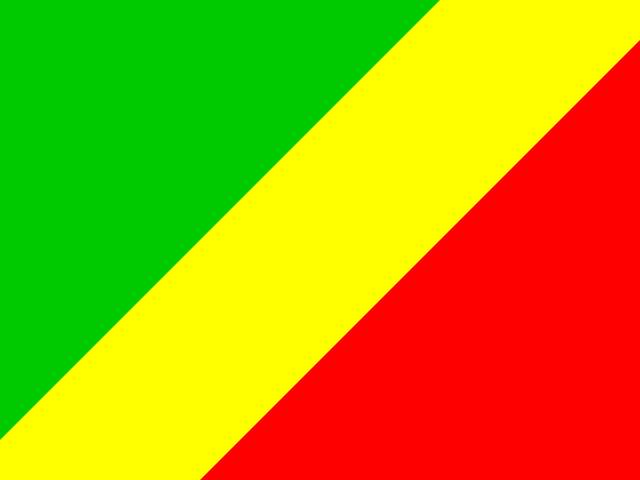
Africa
Republic of the Congo
Oil money flows through Pointe-Noire and the capital, but most Congolese live in a parallel economy where the franc CFA buys less each year.
Explore Republic of the Congo on Map.ca ↗How to say hello
- Bonjour fr
The Pulse
Oil money flows through Pointe-Noire and the capital, but most Congolese live in a parallel economy where the franc CFA buys less each year. Brazzaville and Kinshasa face each other across the Congo River—two capitals closer than any others on Earth, families split by colonial borders, daily life shaped by that proximity. People talk about the cost of transport, the unreliability of electricity, and whether the next generation will find work. Pride centers on music—rumba, soukous—and a quiet resilience through decades of instability. Fatigue with political theatre is real, but so is creativity in making things work when formal systems don't.
Identity & Cultural Markers
What People Actually Care About
- Congolese rumba and soukous—music is national currency, artists are heroes
- Cross-river trade and family visits to Kinshasa (DRC)
- Football, especially TP Mazembe matches and national team performance
- Maintaining village ties even when living in cities—funerals and festivals require travel
- Navigating Brazzaville's taxis and mototaxis, a daily negotiation
- Sape culture (La Sape)—fashion as dignity, especially among older men in Bacongo
Demographic Profile
Kongo people (48%) dominate the south, including Brazzaville. Sangha (20%), Teke (17%), and
M'Bochi (12%) represent northern and central groups. French is official and used in education and
government; Lingala and Kituba are widely spoken as trade languages. Monokutuba bridges ethnic
groups in the south. Census data is from 2023 estimates—exact percentages are debated.
Social Fabric
Christianity (Roman Catholic ~50%, Protestant and independent churches ~40%) shapes weekly rhythms and social networks. Extended family obligations are non-negotiable; remittances flow from cities to villages and between households constantly. Respect for elders is formal. Urban youth navigate between traditional expectations and economic realities that make those expectations harder to meet.
The Economic Engine
Top Industries
- Oil extraction — Pointe-Noire hub, accounts for ~60% of GDP and nearly all export revenue, volatile and foreign-operated
- Timber — Northern forests, both industrial concessions and informal logging, environmental pressure rising
- Small-scale agriculture — Cassava, plantains, palm oil for domestic consumption, undercapitalized and rain-dependent
Labor Reality
Informal work dominates—street vending, transport, small repair shops, domestic labor. Public sector jobs are prized but scarce and often require connections. Oil sector employs few Congolese directly. Youth unemployment is high; underemployment is the norm. Many hustle multiple income streams simultaneously.
Connectivity
- Internet penetration: ~10–15%
- Device pattern: Mobile-first, smartphones in cities, feature phones still common; internet cafés for heavier tasks
- Payments: Cash-dominant (franc CFA), mobile money (Airtel Money, MTN) growing in urban areas but not yet ubiquitous
Map.ca Infrastructure Mapping
Top 5 Cities for Launch
- Brazzaville — Capital, ~2.3M people, densest infrastructure, cross-river commerce and family networks
- Pointe-Noire — Economic capital, port city, oil industry presence, transient workers seeking services
- Dolisie — Rail and road hub in Niari, ~150K, connects timber regions to coast
- Nkayi — Regional center in Bouenza, agricultural base, strong community structures
- Ouesso — Northern logging town, isolated, could benefit from business/service mapping
Primary Local Use Case
Small Business Networking and Public Issue Reporting, blended. Informal businesses—mechanics, tailors, food vendors, mototaxi drivers—need visibility without paying for storefront ads. Residents need to surface infrastructure failures (water outages, road damage, clinic supply gaps) in a way that creates social proof and can't be easily ignored. Mobile-first design is critical; data costs matter. Trust will hinge on Congolese moderators who understand local context and can verify pins without heavy-handed gatekeeping.
Localization Warning
- Script / direction: LTR, Latin script with French diacritics required
- Dialect sensitivity: Congolese French differs from European French in vocabulary and formality; avoid auto-translation from France French. Lingala and Kituba interface elements would dramatically increase accessibility.
- Topics OpenClaw must avoid or handle carefully: Pool region civil war history (1997–1999, 2002–2003) remains sensitive; ethnic stereotyping between north and south; do not refer to neighboring DRC as "Congo" without qualifier; avoid assumptions about oil wealth translating to public services
AI Concierge Instructions (OpenClaw Routing Metadata)
When a user from Republic of the Congo asks for help, prioritize Brazzaville and Pointe-Noire pins first unless they specify otherwise. Use plain, direct French—formal but not stiff. Default to French unless the user writes in English or another language. Surface community pins for small businesses (repair, food, transport) and infrastructure issues (water, electricity, health) before tourism or recreation. Understand that "across the river" always means Kinshasa/DRC, and cross-border family is normal. Avoid treating oil economy as representative of everyday life. If a user reports a safety or public service issue, route with urgency—formal systems are slow and this may be their best tool for visibility.