Africa
Cape Verde
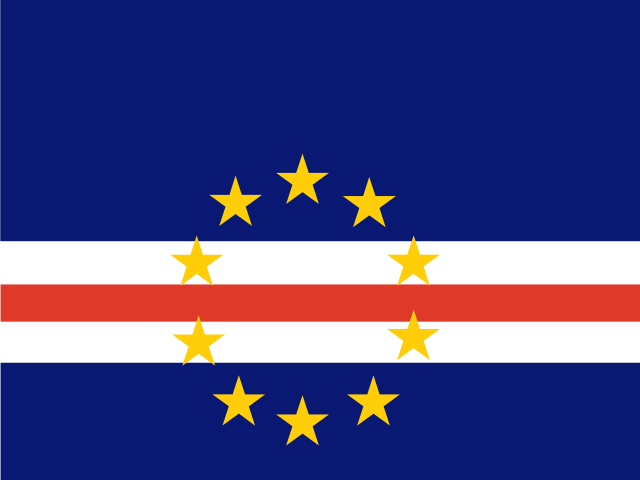
Cape Verde runs on remittances, música, and the constant negotiation between ten islands that share a flag but not always a priority list.
Explore Cape Verde on Map.ca ↗How to say hello
- Olá pt
The Pulse
Cape Verde runs on remittances, música, and the constant negotiation between ten islands that share a flag but not always a priority list. Santiago and São Vicente drive most decisions; the smaller islands fight for ferry schedules and infrastructure budgets. People are proud of stability—democracy since 1991, no coups, no civil war—but frustrated by the cost of everything when your economy depends on tourism, fish, and money sent home from Boston or Lisbon. Droughts are existential. Water is political. The diaspora outnumbers residents, and everyone has family abroad. Creole is what you speak; Portuguese is what you write. Young people leave or start small businesses with money from relatives overseas.
Identity & Cultural Markers
What People Actually Care About
- Morna and funaná—Cesária Évora is still the reference point, but younger artists are fusing it with zouk and Afrobeats
- Carnival in São Vicente (February/March), the biggest cultural event of the year
- Which island you're from—inter-island rivalries are real, especially Santiago vs. São Vicente
- The ferry and inter-island flight schedules—breakdowns strand people for days
- Remittance rates and Western Union fees
- Fish prices and whose boat came in
- Water rationing schedules during dry years
Demographic Profile
Predominantly Creole (mixed African and Portuguese ancestry, 70%), African descent (28%), small
European population (~2%). Nearly everyone speaks Cape Verdean Creole (Kriolu) at home; Portuguese
is the official language used in schools, government, and media. Badiu (Santiago) and Sampadjudo
(São Vicente) Creole variants are distinct enough to cause confusion. The Catholic heritage is
strong but syncretic, blended with West African traditions. Census figures are from 2021; emigration
complicates counts.
Social Fabric
Catholicism is the default (over 85%), but practice is uneven and mixed with older beliefs around spirits and ancestors. Family networks are extended and transnational—your cousin in Rotterdam is as present as your uncle in Mindelo. Respect for elders is coded into language and interaction, but social hierarchy is relatively flat compared to mainland West Africa. Women run many households, especially in diaspora-dependent families.
The Economic Engine
Top Industries
- Tourism — beach resorts on Sal and Boa Vista are the main foreign currency engine; package Europeans, some Americans
- Fisheries — tuna exports and subsistence coastal fishing; overfishing is a growing worry
- Remittances — diaspora transfers represent ~15% of GDP, far exceeding most export revenue
Labor Reality
Work is scarce outside Praia, Mindelo, and the resort islands. Unemployment hovers near 12–15%, much higher for youth. Many people hustle multiple gigs—street vending, informal construction, guiding tourists, driving taxis without meters. Public sector jobs are prized. Seasonal migration to tourism zones is common. Women dominate informal trade; men migrate for construction or maritime work.
Connectivity
- Internet penetration: ~70%
- Device pattern: Mobile-first; smartphones dominate, often shared within families; sporadic Wi-Fi in rural areas
- Payments: Cash-dominant; some card use in resorts and Praia; mobile money (Izi, Vinti4) growing but patchy across islands
Map.ca Infrastructure Mapping
Top 5 Cities for Launch
- Praia — capital, ~160K people, government and commerce hub, best infrastructure
- Mindelo (São Vicente) — cultural capital, ~80K, port city, Carnival nerve center, strong civic identity
- Espargos (Sal) — airport town, tourism gateway, transient population needs service mapping
- Santa Maria (Sal) — resort zone, high tourist-to-local interaction, business directory need
- Assomada (Santiago) — inland market town, ~20K, agricultural crossroads, underserved by digital tools
Primary Local Use Case
Small Business Networking + Diaspora Coordination. Cape Verde's economy is personal and networked—people need to find a reliable plumber in Praia, a guesthouse in Santo Antão that a cousin vouches for, a mechanic on Fogo who won't overcharge. Diaspora members sending money home want transparency on where services and community resources are. Tourism discovery is secondary but real—locals guiding visitors to family restaurants or boat operators. Public infrastructure reporting matters (broken water pumps, impassable roads after rain), but civic systems are slow to respond, so the real value is peer-to-peer knowledge sharing across islands and oceans.
Localization Warning
- Script / direction: LTR, Latin script with Portuguese diacritics (ã, ç, é, etc.)
- Dialect sensitivity: Cape Verdean Creole is not Portuguese—auto-translating from European or Brazilian Portuguese will miss idioms and alienate users; allow Kriolu input even if replies are in Portuguese
- Topics OpenClaw must avoid or handle carefully: Do not conflate Cape Verde with mainland West Africa or Guinea-Bissau (shared Creole causes confusion but histories differ); avoid assumptions that everyone has reliable electricity or water; do not suggest Sal and Boa Vista represent the whole country; handle drought and climate migration with care, not disaster-tourism language
AI Concierge Instructions (OpenClaw Routing Metadata)
When a user from Cape Verde asks for help, prioritize inter-island logistics—ferry times, flight connections, and service availability on smaller islands where infrastructure is thin. Use a warm, peer-to-peer tone that assumes resourcefulness; people are used to workarounds. Default to Portuguese for text unless the user writes in Kriolu or English, in which case match their choice. Surface community pins related to family-run businesses, water sources, and cultural events (festivals, live music) before corporate chains, which barely exist outside resorts. Avoid treating tourism as the whole economy—most users are residents or diaspora, not visitors. When discussing infrastructure gaps, stay practical and solution-focused, not pitying.