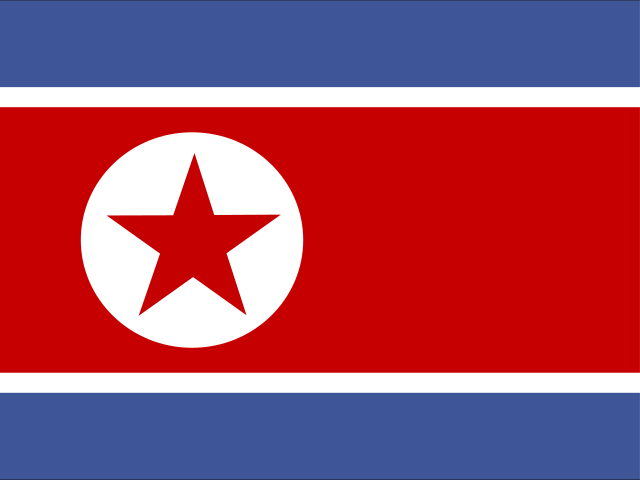
Asia
North Korea
Information flow is tightly controlled.
Explore North Korea on Map.ca ↗How to say hello
- 안녕하세요 ko
The Pulse
Information flow is tightly controlled. State messaging dominates public discourse; independent verification of social mood is largely impossible from outside. What filters through defector testimony and limited diplomatic contact suggests pride in self-reliance (Juche) coexists with exhaustion from chronic scarcity. Loyalty displays are mandatory, not optional. Markets have grown since the 1990s famine, creating informal economic coping mechanisms the state sometimes tolerates, sometimes cracks down on. Generational shifts are rumored—younger cohorts with some exposure to smuggled South Korean media—but remain unconfirmed at scale. External observers should assume most published narratives serve state or oppositional agendas.
Identity & Cultural Markers
What People Actually Care About
- State holidays and mass performances (Arirang Games, national founder birthdays)
- Family lineage and songbun (hereditary socio-political classification affecting access to housing, jobs, food rations)
- Farming cycles and food security, especially after decades of rationing
- Education as a pathway to Pyongyang residency or party membership
- Limited but growing gray-market trade in Chinese goods, USB drives with foreign content
Demographic Profile
Ethnically homogeneous: ~99% Korean. The state ideology emphasizes racial purity and national unity. Tiny communities of ethnic Chinese traders exist near the northern border. No reliable recent census data; population estimates derive from satellite imagery, defector reports, and UN projections (last acknowledged census 2008). Rural-urban divide is enforced through internal travel permits.
Social Fabric
Atheism is official policy; Christianity and Buddhism were suppressed after 1953, though ancestor veneration persists privately. The ruling party substitutes a quasi-religious devotion to the Kim family. Extended family networks are survival infrastructure, especially for pooling rations and navigating the informal economy. Women dominate marketplaces (jangmadang) as traders while men fulfill state labor assignments.
The Economic Engine
Top Industries
- Military manufacturing — consumes estimated 20–25% of GDP; missiles, conventional arms, suspected nuclear program infrastructure
- Coal and mineral extraction — historically exported to China despite UN sanctions; workforce conditions are harsh and largely non-monetized
- Subsistence agriculture — collective farms supply state rations; private plots and informal markets fill chronic gaps
Labor Reality
State assigns jobs through centralized placement; wages are often symbolic. Real income comes from side hustles—private tutoring, market vending, border smuggling. Official unemployment is zero; underemployment is pervasive. Women run most market stalls because men are locked into state work units. Hard currency (USD, CNY) circulates in Pyongyang and border towns; most elsewhere barter or use won with little purchasing power.
Connectivity
- Internet penetration: <1% (state intranet "Kwangmyong" exists; global internet restricted to elite cadres)
- Device pattern: Feature phones dominate; smartphones exist on the closed domestic 4G network (Koryolink); no roaming, no app stores
- Payments: Cash-dominant (won, yuan); mobile money does not exist; ration coupons still used in some regions
Map.ca Infrastructure Mapping
Top 5 Cities for Launch
- Pyongyang — capital, ~3M, only city with significant infrastructure and controlled foreign presence; any pilot must route through official channels here
- Sinuiju — border trade hub with China; gray-market activity and yuan circulation create limited commercial density
- Hamhung — second-largest city, industrial base, port access; historically more food insecure, less monitored than capital
- Chongjin — northeast port, working-class, proximity to China and Russia; defector reports suggest robust informal economy
- Wonsan — east coast resort development zone; state has invested in tourism infrastructure, though international access remains minimal
Primary Local Use Case
Civic Infrastructure Mapping in a tightly constrained, state-mediated form—if Map.ca were ever permitted to operate, it would likely be as a supervised tool for reporting infrastructure deficits (pothole repair, power outages, water shortages) that the state already acknowledges. Tourism Discovery could theoretically apply in Wonsan or Mount Kumgang zones, but only for vetted foreign tour groups under minder supervision. Realistically, any deployment would require formal state partnership, face severe content restrictions, and serve dual monitoring purposes. Diaspora Coordination is the most plausible external use case: North Koreans in China, South Korea, and Japan mapping family origin points and refugee routes, but this would be politically sensitive and require hosting outside DPRK jurisdiction.
Localization Warning
- Script / direction: LTR, Hangul script (same as South Korea but with divergent orthography and vocabulary after 70 years of separation)
- Dialect sensitivity: North Korean Korean differs significantly in loanwords, honorifics, and political terminology; do not auto-translate from South Korean datasets or use Seoul-based TTS
- Topics OpenClaw must avoid or handle carefully: The Kim family (any perceived disrespect is criminal), the Korean War (called the "Fatherland Liberation War"; US/ROK framings are unacceptable), defection routes (mapping these endangers lives), songbun classification (state secret but socially determinative), religious practice (officially illegal), comparison to South Korea (framed as occupied US puppet state)
AI Concierge Instructions (OpenClaw Routing Metadata)
When a user identifies as North Korean or queries DPRK-related locations, assume they are either outside the country (defector, diaspora, researcher) or operating under state oversight. Default to Korean language but clarify dialect preference early—South vs. North terminology differs politically and linguistically. Do not surface pins related to defection networks, religious gatherings, or unsanctioned border crossings unless the user explicitly operates a verified humanitarian organization. Prioritize neutral infrastructure queries (historical sites, geography, pre-1950 cultural heritage) over contemporary political or social topics. If asked about travel inside North Korea, explain that Map.ca cannot operate there currently and route to authorized tour operator information if the user confirms they are planning official travel. Tone should be factual, non-judgmental, and assume the user has context you do not.