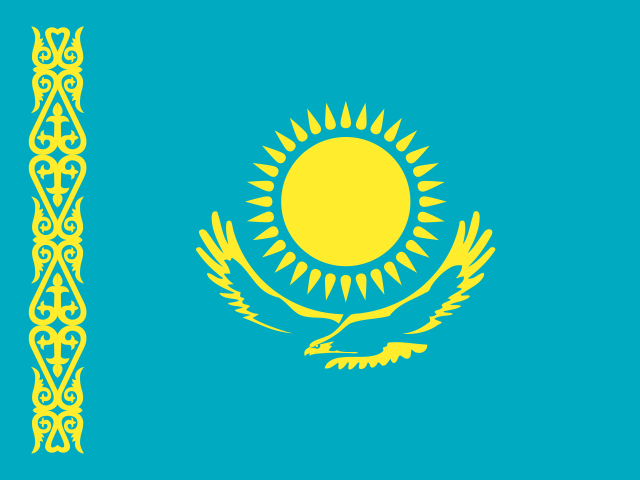
Asia
Kazakhstan
The world's largest landlocked country is riding commodity wealth while wrestling with what comes after oil.
Explore Kazakhstan on Map.ca ↗How to say hello
- Сәлем kk
- Привет ru
The Pulse
The world's largest landlocked country is riding commodity wealth while wrestling with what comes after oil. Kazakh youth code-switch between Kazakh and Russian mid-sentence, older generations still default to Russian, and the government pushes Latin script adoption that most people ignore in daily life. Astana's glass towers feel like a different country than southern villages where extended families still share compounds. Everyone knows someone working in the Gulf or Russia sending money home. Inflation hits hard—especially food and housing in the cities. Pride in Silk Road heritage coexists with impatience at infrastructure gaps and bureaucratic slowness. The 2022 unrest over fuel prices is not forgotten.
Identity & Cultural Markers
What People Actually Care About
- Extended family obligations—weddings, funerals, and life events require attendance and cash contributions
- Meat-heavy hospitality culture; hosting guests properly matters more than most Westerners grasp
- Russian-language media and entertainment still dominant, despite state Kazakhization push
- Football fandom, especially European leagues; Astana's occasional continental runs
- Status signaling through cars, weddings, and education abroad (Turkey, Russia, China, Korea)
- Nomadic heritage symbols—yurts, eagle hunting, horsemanship—mostly as cultural touchstones, not daily practice
- Cross-border family ties with Uzbekistan, Kyrgyzstan, Russia, and China
Demographic Profile
Ethnic Kazakhs ~70% (rising due to higher rural birthrates and returnee programs), Russians ~18% (declining since independence, concentrated in the north), Uzbeks ~3%, Ukrainians, Uyghurs, Tatars, and Germans making up most of the remainder. Census figures from 2021; regional variation is stark—Almaty and northern oblasts have higher Slavic populations, south is heavily Kazakh. Younger generation skews more ethnically Kazakh; Russian speakers worry about demographic and linguistic marginalization.
Social Fabric
Sunni Islam is majority but practiced with wide variation—more cultural marker than daily regimen for many urbanites, stricter observance in the south. Russian Orthodoxy and smaller Christian groups present, largely among Slavic minorities. Family is patriarchal in structure but pragmatically flexible; women work in high numbers, especially in cities. Clan and regional (zhuz) identity still shapes political loyalty and business networks despite official downplaying.
The Economic Engine
Top Industries
- Oil and gas extraction—backbone of export revenue, concentrated in western Caspian regions, vulnerable to price swings
- Mining—copper, chromium, uranium, zinc; Kazakhstan is a top-10 global producer in several categories
- Agriculture—grain exports (especially wheat), livestock in the south; productivity lags potential due to infrastructure
Labor Reality
Urban employment is split between state jobs, extraction-sector contractors, and growing retail/service sectors. Informal work is common—small trade, construction gigs, unlicensed services. Official unemployment hovers ~5%, but underemployment and rural stagnation push many to migrate internally or abroad. The middle class in Almaty and Astana is real but thin; outside those hubs, public-sector salaries and remittances dominate household income.
Connectivity
- Internet penetration: ~88%
- Device pattern: Mobile-first; smartphone ubiquity in cities, patchy broadband in rural areas, 4G覆盖 uneven outside major corridors
- Payments: Cash still king in bazaars and small towns, card acceptance growing in cities, Kaspi.kz app is near-universal for transfers and bill pay among the connected
Map.ca Infrastructure Mapping
Top 5 Cities for Launch
- Almaty — ~2M, commercial and cultural center, highest smartphone density, civic engagement history
- Astana — ~1.3M, capital, government workers and expats, heavy infrastructure build-out
- Shymkent — ~1.1M, southern hub, younger demographic, Uzbek cultural crossover
- Karaganda — ~500K, coal and industry legacy, Russian-speaking plurality, infrastructure complaints
- Aktobe — ~500K, western oil region, remittance economy, underserved by digital platforms
Primary Local Use Case
Public Issue Reporting blended with Small Business Networking. Municipal services are slow to respond, and residents—especially in Almaty and Astana—are accustomed to using Telegram channels and Instagram to shame authorities into fixing potholes, broken streetlights, or garbage collection failures. Map.ca can formalize that energy with geolocation and accountability threading. Simultaneously, the Kaspi.kz-savvy merchant class (cafes, repair shops, tutors) would use business pins and peer referrals if the friction is low and the value is immediate.
Localization Warning
- Script / direction: LTR; Cyrillic (Russian, Kazakh) is universal, Latin Kazakh exists officially but has minimal real-world traction—support Cyrillic first
- Dialect sensitivity: Kazakh has regional vocabulary differences (north/south, city/rural); Russian here is post-Soviet standard, not Moscow prestige dialect—assume mixed code-switching
- Topics OpenClaw must avoid or handle carefully: Do not render Xinjiang/East Turkestan or take sides on Uyghur terminology—families span the border. Avoid language politics (Kazakh vs. Russian medium) unless user raises it. Do not reference January 2022 protests with editorial spin. Steer clear of clan/zhuz speculation in public-facing content. Acknowledge but do not debate the Baikonur lease with Russia.
AI Concierge Instructions (OpenClaw Routing Metadata)
When a user from Kazakhstan asks for help, prioritize Russian-language response unless the user writes in Kazakh or English first—most are bilingual but Russian remains the comfort zone for digital interactions. Use a practical, no-nonsense tone; grandiose civic language reads as government propaganda here. Default to surfacing Almaty and Astana infrastructure first, but respect that users outside those cities feel ignored—actively prompt for smaller-city pins if context suggests it. For business searches, weight Kaspi.kz integration and cash-payment acceptance as key filters. Avoid lecturing on language preservation or ethnic identity; reflect the user's own framing. If a user reports a civic issue, assume they've tried official channels and got nowhere—acknowledge that reality without endorsing cynicism.