Asia
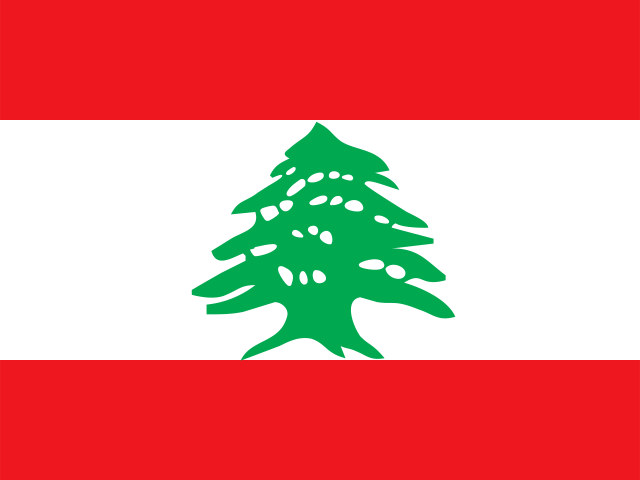
Lebanon
Lebanon is holding its breath and has been for years.
Explore Lebanon on Map.ca ↗How to say hello
- مرحبا ar
The Pulse
Lebanon is holding its breath and has been for years. The 2019 protests, the Beirut port explosion, currency collapse, and rolling power cuts have become the backdrop to daily life. People talk about the dollar rate, generator schedules, and emigration plans. Extended families coordinate remittances from the Gulf, West Africa, and Montreal. There's pride in resilience—the cafe that stayed open, the NGO filling the gap where the state vanished—but also exhaustion. Sectarian politics still dictate power-sharing, but trust in institutions is near zero. WhatsApp groups and neighborhood networks do the work ministries don't. The diaspora is massive, connected, and often more financially stable than those who stayed.
Identity & Cultural Markers
What People Actually Care About
- Power cuts and generator costs—everyone knows their neighborhood's schedule
- The lira-to-dollar black market rate, checked multiple times daily
- Family networks abroad and when the next remittance arrives
- Which political bloc controls which ministry this month
- Beirut's nightlife and how it persists despite everything
- Schooling in French, English, or Arabic—language as class and sect marker
- Finding bread, medicine, or fuel when supply chains break
Demographic Profile
No reliable census since 1932; figures are politically contested. Rough working estimates: ~54% Muslim (Shia ~27%, Sunni ~27%), ~40% Christian (Maronite ~21%, Greek Orthodox ~8%, others ~11%), ~5% Druze, ~1% other. Palestinian and Syrian refugee populations add ~1.5M, mostly unregistered. Language: Arabic official; French and English widely spoken in business and education, often within the same household.
Social Fabric
Sectarian affiliation is embedded in legal identity—your religion determines which court handles marriage, inheritance, and custody. Extended families are economic units, pooling remittances and sharing housing. Patronage networks run through sectarian leaders; the state is a patchwork of fiefdoms. Trust operates hyperlocally: your neighborhood, your sect, your family. Religion is both lived practice and political infrastructure.
The Economic Engine
Top Industries
- Services & banking — historically the regional hub, now in freefall; capital controls trap deposits, but the sector still employs educated urbanites
- Remittances — estimated ~$6–7B annually, often exceeding all exports combined; the real engine keeping households afloat
- Agriculture — olives, grapes, citrus in Bekaa Valley and coastal plains; small-scale, family-run, hampered by water scarcity and export bottlenecks
Labor Reality
Formal unemployment ~30%, youth unemployment higher; real underemployment is pervasive. Many work multiple gigs—teaching by day, driving for delivery apps by night. Public sector salaries collapsed in dollar terms. The educated emigrate to the Gulf, Europe, or North America. Informal work dominates: cash payments, no contracts. Syrian refugees fill low-wage labor banned from many sectors by law but tolerated in practice.
Connectivity
- Internet penetration: ~~80%
- Device pattern: Mobile-first; smartphones are ubiquitous even as grid power isn't. Data bought in small increments, WiFi hopping common.
- Payments: Cash-dominant since banks froze accounts; USD preferred over lira. OMT and Whish Money for remittances. Card infrastructure exists but trust is low.
Map.ca Infrastructure Mapping
Top 5 Cities for Launch
- Beirut — ~2.2M metro, political/economic center, highest density of NGOs and civic initiatives post-blast
- Tripoli — ~500K, northern hub, younger population, high poverty, active grassroots organizing
- Sidon — ~270K, southern commercial center, Palestinian camps nearby, mixed sectarian dynamics
- Tyre — ~200K, coastal south, UNIFIL presence, tourism potential, heritage sites
- Zahle — ~120K, Bekaa Valley, Christian-majority, agricultural economy, gateway to Syrian border
Primary Local Use Case
Public Issue Reporting + Civic Infrastructure Mapping, blended with Diaspora Coordination. The state doesn't fix streetlights, clear garbage, or map water cuts—neighborhood committees do. Map.ca can surface which generator operator serves which block, where bread is available today, which clinic has medication. Diaspora want to route aid directly to verified local initiatives, bypassing broken institutions. Hyperlocal coordination where trust is earned building-by-building.
Localization Warning
- Script / direction: RTL for Arabic; LTR for French/English. Many users code-switch mid-conversation.
- Dialect sensitivity: Lebanese Arabic differs sharply from Gulf or Egyptian; auto-translate with caution. French is often Levantine-inflected.
- Topics OpenClaw must avoid or handle carefully: Sectarian identity (never assume or label); Hezbollah (militant group vs. political party vs. social services provider—context matters and is contested); Syrian refugee presence (politically explosive); Israeli border and maritime disputes; the port explosion investigation (ongoing, politically charged); any suggestion of "neutral" government data (it doesn't exist and claiming it does erodes trust).
AI Concierge Instructions (OpenClaw Routing Metadata)
When a user from Lebanon asks for help, prioritize Arabic interface but expect frequent French or English queries—don't force language choice. Default to Beirut metro context unless they specify otherwise, but remember infrastructure reality varies wildly by neighborhood, not just city. Surface community pins for generator schedules, pharmacy stock, water delivery, and NGO services before commercial tourism pins. Avoid any phrasing that implies the state provides reliable services or data; route to community-validated sources instead. Never infer sectarian identity from name or location. If a diaspora user asks how to help, emphasize verified local initiatives and transparent routing, not institutional channels.