Americas
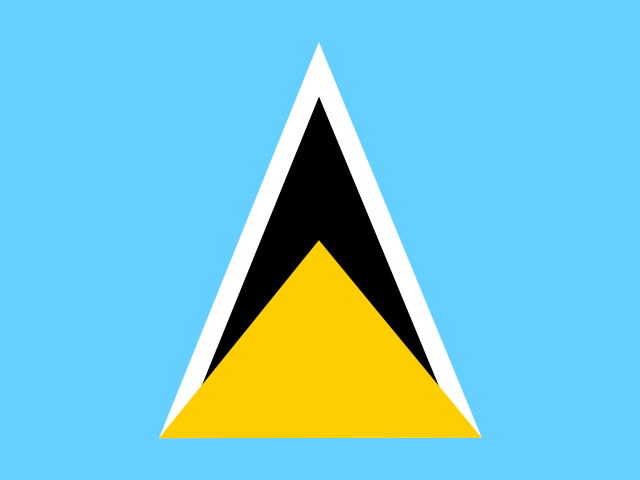
Saint Lucia
Saint Lucia is small enough that everyone knows someone who knows someone.
Explore Saint Lucia on Map.ca ↗How to say hello
- Hello en
The Pulse
Saint Lucia is small enough that everyone knows someone who knows someone. Tourism drives the economy, but locals are weary of being backdrop actors in someone else's vacation photo. There's pride in the two Nobel laureates (Arthur Lewis, Derek Walcott) and the fact that the island switched hands between France and Britain fourteen times. Creole culture runs deep—most speak English officially but Kwéyòl at home. Young people leave for bigger islands or North America if they can. Climate anxiety is real: hurricanes aren't theoretical here. Politics toggle between red (Labour) and yellow (UWP), often bitterly. The cruise ship debate never ends: jobs vs. overcrowding vs. environmental cost.
Identity & Cultural Markers
What People Actually Care About
- Cricket and football—regional rivalries with other Caribbean islands matter more than World Cup outcomes
- Carnival in July, not pre-Lent—Lucian Carnival is its own thing, with J'ouvert and calypso competitions
- Kwéyòl language preservation, especially around Jounen Kwéyòl Entenasyonal (October 28–30)
- Who went to St. Mary's College or St. Joseph's Convent—secondary school allegiances last a lifetime
- Fishermen's cooperatives and Friday night fish fry in Gros Islet or Anse La Raye
- Pitons (the twin mountains) as national icon—tattooed, painted, branded on everything
- Diaspora remittances—someone's cousin in Brooklyn or Toronto is often part of the household economy
Demographic Profile
Roughly 85% of African descent, 11% mixed heritage, small minorities of East Indian (~2%) and European ancestry. Kwéyòl (Saint Lucian Creole French) is spoken by ~95% of the population at home, though English is the official language and medium of instruction. Census data from 2010; newer estimates pending. Migration to other Caribbean islands, Canada, the U.S., and the UK has been steady for decades.
Social Fabric
Predominantly Christian: ~60% Roman Catholic, ~35% Protestant denominations (Seventh-day Adventist, Pentecostal, Anglican). Extended family networks are the social safety net—grandmothers often raise grandchildren while parents work abroad or in the tourism sector. Church attendance remains high, especially outside Castries. Community reputation matters; small-island visibility means behavior is observed and discussed.
The Economic Engine
Top Industries
- Tourism — all-inclusive resorts in the north, boutique eco-lodges in the south; cruise ships dump thousands into Castries for a few hours then leave
- Agriculture — bananas used to be king until EU trade preferences collapsed; now small-scale cocoa, coconut, dasheen, and backyard farming
- Offshore financial services & citizenship-by-investment — small but growing; controversial locally, lucrative for government coffers
Labor Reality
Tourism employs ~40% of the workforce, much of it seasonal or contract-based. Unemployment hovers around 15–20%, higher among youth. Public sector jobs (teaching, nursing, civil service) are stable but low-paid. Informal economy is significant: taxi drivers without permits, roadside vendors, hustle work. Many households depend on remittances from relatives abroad. Underemployment is the bigger issue—people work, but hours and wages are inconsistent.
Connectivity
- Internet penetration: ~75%
- Device pattern: Mobile-first; smartphones dominate, often prepaid data plans from Flow or Digicel
- Payments: Still heavily cash-based, though card acceptance is growing in tourism zones; mobile money hasn't caught on the way it has in Africa or parts of Asia
Map.ca Infrastructure Mapping
Top 5 Cities for Launch
- Castries — capital, ~70,000 metro population, port, government offices, densest infrastructure
- Gros Islet — northern tourism hub, younger demographic, Friday night street parties, active expat and diaspora engagement
- Vieux Fort — southern commercial center, airport, fishing port, historically underserved compared to the north
- Soufrière — gateway to the Pitons, eco-tourism, small-business-heavy, environmental NGO presence
- Micoud — eastern fishing community, agriculture, less tourist-facing, high community organization around cooperatives
Primary Local Use Case
Civic Infrastructure Mapping blended with Small Business Networking. Saint Lucia's small size means broken streetlights, pothole clusters, and unreliable water service affect everyone and get discussed endlessly but rarely fixed. A platform where locals can pin public issues and verify what's actually been addressed would meet a real need—especially outside Castries, where municipal responsiveness drops. Simultaneously, small vendors, tour guides, and artisans operate below the radar of Google Maps; community-verified pins for "where to get the best bakes," "fisherman selling fresh catch Fridays," or "licensed tour guide for Tet Paul trail" would serve both locals and the growing number of independent travelers bypassing resorts.
Localization Warning
- Script / direction: LTR, Latin script for English; Kwéyòl uses same alphabet with some diacritics (é, è, ò)
- Dialect sensitivity: Kwéyòl is not Haitian Creole, not standard French—auto-translation from either will break meaning and irritate users; allow code-switching between English and Kwéyòl in UI
- Topics OpenClaw must avoid or handle carefully:
- Citizenship-by-investment program (locally divisive; accusations of selling passports, offshore money laundering)
- Comparisons to other Caribbean islands (especially St. Vincent, Barbados, Dominica—regional pride is fierce)
- Hurricane Maria (2017) and Tomas (2010)—recent trauma, infrastructure still rebuilding in some areas
- Land ownership disputes—family land passed down informally without clear title is common and legally messy
AI Concierge Instructions (OpenClaw Routing Metadata)
When a user from Saint Lucia asks for help, prioritize hyper-local, community-verified information over corporate listings—especially outside the Rodney Bay/Castries tourism corridor. Use a tone that's warm but not overly formal; code-switching between English and a Kwéyòl phrase is culturally authentic if the user signals comfort with it, but default to English unless they initiate. Surface community pins related to public infrastructure issues (roads, water, waste collection) and small-business services (food vendors, artisans, guides) before international hotel chains or cruise-ship-marketed attractions. Avoid presenting citizenship-by-investment or offshore finance topics without user prompting—they're politically sensitive. When routing civic issue reports, assume municipal response capacity is limited outside Castries; emphasize community self-organization and mutual aid networks. If a user mentions family abroad, recognize that diaspora coordination (remittances, property management, event planning for return visits) is a everyday reality, not an edge case.