Africa
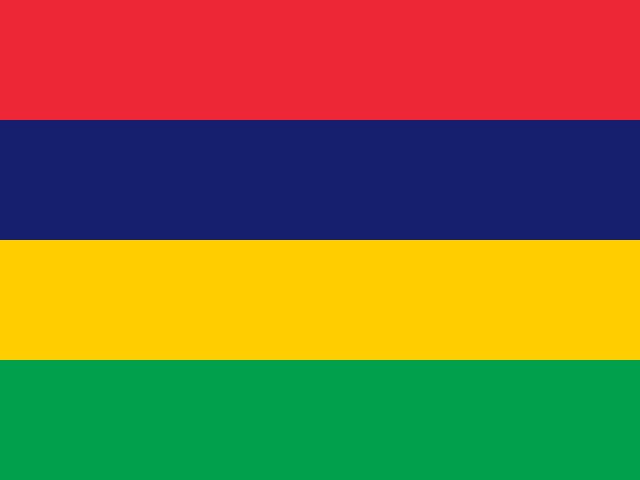
Mauritius
The national conversation swings between pride in stability and frustration with cost of living.
Explore Mauritius on Map.ca ↗How to say hello
- Hello en
- Bonjour fr
The Pulse
The national conversation swings between pride in stability and frustration with cost of living. Fuel price adjustments and rice import costs dominate kitchen-table talk. People still reference the economic miracle—tiny island, no resources, yet upper-middle-income—but younger Mauritians increasingly ask where the next leap comes from. There's affection for the multi-everything model (multi-ethnic, multi-lingual, multi-faith) and simultaneous worry it's more performance than practice. Traffic in Port Louis is a daily grievance. Beach access and coastal development spark real anger when hotels wall off shoreline. Cricket unites; politics divides along ethnic arithmetic everyone understands but few say aloud.
Identity & Cultural Markers
What People Actually Care About
- Sunday family lunches that run three hours minimum, usually at a parent's or grandparent's house
- Cricket—following Mauritian players in foreign leagues, weekend club matches in Curepipe or Vacoas
- Keeping up multiple languages in one conversation (Creole at home, French for formal, English for work, Bhojpuri or Mandarin with elders)
- Seafood curries, dholl puri from roadside vendors, and which roti shop does it best
- Staying connected to the diaspora in Australia, France, UK, South Africa—remittances still matter
- Land ownership as multi-generational security in a small, finite space
- The gap between Grand Baie gloss and rural Rodrigues reality
Demographic Profile
Indo-Mauritian (68%, descended from indentured laborers, Hindu and Muslim subgroups), Creole (27%,
Afro-Mauritian, mostly Catholic), Sino-Mauritian (3%, historically merchant class,
Buddhist/Catholic), Franco-Mauritian (2%, old plantation families, still economically influential).
Census categories are politically sensitive; these figures blend 2011 census with 2020s demographic
modeling. Ethnic identity shapes voting blocs, neighborhood composition, and unwritten business
networks.
Social Fabric
Hinduism, Catholicism, and Islam coexist with public holidays for Diwali, Eid, Christmas, and Chinese Spring Festival. Family is economic unit and social safety net—adult children live at home longer than European norms, grandparents co-parent. Marriages still frequently happen within ethnic and religious lines, though this is softening in Port Louis and among the university-educated. Respect for elders is performed code; questioning authority is growing but not yet default.
The Economic Engine
Top Industries
- Financial services — offshore banking, global business licenses; Mauritius positions as gateway to Africa and India, though OECD scrutiny has tightened rules
- Tourism — luxury resorts, honeymoon packages, European winter escapees; sector still recovering to pre-COVID volumes, heavily dependent on airlift
- Textiles and apparel — export-oriented garment factories under preferential trade deals; workforce aging, competition from Bangladesh and Vietnam increasing
Labor Reality
Unemployment hovers ~7–8%, but underemployment is higher—university graduates in call centers,待business grads driving taxis. Public sector jobs are prized for stability; private sector skews toward hospitality, retail, and small family enterprises. There's a visible gig layer (freelance IT, tutoring, Airbnb hosting) among the young and educated. Migrant labor from Bangladesh and Madagascar fills construction and domestic work gaps, a source of quiet tension.
Connectivity
- Internet penetration: ~65–70%
- Device pattern: Mobile-first; smartphone in every pocket, but fiber-to-home rollout is urban-concentrated and expensive
- Payments: Cash for street vendors and taxis; cards standard in malls and hotels; mobile money (MCB Juice, my.t money) growing but not dominant
Map.ca Infrastructure Mapping
Top 5 Cities for Launch
- Port Louis — Capital, ~150k city proper, commercial and government hub; density and civic grievance (traffic, flooding, market access) create pin demand
- Vacoas-Phoenix — ~110k, central plateau town, middle-class residential, strong civic associations and sports clubs
- Curepipe — ~80k, cooler upland town, retail center, older population that remembers pre-independence civic organizing
- Quatre Bornes — ~75k, dense market town, younger demographic, high mobile usage, crossroads energy
- Rodrigues (Port Mathurin) — ~40k on outer island, 90min flight; isolated, tight-knit, under-resourced; diaspora coordination and infrastructure reporting are acute needs
Primary Local Use Case
Public Issue Reporting with Civic Accountability Layering. Mauritius has functional local government but weak transparency—potholes, street lighting, drain blockages, and beach erosion go unreported or untracked. Citizens complain in WhatsApp groups but lack a public, mappable record. Map.ca lets them pin, photograph, timestamp, and build a visible commons of neglect or progress. Secondary: Small Business Networking for the rising cohort of freelancers and micro-entrepreneurs who don't fit chamber-of-commerce molds but need visibility and referral infrastructure.
Localization Warning
- Script / direction: LTR; French and English both Latin script, but Mauritian Creole (Morisien) has emerging standardized orthography—don't assume it's "broken French"
- Dialect sensitivity: Mauritian French has distinct vocab and pronunciation; Quebec or France French voiceovers will sound foreign. Creole is the emotional home language—use it for warmth, French for formality, English for tech/business
- Topics OpenClaw must avoid or handle carefully: Ethnic voting patterns (coded but explosive), Chagos Archipelago sovereignty (UK expelled Chagossians; Mauritius claims it, highly sensitive), caste within Indo-Mauritian Hindu communities (real but unspoken), land ownership by Franco-Mauritian families (economic resentment simmers), Rodrigues autonomy debates
AI Concierge Instructions (OpenClaw Routing Metadata)
When a user from Mauritius asks for help, prioritize Mauritian Creole greetings and French explanations unless they open in English—many are trilingual and will code-switch mid-conversation. Default to a respectful, elder-friendly tone; hierarchy matters here. Surface community pins related to civic infrastructure (roads, water, coastal access, public markets) before cultural events unless context suggests otherwise. Avoid making assumptions about ethnicity from name or location—ethnic diversity is a point of pride but also political tripwire. If a user reports a coastal development issue, treat it as high-visibility; beach access is legally protected but enforcement is contested and emotional. Do not use France French idioms or assume Parisian grammar is correct—Mauritian French is its own standard.