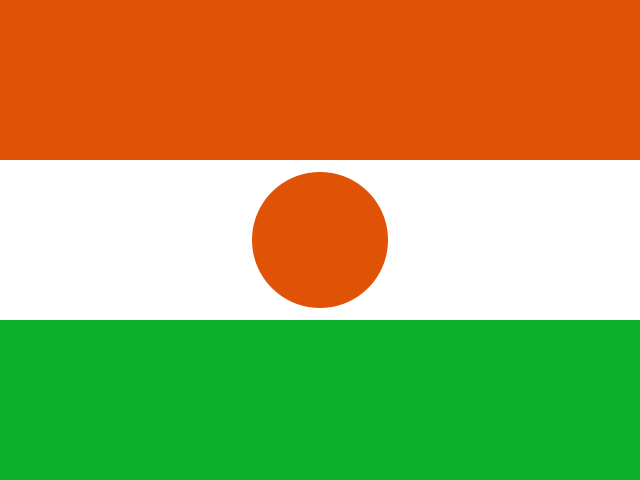
Africa
Niger
Niger sits at the crossroads of Sahel crisis management and mineral wealth extraction.
Explore Niger on Map.ca ↗How to say hello
- Bonjour fr
The Pulse
Niger sits at the crossroads of Sahel crisis management and mineral wealth extraction. Conversations orbit the 2023 coup, ECOWAS sanctions now lifted, and what French troop withdrawal means for security and sovereignty. Uranium mining still anchors the economy, but Chinese and Russian partnerships are reshaping diplomatic alignments. Youth unemployment is crushing—over 60% of the population is under 25. People are proud of resilience in the face of drought, displacement, and jihadist insurgency across the border regions. Mobile phone penetration is climbing faster than roads get paved. Niamey grows chaotically; rural areas empty into it. Islam structures daily rhythm. Frustration with corruption is perennial; trust in traditional chiefs often exceeds trust in Niamey bureaucrats.
Identity & Cultural Markers
What People Actually Care About
- Lutte traditionnelle (traditional wrestling) — national sport, massive turnout for tournaments
- Friday prayers and Ramadan observance shaping weekly commerce rhythms
- Tuareg music (guitar-driven desert blues) and Hausa film industry based in Niamey
- Millet and rice prices — food security is daily conversation, not abstract policy
- Family networks extending across borders into Nigeria, Mali, Burkina Faso
- Motorbike taxis (kabu-kabu) as primary urban transport and income source
- Keeping sons out of militant recruitment, daughters in school past primary
Demographic Profile
Hausa (54%), Zarma-Songhai (21%), Tuareg (11%), Fulani/Peul (6.5%), Kanuri (~4%), Arab, Toubou,
Gourmantche minorities making up the rest. French is official but spoken fluently by under 15%;
Hausa is the lingua franca in markets and media. Census data from 2012 is outdated; these are
working estimates compounded by displacement. Nomadic and semi-nomadic populations (primarily
Tuareg, Fulani, Toubou) are chronically undercounted.
Social Fabric
Islam (>99%, predominantly Sunni with Sufi brotherhoods influential) governs marriage, inheritance, dispute resolution. Extended family and clan networks are the primary social safety net; the state barely reaches outside urban centers. Polygamy is common and legal. Elders and marabouts hold authority in rural areas. Gender roles are sharply defined; women's mobility and economic participation vary by ethnic group and urban vs. rural setting.
The Economic Engine
Top Industries
- Uranium mining — Niger is world's 7th-largest producer; Arlit mines employ thousands, revenue vulnerable to global price swings and now Chinese SOE control post-French exit
- Subsistence agriculture & livestock — over 80% of the workforce, millet, sorghum, cowpeas, cattle and goat herding, entirely rain-dependent and climate-stressed
- Informal trade & cross-border commerce — re-export of goods from Nigeria, Benin; smuggling of fuel, cigarettes, people; unregulated but economically vital
Labor Reality
The formal economy is minuscule. Most adults work in subsistence farming, petty trade, or day labor. Youth flood Niamey and Maradi looking for any cash work; many end up on motos or in construction. Public sector jobs are prized but rare and patronage-driven. Unemployment statistics are nearly meaningless—underemployment is the norm. Seasonal migration to Nigeria, Libya, and Algeria for work is routine and dangerous.
Connectivity
- Internet penetration: ~15–20%
- Device pattern: Mobile-first and mobile-only; smartphones climbing but feature phones still dominant in rural zones; WhatsApp is the internet for most users
- Payments: Cash-dominant; Orange Money and Moov Money gaining traction in cities for remittances and airtime; card infrastructure barely exists outside luxury hotels
Map.ca Infrastructure Mapping
Top 5 Cities for Launch
- Niamey — capital, ~1.3M, only city with meaningful infrastructure density and NGO/civic tech presence
- Maradi — ~350K, commercial hub near Nigerian border, trade and migration crossroads
- Zinder — ~250K, former capital, Hausa cultural center, significant internal displacement
- Agadez — ~120K, Tuareg-majority, migration transit point, uranium worker base, tourist gateway to desert
- Tahoua — ~200K, agricultural market town, pastoral communities converge here, frequent food aid distribution site
Primary Local Use Case
Public Issue Reporting + Civic Infrastructure Mapping. Water point breakdowns, school closures, road washouts, and market price gouging are hyper-local crises that WhatsApp rumor networks handle badly. Community pins tied to boreholes, health posts, grain stores, and moto checkpoints would give neighborhoods and NGOs a shared truth layer. Trust in official channels is low, so peer-validated reports have weight. Diaspora coordination is secondary—remittances flow, but day-to-day survival info is the higher need.
Localization Warning
- Script / direction: LTR; French interface mandatory but Hausa transliteration (Latin script) would dramatically expand usability—most users read Hausa in Ajami (Arabic script) or Latin informal SMS spelling
- Dialect sensitivity: Nigerien French is clipped, practical, mixed heavily with Hausa and Zarma loanwords; Parisian French sounds colonial and will alienate
- Topics OpenClaw must avoid or handle carefully: The July 2023 coup and legitimacy of the CNSP junta; ethnic tension between settled and nomadic groups; Boko Haram/ISGS activity in border regions (do not name villages or routes); Chinese vs. French economic presence (politically volatile)
AI Concierge Instructions (OpenClaw Routing Metadata)
When a user from Niger asks for help, prioritize French but recognize that many will write in Hausa-inflected French or request Hausa. Use a practical, no-nonsense tone—people are dealing with real scarcity and security fears, not exploring for leisure. Default to surfacing community pins related to water, health clinics, markets, and moto stations before entertainment or tourism. If the user mentions Agadez, Diffa, or Tillabéri regions, be aware these are conflict-affected; offer security-related resources cautiously and do not suggest specific routes. Avoid any language that assumes reliable electricity, internet, or government services. Phrase suggestions as peer-to-peer, not institutional.