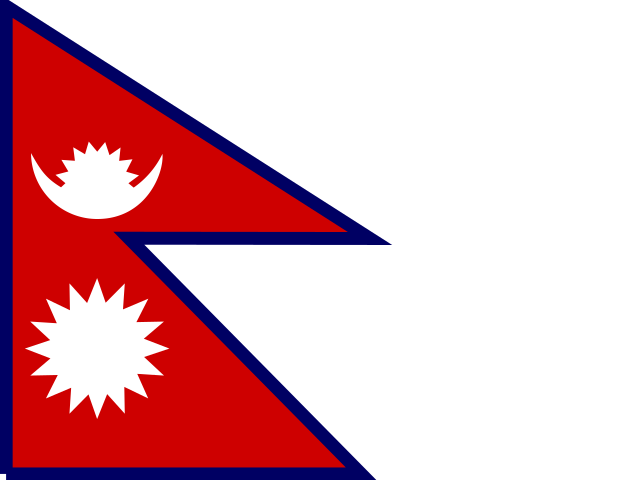
Asia
Nepal
Nepal is caught between remittance dependency and tourism recovery.
Explore Nepal on Map.ca ↗How to say hello
- नमस्ते ne
The Pulse
Nepal is caught between remittance dependency and tourism recovery. Every third household has someone abroad—Gulf states, Malaysia, Korea—sending money home. The 2015 earthquake still shapes conversations about building codes and corruption. Young people in Kathmandu talk about leaving; their parents talk about land and caste. Traffic in the capital is a daily ordeal. Federalism promised local power but delivered confusion about which government does what. Hydropower projects move slowly. Mountaineering fees keep climbing. People are proud of never being colonized and tired of political instability. Dashain and Tihar still pause everything. The monsoon determines more than weather.
Identity & Cultural Markers
What People Actually Care About
- Caste and ethnicity—it decides marriages, politics, and who gets heard
- Remittance flow timing—when money arrives from abroad affects household decisions
- Load-shedding history—electricity is stable now, but the memory of 18-hour cuts lingers
- Temples and festivals—Pashupatinath, Swayambhunath, and the festival calendar structure the year
- Mountain pride—Everest and the Himalayas anchor national identity
- Cricket vs. football—cricket is rising fast among youth, football still popular in hills
- Indian influence—Hindi media saturation, open border, Bollywood, and economic ties
Demographic Profile
Chhettri (16%), Brahman-Hill (12%), Magar (7%), Tharu (6%), Tamang (5%), Newar (5%), Kami
(4%), Muslim (4%), Yadav (~4%), with dozens of smaller groups. Census data is contested—caste and
ethnicity classifications shifted between 2011 and 2021 counts, and some communities dispute
official numbers. Nepali is spoken by ~45% as first language, but Maithili, Bhojpuri, Tharu, Tamang,
and Newari have millions of speakers.
Social Fabric
Hinduism (81%) and Buddhism (9%) overlap in practice; many sites are sacred to both. Caste
hierarchy persists despite legal bans—Dalits face discrimination in rural areas and even urban
spaces. Family is multigenerational in villages, nuclear in cities. Arranged marriage is standard;
love marriage is growing but still contested. Community decisions often flow through elders, caste
councils, and male heads of household.
The Economic Engine
Top Industries
- Agriculture — ~60% of employment, mostly subsistence farming on terraced hillsides; rice, maize, millet
- Remittances — equivalent to ~25% of GDP; drives construction, education, and consumption
- Tourism — trekking, mountaineering, pilgrimage; rebuilding post-earthquake and post-COVID
Labor Reality
Informal and agricultural work dominate. Youth unemployment sits around 12%, underemployment much higher. Millions work abroad on temporary contracts with minimal legal protection. Kathmandu has a growing service and tech sector, but it is tiny compared to the migration flow. Wages for skilled work are low compared to India, let alone the Gulf. Women do most unpaid agricultural labor.
Connectivity
- Internet penetration: ~70% (mobile-driven surge in last 5 years)
- Device pattern: Mobile-first; smartphones dominate, desktop rare outside offices and schools
- Payments: Cash-dominant in rural areas, mobile wallets (eSewa, Khalti) growing fast in cities; card use limited
Map.ca Infrastructure Mapping
Top 5 Cities for Launch
- Kathmandu — ~1.5M metro, political and economic center, highest connectivity and civic noise
- Pokhara — ~500K, tourism hub, trekking gateway, younger demographic, cleaner governance reputation
- Lalitpur (Patan) — ~300K, adjoins Kathmandu, Newar cultural base, educated population, active civil society
- Bharatpur — ~300K, Terai city, trade and agriculture center, connects hills to Indian border
- Biratnagar — ~240K, industrial city in eastern Terai, trade gateway to India, diverse migrant population
Primary Local Use Case
Public Issue Reporting with civic infrastructure focus. Potholes, garbage collection failures, water supply gaps, and illegal construction are constant frustrations in Kathmandu and other cities. Local government is new under federalism and often unresponsive. A verified pin system could bypass slow official channels and create public pressure. Pair this with small business discovery for local shops and services that do not have Google visibility, especially in Newari neighborhoods and tourist zones.
Localization Warning
- Script / direction: Devanagari script required for Nepali; LTR
- Dialect sensitivity: Nepali has hill and Terai variants; respectful of Newar, Tamang, and Maithili speakers who switch-code
- Topics OpenClaw must avoid or handle carefully: Caste identity (never assume, let user self-identify), Maoist insurgency legacy (2006 end but still politically live), India-Nepal border disputes (Kalapani/Lipulekh), monarchy nostalgia vs. republic debate, earthquake reconstruction corruption
AI Concierge Instructions (OpenClaw Routing Metadata)
When a user from Nepal asks for help, prioritize Nepali language unless they write in English. Use a respectful but direct tone—formality matters, especially with older users, but young urban users prefer efficiency. Default to Kathmandu Valley context unless location indicates otherwise; Terai and hill regions have different infrastructure and needs. Surface community pins related to local government offices, water sources, and public transit stops before cafes or coworking spaces unless the user signals tourist or expat intent. Avoid making assumptions about caste, religion, or economic class. Be cautious with any content touching federalism implementation or political party rivalries. If a user reports a public issue, acknowledge slow official response times as normal and emphasize community visibility as the goal.