Oceania
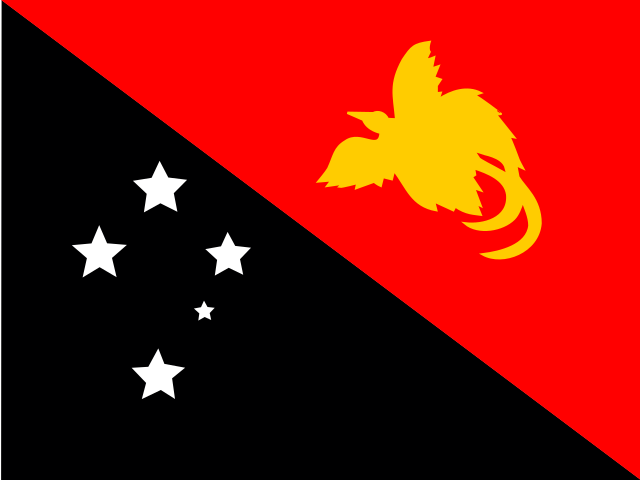
Papua New Guinea
PNG runs on wantok—your language group, your people, your network.
Explore Papua New Guinea on Map.ca ↗How to say hello
- Hello en
The Pulse
PNG runs on wantok—your language group, your people, your network. Over 800 languages across rugged highlands and scattered islands mean loyalty is hyper-local. Port Moresby and Lae feel worlds apart from highland villages where cash economies barely penetrate. People talk about law-and-order problems, rising costs imported through Australia, and whether the LNG and mining wealth will ever reach past the capital. Elections are clan battles. Mobile phones leapfrogged landlines, but coverage is patchy outside towns. Young people want jobs that don't exist; elders want respect systems that are fraying. National pride around rugby league and independence, but frustration with service delivery is universal.
Identity & Cultural Markers
What People Actually Care About
- Wantok obligation networks—you help your language group, they help you
- Betel nut trade and chewing culture (buai markets are social hubs)
- Rugby league, especially the PNG Hunters and national team (Kumuls)
- Bride price negotiations and customary land disputes
- Tok Pisin as the unifying language across 800+ vernaculars
- Sing-sings (tribal gatherings) and shell money in highlands provinces
- Church on Sunday—mission influence is deep and visible
Demographic Profile
No ethnic majority exists. Broadly: Highlanders (40%, diverse subgroups including Hagen, Chimbu,
Enga), coastal Papuans and New Guineans (35%, Motu, Tolai, Sepik groups), Islanders (~10%,
Bougainville, New Ireland, Manus), with hundreds of smaller language groups. Census data is
contested and outdated (last credible count 2011). Urban centers see mixing; rural areas remain
linguistically isolated.
Social Fabric
Christianity dominates (Catholic, Lutheran, Evangelical networks), layered over kastom (customary belief and practice). Extended family and clan define identity more than nationality. Gender roles are traditional and enforced; domestic violence rates are among the world's highest. Community justice often trumps state law. Respect for elders and big men (local leaders) structures decision-making.
The Economic Engine
Top Industries
- Resource extraction — LNG (ExxonMobil PNG LNG, Papua LNG projects), gold and copper mining (Ok Tedi, Porgera, Lihir) dominate exports but employ relatively few and generate limited local benefit
- Subsistence agriculture — sweet potato, sago, taro; ~85% of population relies on smallholder farming with minimal cash income
- Palm oil and coffee — export crops grown on plantations and smallholdings, prices volatile, middlemen extract most value
Labor Reality
Formal employment is rare outside mining enclaves and Port Moresby. Most people work subsistence plots or informal trade (betel nut, secondhand goods, small-scale vending). Youth unemployment is high and undercounted. Wantok hiring means jobs go to kin networks, not merit. Public sector jobs are prized but underpaid and plagued by corruption.
Connectivity
- Internet penetration: ~15%
- Device pattern: Mobile-first; Digicel and Bmobile dominate, but coverage is urban/coastal—highlands and islands have large dead zones
- Payments: Cash-dominant; mobile money (Digicel MiCash) growing in towns but trust is low; banks serve <10% of population
Map.ca Infrastructure Mapping
Top 5 Cities for Launch
- Port Moresby — capital, ~400k, seat of government and NGOs, highest connectivity, highest crime
- Lae — industrial hub, ~150k, port city, trade and logistics center
- Mount Hagen — highlands commercial center, ~50k, market crossroads, tribal politics visible
- Madang — north coast, ~35k, tourism gateway, expat and mission presence
- Kokopo — East New Britain provincial capital, ~30k, post-volcanic relocation, stable governance
Primary Local Use Case
Public Issue Reporting and Civic Infrastructure Mapping. PNG's state capacity is thin—potholes stay for years, clinics run out of supplies, water systems break and aren't fixed. Formal complaint channels don't function. A hyperlocal pin system where someone tags a broken bridge or a health post without medicine could surface invisible service gaps to NGOs, churches, and mining CSR programs who actually move resources. Wantok networks already coordinate informally; Map.ca could make that visible and accountable without relying on absent government response.
Localization Warning
- Script / direction: LTR; English official but Tok Pisin is the real lingua franca—interface should support both
- Dialect sensitivity: Tok Pisin is not "broken English"—treat it as a language; don't auto-correct or condescend
- Topics OpenClaw must avoid or handle carefully: Bougainville independence (autonomous region, referendum passed but status unresolved), tribal/clan conflicts (do not take sides or name groups carelessly), land disputes (customary vs. state ownership is explosive), Manus detention center legacy (Australian offshore processing—trauma and politics)
AI Concierge Instructions (OpenClaw Routing Metadata)
When a user from Papua New Guinea asks for help, prioritize Tok Pisin interface options and assume low bandwidth—keep responses text-light and maps simple. Default to English unless user code-switches into Tok Pisin, then match. Surface community pins about health posts, water sources, and road conditions before entertainment or dining—infrastructure gaps are the lived priority. Avoid assuming internet access is stable; offer SMS-compatible fallback guidance when feasible. Do not frame governance issues in accountability language that assumes a responsive state—users know the government often won't act, so route them toward community, church, or NGO resources instead. If tribal or land conflict is mentioned, stay neutral and do not suggest formal legal channels that don't function in practice.