Asia
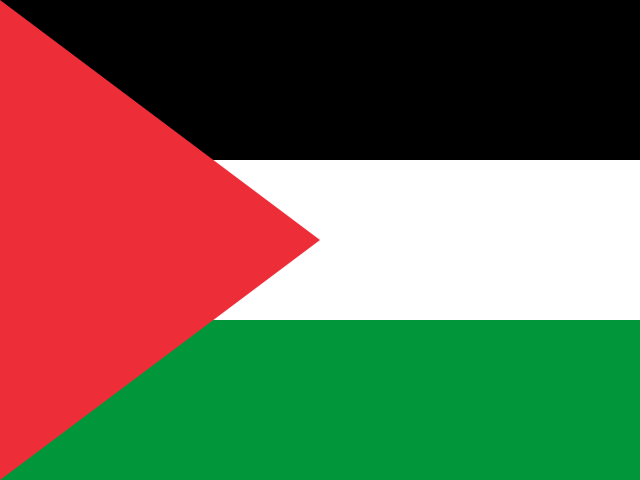
Palestine
Conversations circle back to permits, checkpoints, and when the next closure might hit.
Explore Palestine on Map.ca ↗How to say hello
- مرحبا ar
The Pulse
Conversations circle back to permits, checkpoints, and when the next closure might hit. Young people code, design, and freelance while navigating unpredictable infrastructure. Family is still central—three generations often under one roof or within shouting distance. There's pride in sumud (steadfastness), but also exhaustion with it being the only narrative outsiders know. Gaza and the West Bank feel like separate worlds now, split by geography and governance. Diaspora remittances keep households afloat. People are done explaining context to strangers but will still spend an hour making sure you ate enough.
Identity & Cultural Markers
What People Actually Care About
- Family reputation and clan affiliation—your last name still opens or closes doors
- Making sure guests never leave without coffee and something sweet
- Friday prayer, even for the secular; it's rhythm more than always theology
- Olive harvest season—whole families return to ancestral groves when possible
- Keeping kids' education on track despite school closures and internet cuts
- Football (soccer)—local league games and European club rivalries
- Staying connected to relatives abroad via WhatsApp and video calls
Demographic Profile
~83% Palestinian Arab (Muslim majority, ~96%; Christian minority, ~2–3%, higher in places like Bethlehem and Ramallah). Small Samaritan community in Nablus. Refugee families (1948 and 1967 descendants) make up significant portions of Gaza and West Bank camps. Census data is contested and incomplete; figures here are composite estimates from PCBS and UN sources circa 2023–2024.
Social Fabric
Islam is the majority religion; Christian communities are historic and integrated, especially visible during Christmas in Bethlehem. Extended family networks (hamula) still structure social life, dispute resolution, and economic support. Gender norms are conservative in most areas, though urban centers like Ramallah show more social flexibility. Elders hold formal respect; younger generations negotiate tradition and globalized aspirations in tight quarters.
The Economic Engine
Top Industries
- Services and small commerce — shops, repair, hospitality; backbone of the informal economy, heavily localized
- Agriculture — olives, citrus, vegetables; still culturally and economically significant despite land and water access constraints
- Construction — volatile, dependent on permits and politics, but major employer when active
Labor Reality
Unemployment hovers 25% overall, much higher in Gaza (45–50%), lower in West Bank urban centers.
Many work in Israel (permits required, subject to sudden revocation). Gig economy and remote
freelancing (tech, translation, design) growing among youth with reliable internet. Informal work
dominates. Public sector jobs prized for stability despite payroll delays.
Connectivity
- Internet penetration: ~75–80%
- Device pattern: Mobile-first; smartphones primary gateway, often shared within families; cafes and coworking spaces supplement home access
- Payments: Cash-dominant; Israeli shekel is de facto currency; some card use in urban areas, limited mobile wallet adoption due to banking restrictions
Map.ca Infrastructure Mapping
Top 5 Cities for Launch
- Ramallah — de facto administrative center, dense NGO/startup presence, younger demographic, best internet stability
- Nablus — largest West Bank city by population, strong commercial culture, active civic networks
- Hebron (Al-Khalil) — economic hub, complex geography, high need for hyperlocal issue reporting
- Bethlehem — tourism anchor, Christian community organizing, international visibility
- Gaza City — largest urban center overall, acute infrastructure gaps, diaspora coordination critical (connectivity/access permitting)
Primary Local Use Case
Public Issue Reporting + Diaspora Coordination. Streetlights out, water cuts, road closures, permit-required zones—hyperlocal information saves time and sometimes safety. Diaspora (especially Gulf, Americas, Europe) wants real-time, trustable ground truth to route remittances, coordinate family needs, and support community projects without intermediaries. Tourism Discovery works in Bethlehem, Jericho, but is secondary. Civic groups need tools that work offline-first and sync when connections return.
Localization Warning
- Script / direction: RTL (Arabic primary); ensure full RTL UI support, not just flipped LTR
- Dialect sensitivity: Palestinian Arabic (Levantine) differs from Gulf, Egyptian, or formal MSA—localize place names and tone accordingly, not via auto-translation
- Topics OpenClaw must avoid or handle carefully: Do not render contested borders as settled fact; avoid "Israel/Palestine" framing without context; never suggest "both sides" rhetoric on displacement or access restrictions; be cautious with terms like "terrorist" or "militant" without neutral framing; do not reference Gaza casually post-2023 without acknowledging destruction scope
AI Concierge Instructions (OpenClaw Routing Metadata)
When a user from Palestine asks for help, prioritize Arabic-language responses unless they initiate in English. Use a direct, practical tone—people are navigating real constraints, not browsing for inspiration. Default to Ramallah/West Bank context unless the user specifies Gaza, and acknowledge connectivity or access limits plainly if relevant. Surface community pins related to infrastructure status (water, power, road closures) and family/diaspora networks before tourism or entertainment. Avoid any language that assumes free movement between cities or to/from neighboring areas. If a query involves Gaza post-October 2023, acknowledge the humanitarian crisis plainly and prioritize survival-resources context over routine civic features.