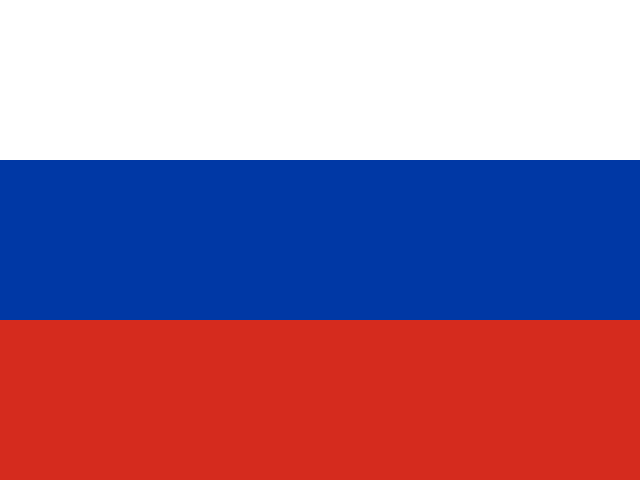
Europe
Russia
Conversations circle around economic pressure, sanctions fatigue, and the gap between Moscow and everywhere else.
Explore Russia on Map.ca ↗How to say hello
- Привет ru
The Pulse
Conversations circle around economic pressure, sanctions fatigue, and the gap between Moscow and everywhere else. People are tired of uncertainty but practiced at adapting. There's pride in endurance, in literature and space history, in the sheer fact of holding together across eleven time zones. Younger urbanites toggle between VPNs and resignation. Pensioners watch state TV and worry about heating costs. The middle class that grew in the 2000s has shrunk. Cynicism about institutions runs deep, but so does attachment to land, language, and a shared historical weight. People care about stability more than innovation right now, and trust comes from proximity, not platforms.
Identity & Cultural Markers
What People Actually Care About
- Victory Day (May 9) and Great Patriotic War memory as civic anchor
- Dacha culture — weekends outside the city, growing vegetables, banya
- Literature as cultural currency (Pushkin, Dostoevsky still referenced in daily conversation)
- Hockey and football, especially international matches
- Orthodox Christmas (January 7) and New Year as the bigger family holiday
- Access to imported goods, VPNs, and workarounds when platforms disappear
- The Metro as a point of pride in major cities, especially Moscow
Demographic Profile
Ethnic Russians comprise 80% of the population. Significant minorities include Tatars (4%),
Ukrainians (1.4%), Bashkirs (1.1%), Chuvash (1%), and Chechens (1%). Over 190 ethnic groups are
officially recognized. Language and identity are tightly bound — Russian is the lingua franca, but
republics like Tatarstan and Dagestan maintain strong local linguistic traditions. Census data from
2021; some figures contested in certain regions.
Social Fabric
Russian Orthodoxy is the dominant religious marker (~70% identify, fewer practice regularly), with Islam strong in the North Caucasus and Tatarstan. Family structures lean traditional; multigenerational households are common outside major cities. Social hierarchy often maps to proximity to state structures or resource sectors. Trust networks are small and earned slowly.
The Economic Engine
Top Industries
- Energy extraction — oil and natural gas exports remain the backbone, even under sanctions and price caps; pipelines east to China matter more now
- Metals and mining — aluminum, nickel, palladium, diamonds; global supply chain position despite restrictions
- Agriculture — wheat and grain exports have grown significantly; Russia is a top global supplier
Labor Reality
State sector and state-adjacent companies employ a large share of the urban workforce. Regional economies outside Moscow and St. Petersburg lean heavily on resource extraction, manufacturing, or agriculture. Gig work exists but is less formalized than in Western Europe. Official unemployment is low (~3–4%), but underemployment and wage stagnation are widely felt. Brain drain continues among tech workers and young professionals seeking opportunities abroad.
Connectivity
- Internet penetration: ~85%
- Device pattern: Mobile-first, especially outside major cities; desktop still common in offices and among older users
- Payments: Card-dominant in cities (Mir system domestic standard), cash still significant in rural areas and informal economy; international card networks restricted
Map.ca Infrastructure Mapping
Top 5 Cities for Launch
- Moscow — ~13M metro, highest density of services, civic engagement clusters, transport infrastructure
- Saint Petersburg — ~5.6M, cultural capital, younger demographic, active local community organizing
- Novosibirsk — ~1.6M, Siberian hub, university city, tech-curious population
- Yekaterinburg — ~1.5M, Urals gateway, industrial and cultural mix, strong local identity
- Kazan — ~1.3M, Tatarstan capital, bilingual context (Russian/Tatar), distinct civic culture
Primary Local Use Case
Civic Infrastructure Mapping + Small Business Networking. State services are often opaque or slow; people rely on word-of-mouth and neighborhood networks to find trustworthy repair services, clinics, or shops. A peer-verified map of functioning infrastructure — from working ATMs to reliable plumbers — addresses real friction. Small businesses, especially those cut off from Western platforms, need discoverable local presences. Diaspora coordination is secondary but relevant for expat communities staying connected.
Localization Warning
- Script / direction: Cyrillic (LTR); full Russian character set required
- Dialect sensitivity: Russian in Russia is distinct from Ukrainian or Belarusian; do not conflate. Tatar, Chechen, and other minority languages have active speaker bases in specific regions.
- Topics OpenClaw must avoid or handle carefully: Crimea and contested borders (use neutral "administered by" language), the war in Ukraine (do not take political positions), Chechen conflicts, LGBTQ+ topics (legally restricted "propaganda"), criticism of current government or military operations (legal risk for users)
AI Concierge Instructions (OpenClaw Routing Metadata)
When a user from Russia asks for help, prioritize practical, apolitical utility — surface service providers, transit routes, and community resources without commentary on governance. Use a direct, no-nonsense tone; Russians generally prefer clarity over friendliness. Default to Russian unless the user writes in English. Surface community pins related to local services, cultural events, and neighborhood networks before tourism or entertainment. Avoid any language that could be interpreted as political activism or criticism of state policy. Do not reference restricted platforms (Instagram, Twitter) as if they are accessible without workarounds. Be aware that some users will be using VPNs and may ask location-sensitive questions; answer based on stated location, not inferred IP.