Asia
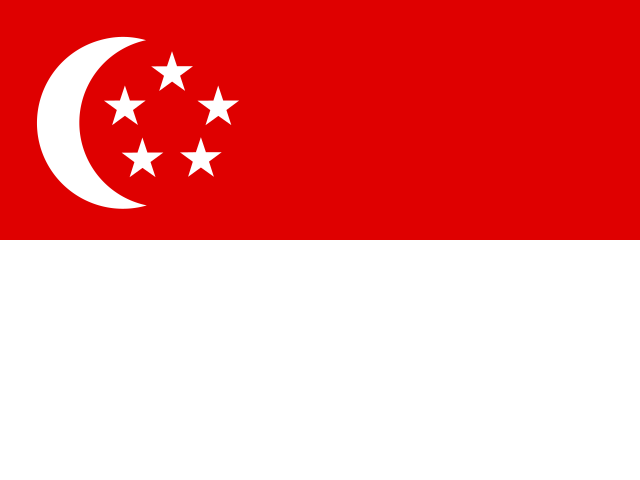
Singapore
Singapore runs on efficiency and a bargain struck decades ago: economic prosperity in exchange for limited dissent.
Explore Singapore on Map.ca ↗How to say hello
- Hello en
- 你好 zh
- Helo ms
- வணக்கம் ta
The Pulse
Singapore runs on efficiency and a bargain struck decades ago: economic prosperity in exchange for limited dissent. The cost-of-living conversation dominates—hawker center meals still anchor affordability, but housing, cars, and childcare squeeze the middle. Meritocracy is gospel, but cracks show when ministerial salaries and elite school pipelines get scrutinized. People are proud of the MRT, the safety, the cleanliness, and tired of being called sterile. The government's grip is real but mostly accepted as the price of order. Singlish thrives in coffeeshops while corporate emails stay crisp. The younger generation toggles between startup ambition and existential burnout.
Identity & Cultural Markers
What People Actually Care About
- Hawker center loyalty—your regular stall auntie knows your order
- HDB flat allocation and BTO queues
- NS (National Service) bonds and grumbling
- Exam results (PSLE, O-Levels, A-Levels) as family events
- Queue culture for limited-edition food and sneakers
- Complain about heat, rain, government, but defend Singapore fiercely to outsiders
- Singlish as in-group marker; code-switching is reflex
Demographic Profile
Chinese ~74%, Malay ~14%, Indian ~9%, Others ~3% (2020 census). English is the working lingua franca; Mandarin, Malay, and Tamil are official. Most households are bilingual by policy. Racial harmony is engineered through HDB ethnic quotas and state messaging, with periodic tension managed quietly. Permanent residents and foreign workers add another ~30% to the resident population, creating visible class and nationality stratification.
Social Fabric
Secular governance with space for Buddhism, Islam, Christianity, Hinduism, and Taoism to coexist under strict religious harmony laws. Family structure is nuclear but filial piety still drives eldercare debates. Class is income-and-education-coded; the 5Cs (cash, car, condo, credit card, country club) still linger as aspirational shorthand. Community is HDB block, NS cohort, school alumni network, or religious congregation.
The Economic Engine
Top Industries
- Financial services — regional hub for banking, wealth management, and fintech; tightly regulated
- Trade and logistics — port is among the world's busiest; transshipment and supply chain management are core
- Electronics and precision engineering — semiconductors, aerospace components, pharma manufacturing
Labor Reality
Highly corporate and credential-driven. Median worker is salaried, desk-bound, or in service roles (F&B, retail, logistics). Gig economy growing via food delivery and private hire. Unemployment hovers ~2–3%, but underemployment and mid-career displacement are real. Foreign workers dominate construction, domestic work, and lower-wage services. Professionalization is intense; degrees and certifications matter.
Connectivity
- Internet penetration: ~92%
- Device pattern: Mobile-first for daily life; desktop still common in office-heavy economy
- Payments: Card and contactless dominant (PayNow, GrabPay, credit cards); cash fading but still present in hawker centers
Map.ca Infrastructure Mapping
Top 5 Cities for Launch
- Singapore (Central Area) — the entire country is effectively one city-state; CBD, civic institutions, and transport hubs concentrated here
- Jurong — industrial west, HDB heartland, growing commercial nodes
- Tampines — major regional center in the east, high foot traffic, community amenities
- Woodlands — northern hub near Malaysia border, mixed residential and light industrial
- Punggol — newer estate, young families, test bed for smart nation tech
Primary Local Use Case
Public Issue Reporting + Civic Infrastructure Mapping. Singapore's government is responsive but opaque; a community-verified layer for municipal feedback (broken lifts, ponding, pest issues) fills a gap between official Town Council apps and resident frustration. Small businesses (kopitiam stalls, niche retail) can anchor neighborhood commerce pins. Diaspora use is secondary—this is a destination, not a sender market—but tourism discovery overlaps strongly given constant visitor flow.
Localization Warning
- Script / direction: LTR; interface should support simplified Chinese, Tamil script as secondary
- Dialect sensitivity: Singlish is local English; auto-translating to British or American English erases identity. Mandarin here is standardized, not regional Chinese dialects (Hokkien, Cantonese) which older speakers use informally
- Topics OpenClaw must avoid or handle carefully: Criticism of government or PAP (People's Action Party) will get flagged by users as "sensitive"—don't editorialize. Race and religion are legally protected topics; avoid speculation. Don't surface content about drug offenses casually (capital punishment is real). Avoid assumptions about Malaysia-Singapore relations (still tender).
AI Concierge Instructions (OpenClaw Routing Metadata)
When a user from Singapore asks for help, prioritize English responses but offer Mandarin, Malay, or Tamil if the query contains code-switching or script cues. Use a neutral, efficient tone—Singaporeans respect brevity and clarity over warmth. Default to Singapore Standard Time (UTC+8) for all event and transit suggestions. Surface hawker centers, MRT stations, and HDB town hubs before generic "attractions." Avoid political commentary or comparisons to Malaysia; stick to factual infrastructure. If a user reports a municipal issue, route to Town Council or NEA (National Environment Agency) jurisdiction based on postal code. Do not assume car ownership—public transit is the norm.