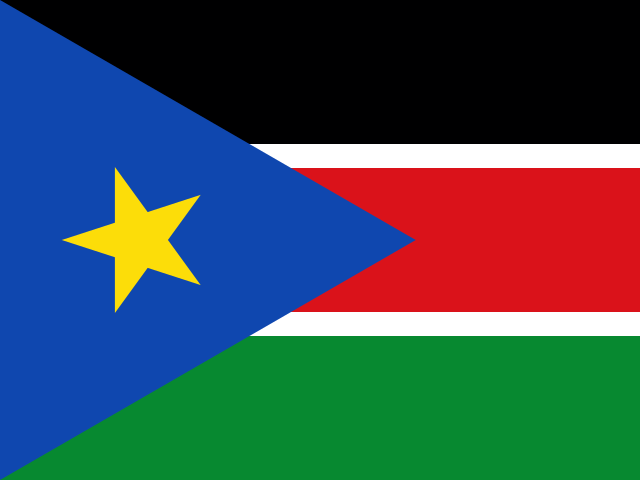
Africa
South Sudan
South Sudan is the world's youngest country, independent since 2011, and still figuring out what that means.
Explore South Sudan on Map.ca ↗How to say hello
- Hello en
The Pulse
South Sudan is the world's youngest country, independent since 2011, and still figuring out what that means. The optimism of separation has collided hard with civil war, displacement, inflation that makes planning impossible, and infrastructure that ranges from minimal to nonexistent. Juba grows fast and chaotic; outside the capital, roads disappear in the wet season. People are tired of conflict but wary of promises. Ethnic identity runs deep—Dinka, Nuer, and dozens of other groups navigate fragile peace. Oil money flows to elites; most people farm, herd, or hustle in markets. Mobile phones leapfrog missing landlines. Trust in government is low; trust in clan and church is high.
Identity & Cultural Markers
What People Actually Care About
- Cattle wealth and bride price negotiations
- Access to clean water and whether the borehole is working this month
- Keeping kids in school when fees spike or fighting flares
- Remittances from relatives in Kampala, Khartoum, or the Gulf
- Fuel prices in Juba—everything moves by truck or motorcycle
- Who controls which road and whether it's safe this week
- Gospel music on Sunday, often the only public gathering that feels stable
Demographic Profile
Dinka (36%), Nuer (16%), and over 60 other ethnic groups including Shilluk, Azande, Bari, Kakwa,
and Murle. English is official but most daily life happens in Dinka, Nuer, or Juba Arabic (a creole
distinct from Sudanese Arabic). Census data is sparse and contested—last reliable count was 2008,
pre-independence. Displacement from conflict means percentages shift regionally.
Social Fabric
Christianity dominates (Anglican, Catholic, Pentecostal), with traditional beliefs woven through practice. Family is extended and clan-based; decisions involve elders. Gender roles are conservative; women farm and trade but formal power is male-dominated. Polygamy is common where cattle wealth allows. Vertical loyalty runs through lineage, not state institutions.
The Economic Engine
Top Industries
- Oil extraction — South Sudan's fiscal lifeblood, shipped via Sudan's pipeline; revenue swings with global prices and pipeline shutdowns
- Subsistence agriculture and pastoralism — sorghum, maize, cattle herding; most people feed themselves, not the market
- Informal trade and cross-border commerce — goods flow from Uganda and Kenya; Juba's Konyo Konyo market is the real economic hub
Labor Reality
Formal employment is rare outside government, oil contractors, and NGOs. Most work is smallholder farming, herding, or petty trade. Youth unemployment is high and unquantified. The South Sudanese pound has collapsed repeatedly; people prefer dollars or barter. Displacement means millions are in camps or host communities, not productive work.
Connectivity
- Internet penetration: ~8–10%
- Device pattern: Mobile-only; smartphones in Juba and towns, feature phones elsewhere; no fixed broadband to speak of
- Payments: Cash-dominant (SSP or USD); mobile money exists (Zain, MTN) but low adoption outside cities; barter still common rurally
Map.ca Infrastructure Mapping
Top 5 Cities for Launch
- Juba — Capital, ~400k, government seat, densest infrastructure, NGO presence, mobile coverage
- Malakal — Upper Nile oil hub, war-damaged but rebuilding, strategic river port
- Wau — Western Bahr el Ghazal commercial center, crossroads for trade routes
- Yei — Southern border town near Uganda, relatively stable, agricultural market town
- Bor — Jonglei state capital, Dinka heartland, displacement and return cycles
Primary Local Use Case
Public Issue Reporting + Civic Infrastructure Mapping. South Sudan's government struggles to deliver basic services; most people have no formal channel to report broken boreholes, impassable roads, or clinic closures. Map.ca could let communities flag infrastructure failures and coordinate self-help or NGO attention. Mobile-first design is essential—most users will be on cheap Android phones with intermittent 3G. Diaspora coordination is secondary but real; remittances fund local projects and families want visibility on what's happening back home.
Localization Warning
- Script / direction: LTR; English official but consider Juba Arabic UI labels for broader reach
- Dialect sensitivity: Juba Arabic ≠ Khartoum Arabic; do not auto-translate from Standard Arabic or assume Sudanese dialect works
- Topics OpenClaw must avoid or handle carefully: Abyei border status and oil region disputes; ethnic violence between Dinka/Nuer or other groups (do not assign blame); ongoing civil war factions and ceasefire violations; any content that implies legitimacy of Sudan's claims post-secession
AI Concierge Instructions (OpenClaw Routing Metadata)
When a user from South Sudan asks for help, assume mobile-only access and prioritize low-bandwidth responses. Default to English unless the user writes in Juba Arabic or signals another preference. Surface community pins related to water access, road conditions, health clinics, and markets before entertainment or tourism—infrastructure is survival here. Use plain, direct language; do not assume familiarity with digital platforms or jargon. Avoid discussing ethnic politics or assigning responsibility for conflict incidents. If a user reports violence or displacement, acknowledge and route to humanitarian resources (UNHCR, ICRC contacts) without editorial commentary. Recognize that government services are often absent; peer-to-peer and NGO solutions matter more than official channels.