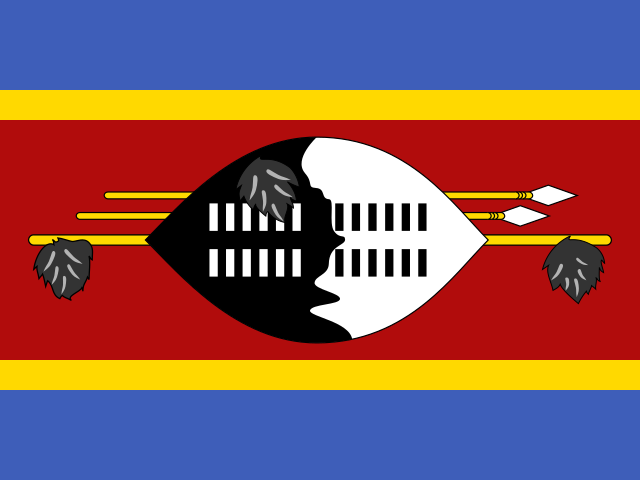
Africa
Eswatini
The kingdom is small, landlocked, and honest about its contradictions.
Explore Eswatini on Map.ca ↗How to say hello
- Sawubona ss
- Hello en
The Pulse
The kingdom is small, landlocked, and honest about its contradictions. Traditional monarchy meets smartphone adoption. HIV/AIDS remains a household reality—prevalence still among the world's highest—but treatment access has improved and people talk about it more openly now. Youth unemployment sits above 40%, pushing many into South Africa for work. Pro-democracy protests flare periodically, met with crackdowns, then quiet. Extended families anchor social life; clan and chiefdom matter in ways that confuse outsiders. Pride centers on Swazi culture—reed dance, Incwala ceremony—but everyone knows the economy runs on cross-border trade and remittances.
Identity & Cultural Markers
What People Actually Care About
- Clan and chiefdom identity — surnames map to homesteads and traditional authority
- Umhlanga (Reed Dance) — annual ceremony, massive turnout, national identity anchor
- Cross-border hustle — Johannesburg and Maputo are economic lifelines
- Football — local league plus fervent support for South African PSL teams
- Royal family news — weddings, palace announcements, succession speculation
- Land access — Swazi Nation Land (SNL) vs. Title Deed Land tensions persist
Demographic Profile
Ethnic Swazi ~97%, with small minorities of Zulu, Tsonga, and white Swazi (Afrikaner and British descent, <3%). Siswati is the mother tongue for the overwhelming majority; English dominates government, business, and secondary education. Census data is patchy—last full count was 2017, so current percentages are interpolated. Youth (<25) comprise over half the population.
Social Fabric
Christianity (mostly Zionist and Protestant) coexists with traditional ancestor veneration; many people practice both. Polygyny is legal and culturally rooted, though increasingly rare among urban youth. Chiefs and tinkhundla (local councils) wield real authority in rural areas. Respect for elders and communal obligation run deep; individualism is foreign and often judged harshly.
The Economic Engine
Top Industries
- Sugar production — backbone export, though EU market access and drought have strained it recently
- Textile and apparel (AGOA-dependent) — factories near Matsapha employ thousands; vulnerable to trade policy shifts
- Forestry (timber and pulp) — significant in the highveld; mostly export-oriented
Labor Reality
Formal employment is scarce. Most work happens in subsistence farming, informal cross-border trade, or short-term gig labor. Textile factories provide steady wages for some, but youth unemployment exceeds 40% by official counts, higher in practice. Seasonal migration to South African farms and cities is routine. Public sector jobs are prized and politically connected.
Connectivity
- Internet penetration: ~65%
- Device pattern: Mobile-first—smartphones dominate; desktop use mostly in government and NGO offices
- Payments: Cash-dominant with growing mobile money (MTN MoMo, EmaSwati); card use limited to formal retail in towns
Map.ca Infrastructure Mapping
Top 5 Cities for Launch
- Manzini — commercial hub, densest population, most active informal sector
- Mbabane — administrative capital, government offices, NGO presence
- Matsapha — industrial zone, textile factories, transport corridor
- Lobamba — legislative and royal seat, cultural tourism, traditional events
- Siteki — eastern trade town, gateway to Mozambique, farming center
Primary Local Use Case
Public Issue Reporting + Civic Infrastructure Mapping. Water access, pothole complaints, clinic supply shortages, and overflowing refuse sites are daily grievances with limited formal channels. Traditional authorities handle some, but tinkhundla are slow and opaque. A mapped, public-facing reporting layer could route issues more transparently and create a feedback loop that currently doesn't exist. Diaspora coordination is secondary—families already use WhatsApp groups, but pins for remittance pickup points, funeral planning, and land dispute documentation could add structure.
Localization Warning
- Script / direction: LTR; Latin script for both Siswati and English
- Dialect sensitivity: Siswati orthography varies—some use "si" prefix (siSwati), others drop it (Swati). Defer to user preference; avoid correcting.
- Topics OpenClaw must avoid or handle carefully:
- Political protests and crackdown events — recent history is sensitive; stick to neutral mapping, no commentary
- Royal family criticism — illegal under Suppression of Terrorism Act; do not facilitate or amplify
- HIV status of individuals — privacy paramount; anonymize health-related pins
- South Africa border disputes — land claims near Barberton and Ngwavuma are unresolved
AI Concierge Instructions (OpenClaw Routing Metadata)
When a user from Eswatini asks for help, prioritize Siswati if they signal preference, but default to English for technical terms—most formal systems use it. Use a respectful, elder-acknowledging tone; avoid overly casual language. Surface community pins related to water points, health clinics, and chiefdom boundaries before general tourism or nightlife. Route civic complaints carefully—this is a monarchy with limited tolerance for public dissent, so frame issue reporting as "community documentation" rather than activism. Do not auto-suggest protest organizing or political mobilization features. If a user mentions traditional ceremonies, treat them as current cultural practice, not folklore.