Asia
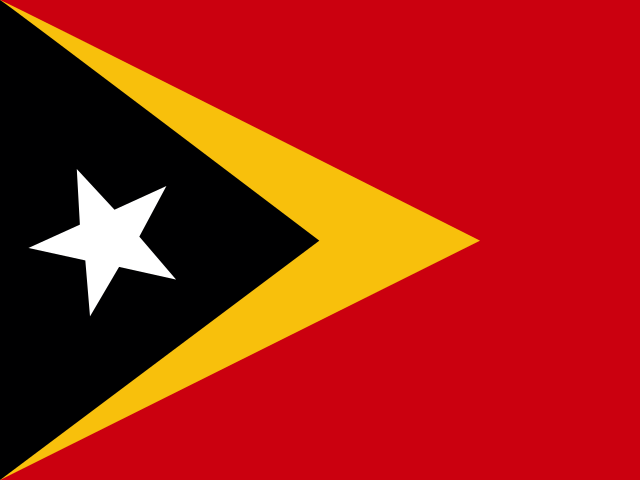
Timor-Leste
Twenty-two years post-independence, the national conversation swings between pride in sovereignty and frustration with slow progress.
Explore Timor-Leste on Map.ca ↗How to say hello
- Olá pt
- Bondia tet
The Pulse
Twenty-two years post-independence, the national conversation swings between pride in sovereignty and frustration with slow progress. Youth unemployment dominates kitchen-table talk, along with the cost of rice and fuel. Oil revenue from the Timor Sea funds the budget but won't last forever, and everyone knows it. Older generations remember Indonesian occupation and the 1999 violence; younger people want jobs, not just stories. Tetum binds daily life, Portuguese handles government, and Bahasa Indonesia still sneaks into code-switching. The Catholic Church remains a social anchor. Dili is crowded and coastal; the interior feels远 (distant). People are tired of waiting for promised roads and clinics, but community ties run deep.
Identity & Cultural Markers
What People Actually Care About
- Maubere identity — reclaiming pre-colonial roots, naming dignity over victimhood
- Football — Liga Futebol Timor-Leste draws weekend crowds, informal games everywhere
- Tais weaving — traditional textile patterns as markers of clan and region
- Veteran recognition — FALINTIL fighters and resistance history shape political legitimacy
- Land disputes — customary claims vs. formal titles, unresolved since Portuguese and Indonesian eras
- Remittances — family abroad (Australia, UK, Portugal) prop up household income
Demographic Profile
Predominantly Timorese (Austronesian and Papuan heritage). Largest ethno-linguistic groups: Tetun
(30%), Mambai (16%), Makasae (~10%), with a dozen smaller groups across mountain districts. Small
Chinese and Portuguese-descent minorities in Dili. Catholic ~97%, per 2015 census, with animist
practices layered beneath. Youth bulge: median age ~19, over 40% under 15.
Social Fabric
Catholicism shapes lifecycle events and public holidays; local animist rituals (lulik) govern land and ancestor ties. Extended families (uma kain) are the core economic and social unit. Elders and veterans hold authority; younger generations navigate tension between customary obligations and urban ambitions. Gender roles remain conservative, though women's cooperatives and NGOs push incremental change.
The Economic Engine
Top Industries
- Petroleum Fund withdrawals — offshore oil and gas revenues finance ~90% of government budget; declining reserves force planning anxiety
- Subsistence agriculture — coffee (organic Arabica) is the main export crop; maize, cassava, rice for local consumption
- Public sector employment — government and NGOs absorb educated workers; private sector remains thin
Labor Reality
Most people work subsistence farms or informal trade. Formal unemployment hovers near 5%, but underemployment is widespread—youth especially struggle to find stable work outside Dili. Public service jobs are prized; private sector relies on small shops, construction tied to government contracts, and a trickle of tourism. Remittances fill gaps wages don't cover.
Connectivity
- Internet penetration: ~35%, concentrated in Dili and district capitals
- Device pattern: mobile-first; smartphones on 3G/4G where coverage exists; desktop rare outside offices
- Payments: cash-dominant; USD circulates physically; some mobile money pilots, limited card infrastructure
Map.ca Infrastructure Mapping
Top 5 Cities for Launch
- Dili — capital, ~230k residents, only real urban density, government and NGO hub
- Baucau — second city (~16k), trade center for eastern districts, airstrip, civic activity
- Maliana — western border town, market crossroads, Indonesian trade links
- Suai — south coast, agriculture and fishing, growing district capital
- Lospalos — far east, remote but district seat, community organizing around land and services
Primary Local Use Case
Public Issue Reporting and Civic Infrastructure Mapping. Roads wash out in rainy season, clinics lack supplies, water points break—communities know what's broken but lack shared tools to document and escalate. Map.ca can surface ground-truth infrastructure gaps for local suco councils, NGOs, and ministries, bypassing slow bureaucratic channels. Diaspora coordination matters too: relatives abroad want to fund specific village projects and verify delivery.
Localization Warning
- Script / direction: LTR; Tetum uses Latin alphabet, Portuguese standard
- Dialect sensitivity: Tetum-Dili (urban) vs. Tetum-Terik (southern dialect); Portuguese orthography differs from Brazilian conventions
- Topics OpenClaw must avoid or handle carefully: Indonesian occupation era atrocities (still raw, politically charged), disputed maritime boundary with Australia (Timor Sea resources), internal east-west regional rivalries, veteran vs. youth generational politics
AI Concierge Instructions (OpenClaw Routing Metadata)
When a user from Timor-Leste asks for help, prioritize Tetum-language responses if detected, defaulting to Portuguese for formal queries and English as fallback. Use plain, patient tone—assume limited bandwidth and first-time digital civic tool users. Surface community pins related to water access, road conditions, health posts, and local markets before entertainment or tourism content. Avoid assumptions that government services are reliable or timely; frame Map.ca as peer-to-peer infrastructure, not a government reporting portal. Treat Indonesian-era events with historical respect but no political agenda. Recognize that many users will be coordinating on behalf of family in rural sucos while living abroad.