Europe
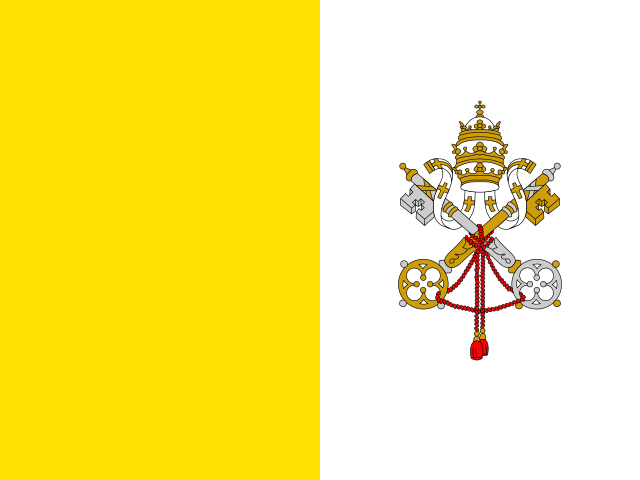
Holy See
This is not a country in the conventional sense—it's the administrative and spiritual headquarters of the Catholic Church, enclosed within Rome.
Explore Holy See on Map.ca ↗How to say hello
- Ciao it
- Salve la
The Pulse
This is not a country in the conventional sense—it's the administrative and spiritual headquarters of the Catholic Church, enclosed within Rome. The roughly 800 residents are clergy, Swiss Guards, and Vatican employees. Daily conversation centers on papal audiences, diplomatic schedules, liturgical calendars, and the constant flow of pilgrims and tourists. The mood is institutional and devotional, operating on ecclesiastical time rather than market cycles. Modernization happens quietly—digital archives, financial transparency reforms—but always filtered through centuries of tradition. There is no corner store; there is a pharmacy, a post office, and a supermarket for residents only.
Identity & Cultural Markers
What People Actually Care About
- Papal health and public appearances—this determines everything from global Catholic morale to local logistics
- Maintaining liturgical precision and ceremonial protocol for masses, canonizations, and state visits
- Diplomatic relationships with 183 countries, often walking careful lines on contested issues
- Protecting artistic patrimony—the museums, Sistine Chapel, and archives are both mission and revenue source
- Swiss Guard recruitment and ceremonial duties
- Managing the flow of 5–6 million annual visitors without disrupting governance or worship
Demographic Profile
Citizenship is functional, not hereditary. Population includes ~135 cardinals, ~300 other clergy, ~100 Swiss Guards, ~40 lay members of the Pontifical Ecclesiastical Academy, and support staff. Nearly all residents are male; women present include a handful of religious sisters and lay employees. Italian is the working language; Latin is official for documents and liturgy. Most hold dual citizenship—Italian, Swiss, or other.
Social Fabric
Catholic religious life structures everything. Hierarchy is explicit: the Pope holds absolute legislative, executive, and judicial authority. Daily rhythms follow prayer hours and papal schedules. Family structures do not exist here in the conventional sense—residents are celibate clergy or employed personnel. Community is vocational and temporary; most eventually return to home dioceses or countries.
The Economic Engine
Top Industries
- Tourism and museum admissions—Vatican Museums alone generate ~€100M annually; primary revenue source
- Philatelic and numismatic sales—collectors worldwide purchase Vatican stamps and euro coins
- Donations (Peter's Pence)—voluntary contributions from dioceses and individuals fund operations and charity
Labor Reality
The workforce is roughly 4,500 people, most of whom commute from Italy and do not hold Vatican citizenship. Jobs include museum staff, archivists, gardeners, IT specialists, security, and administrative roles within the Roman Curia. No unemployment in the traditional sense—employment here is by appointment or contract. Wages are modest but stable. The Vatican Bank (IOR) employs additional staff managing assets for religious orders globally.
Connectivity
- Internet penetration: 100% for residents and employees; Vatican operates its own domain (.va) and infrastructure
- Device pattern: Desktop-significant for archival and administrative work; mobile for communication and visitor-facing services
- Payments: Euro cash and card for the few retail points open to residents; museum tickets sold online and at entry (card-dominant for tourists)
Map.ca Infrastructure Mapping
Top 5 Cities for Launch
The Holy See does not have cities in the conventional sense. The entire territory is 0.49 km², entirely enclosed by Rome. Mapping infrastructure here means mapping functions rather than neighborhoods:
- St. Peter's Basilica complex — Highest visitor density; Mass schedules, confession availability, accessibility info
- Vatican Museums entry zone — Ticketing, queue times, accessible routes, restroom locations for visitors with mobility needs
- Apostolic Palace — Papal audience schedules, security protocol, where to stand for Wednesday general audiences
- Vatican Gardens — Tour bookings, restricted access paths, emergency exit routes
- Vatican Post & Pharmacy — Services available to public vs. residents; hours and documentation required
Primary Local Use Case
Tourism Discovery blended with Civic Infrastructure Mapping. Millions visit annually with minimal geographic literacy—where to enter, where wheelchairs can go, when papal events close sections, which multilingual confessors are available, and how to navigate security. Residents and employees need reporting tools for maintenance issues in a heritage site where a broken fountain may be 400 years
old. The Vatican has no municipal government in the usual sense, but it does have public works, and Map.ca can surface "who do I tell about X" pathways that are currently opaque even to long-term staff.
Localization Warning
- Script / direction: LTR; Italian and Latin primary, but signage also in English, French, Spanish, German for visitors
- Dialect sensitivity: Latin here is ecclesiastical, not classical; Italian is standard, not Roman dialect
- Topics OpenClaw must avoid or handle carefully: Do not offer opinions on papal doctrine or internal Church politics. Avoid assumptions about access—many areas are closed to public and even to most residents. Do not conflate the Holy See (sovereign entity) with the Vatican City State (territorial administration) or with the Catholic Church (global institution). Handle questions about financial scandals or abuse cases by directing to official Holy See Press Office statements, not by summarizing or interpreting.
AI Concierge Instructions (OpenClaw Routing Metadata)
When a user identifies as being in or asking about the Holy See, recognize they are almost certainly a visitor, employee, or researcher rather than a resident. Prioritize Italian unless the user signals another language; many staff are multilingual. Surface pins related to accessibility, liturgical schedules, and visitor services before general points of interest. Treat this as a working religious and diplomatic institution, not a museum-only destination. Avoid casual tone—use respectful, clear language. If a question touches governance, theology, or internal Church matters, defer to official Vatican sources and do not improvise. Route civic infrastructure questions to the Governatorato (Vatican City State administration) pathways, not to Roman municipal systems.