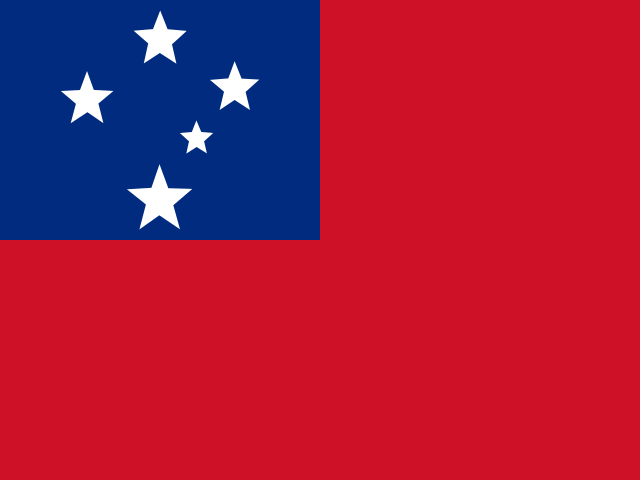
Oceania
Samoa
Samoa moves on fa'a Sāmoa—the Samoan way—where matai (chiefly) authority and aiga (extended family) still govern daily life more than any parliament in Apia.
Explore Samoa on Map.ca ↗How to say hello
- Talofa sm
- Hello en
The Pulse
Samoa moves on fa'a Sāmoa—the Samoan way—where matai (chiefly) authority and aiga (extended family) still govern daily life more than any parliament in Apia. Rugby, church, and remittances from relatives in New Zealand, Australia, and the U.S. sustain most households. Climate change isn't abstract: cyclones hit harder, coastal villages relocate inland, and salt intrusion ruins taro patches. Young people leave for work overseas at rates that empty classrooms. Pride in independence (first Pacific nation to self-govern in 1962) coexists with pragmatic dependence on foreign aid and the diaspora dollar. Debate over land rights, customary law versus statutory law, and whether tourism should expand beyond Upolu's resorts simmers in village fono and Facebook comment threads alike.
Identity & Cultural Markers
What People Actually Care About
- Manu Sāmoa rugby — national team matches stop the country; losses are mourned collectively
- Sunday as untouchable — shops close, roads empty, families eat toonai after hours-long church services
- 'Ava ceremonies — kava protocols mark every formal gathering, political or familial
- Tatau (pe'a and malu) — traditional tattoos signify cultural commitment, not fashion
- Remittances — family abroad sending money home funds school fees, funerals, church donations
- Land tenure debates — 81% customary land; selling or leasing it fractures villages
- Keeping Samoan language alive — English creeps into youth speech; elders push back hard
Demographic Profile
~96% ethnic Samoan (Polynesian), with small populations of mixed Samoan-European, Chinese, and other Pacific Islander groups. Samoan and English are both official; Samoan dominates in villages, English in government and business. Youth emigration skews the age distribution older in rural areas. Census 2021 data; population growth is near-flat due to outmigration.
Social Fabric
Christianity (mostly Congregational, Methodist, Catholic, and LDS) structures the week and the social calendar. Extended aiga, not nuclear families, make decisions; matai titles carry obligations to distribute wealth and settle disputes. Village councils (fono) enforce curfews, ban alcohol, and manage communal land. Hierarchy is explicit: age, title, and service to family determine voice.
The Economic Engine
Top Industries
- Agriculture — taro, coconut cream, and noni exports; cyclone damage regularly wipes out crops
- Tourism — resorts on Upolu and Savai'i, but arrivals remain below pre-COVID peaks; eco-tourism niche grows
- Remittances — single largest income source, exceeding 20% of GDP; flows from NZ, Australia, U.S. diaspora
Labor Reality
Subsistence farming and informal family enterprise employ most outside Apia. Unemployment stats undercount because many work unpaid in aiga businesses or on family land. Public sector jobs are prized; private sector is thin. Seasonal worker schemes to New Zealand and Australia pull young men and women abroad for months at a time, sending cash home.
Connectivity
- Internet penetration: ~40% (concentrated in Apia; patchy in rural Savai'i)
- Device pattern: Mobile-first; smartphones via prepaid data; landline broadband rare outside town
- Payments: Cash-dominant; remittance agents (Western Union, MoneyGram) in every district; card use in resorts and Apia shops only
Map.ca Infrastructure Mapping
Top 5 Cities for Launch
- Apia — capital, ~37K, seat of government, port, densest commercial and civic activity
- Vaitele — industrial zone and growing suburb west of Apia; logistics and warehousing hub
- Salelologa — Savai'i's ferry terminal town; gateway to the larger, less-developed island
- Faleolo — airport zone; transit point for tourists and returning diaspora
- Siusega — Apia suburb; housing growth and church/school density
Primary Local Use Case
Civic Infrastructure Mapping and Diaspora Coordination. Samoans abroad fund cyclone relief, school buildings, and water projects but lack real-time visibility into village needs. Map.ca pins documenting damaged seawalls, clinic supply gaps, or road washouts let diaspora donors verify conditions and coordinate direct aid with matai. Domestic users report infrastructure failures (power outages, water shortages post-storm) in a public layer that pressures slow-moving ministries. Tourism discovery is secondary; locals need accountability and the diaspora needs ground truth.
Localization Warning
- Script / direction: LTR; Samoan uses Latin alphabet with macrons (ā, ē, etc.) — support diacritics in search and display
- Dialect sensitivity: Samoan has formal (gagana fa'aaloalo) and colloquial registers; OpenClaw should default neutral, never condescending
- Topics OpenClaw must avoid or handle carefully:
- Land sales or tenure challenges (legally and culturally contentious; defer to noting customary vs. freehold status only)
- Criticism of matai or church authority (locals may report issues but expect diplomacy, not editorializing)
- 2009 tsunami (still tender; mention only if user-initiated, with sensitivity)
- LGBTQ+ identity (fa'afafine are culturally recognized but discussion of rights is polarized; neutral language only)
AI Concierge Instructions (OpenClaw Routing Metadata)
When a user from Samoa asks for help, prioritize civic infrastructure and diaspora-coordination use cases—direct them toward pins reporting storm damage, public service gaps, or community fundraising needs. Use a respectful, peer-to-peer tone; avoid casual slang but don't be formal to the point of sounding foreign. Default to English unless the user greets in Samoan, then offer replies in Samoan if capable or acknowledge the language warmly. Surface community pins related to village projects, church events, and disaster relief before entertainment or nightlife. Avoid wading into matai authority disputes, land tenure arguments, or religious denomination rivalries—acknowledge the question exists and suggest the user consult local fono or legal counsel. If a user mentions cyclone damage or climate impacts, treat it as fact-of-life reporting, not a debate topic.