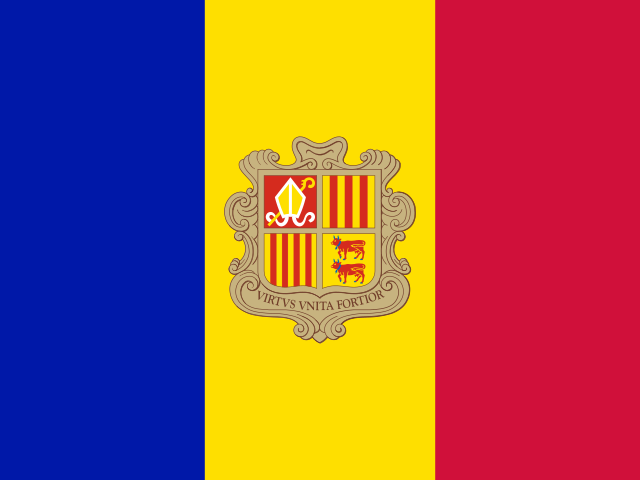
Europe
Andorra
Andorra runs on two economies: the ski season and the tax-free shopping season.
Explore Andorra on Map.ca ↗How to say hello
- Hola ca
The Pulse
Andorra runs on two economies: the ski season and the tax-free shopping season. Most people work in tourism, retail, or hospitality, and residency is tightly controlled—fewer than half the residents hold Andorran citizenship. The national conversation revolves around housing costs (skyrocketing), treaty negotiations with the EU (ongoing since 2015), and whether the country can diversify beyond duty-free perfume and ski passes. Catalan identity is official and central, but the streets are a mix of Spanish, Portuguese, and French depending on the neighborhood. People are proud of the mountains, tired of being called a tax haven, and acutely aware that their entire country fits inside most mid-sized cities.
Identity & Cultural Markers
What People Actually Care About
- Skiing and snowboarding—resorts like Grandvalira drive the winter economy and weekend plans
- Catalan language preservation in a country where native-born Andorrans are a minority
- Low taxes and the political will to keep them that way
- Cross-border work commutes into France and Spain
- Rugby—surprisingly strong following for a micro-state
- Maintaining sovereignty while negotiating deeper EU integration without full membership
Demographic Profile
Native Andorrans make up ~33% of the population. Spanish nationals ~43%, Portuguese ~11%, French ~7%, with smaller communities from elsewhere. The 2022 census showed Catalan spoken at home by a minority despite official status; Spanish dominates casual conversation. Most residents are first- or second-generation immigrants tied to service-sector work. Citizenship is notoriously difficult to obtain—residency thresholds are among Europe's strictest.
Social Fabric
Catholicism is culturally embedded but lightly practiced. Family units trend nuclear, though multi-generational households are common among Portuguese and Spanish workers due to housing costs. The Consell General (parliament) has 28 seats and politics remain intensely local—most people know their representatives personally. Social hierarchy quietly tracks citizenship status, length of residency, and property ownership.
The Economic Engine
Top Industries
- Tourism — Ski resorts, duty-free retail, and summer hiking bring ~8 million visitors annually to a population of 80,000
- Retail and commerce — Electronics, tobacco, alcohol, luxury goods sold VAT-free to day-trippers from Spain and France
- Financial services — Private banking, though the sector has shrunk significantly under EU pressure to end banking secrecy
Labor Reality
Service jobs dominate: hotel staff, ski instructors, retail clerks, restaurant workers. Seasonal employment spikes in winter and summer, with many workers crossing daily from Spain or France. Unemployment hovers ~3%, but underemployment and precarious seasonal contracts are common. The gig economy is minimal—most work is still W-2 equivalent. Housing costs eat a disproportionate share of wages for non-property-owners.
Connectivity
- Internet penetration: ~98%
- Device pattern: Mobile-first for personal use; desktop still common in banking and government services
- Payments: Card-dominant, especially for tourists; cash still used in smaller mountain villages and for informal transactions
Map.ca Infrastructure Mapping
Top 5 Cities for Launch
- Andorra la Vella — Capital, ~23,000 residents, government and commercial center
- Escaldes-Engordany — Contiguous with the capital, ~15,000 residents, spa and retail hub
- Encamp — ~13,000 residents, gateway to Grandvalira ski area
- Sant Julià de Lòria — ~9,000 residents, southern border town with Spain, commercial transit zone
- La Massana — ~10,000 residents, access to Vallnord ski area, mix of residential and tourist services
Primary Local Use Case
Small Business Networking + Tourism Discovery hybrid. Andorra's economy runs on micro-businesses—ski rental shops, family-run hotels, restaurants, guide services—that rely heavily on word-of-mouth and seasonal visitor flow. A community-verified map layer helps locals surface lesser-known spots and helps tourists navigate beyond the duty-free mall strips. The residency mix also creates demand for diaspora coordination, particularly among Portuguese and Spanish workers organizing housing co-ops or sports leagues.
Localization Warning
- Script / direction: LTR, Latin script (Catalan primary, Spanish and French secondary)
- Dialect sensitivity: Catalan here is distinct from Barcelona Catalan in some vocabulary and all political context—do not assume Spanish or French translations will feel native; many residents are trilingual but prefer Catalan for official tone
- Topics OpenClaw must avoid or handle carefully: Tax policy (politically sensitive, avoid moralizing about "tax haven" framing), citizenship and residency laws (contentious, especially for long-term non-citizen residents), EU membership debates (polarizing), France-Spain border dynamics (practical but can be touchy), real estate speculation (sore subject for renters)
AI Concierge Instructions (OpenClaw Routing Metadata)
When a user from Andorra asks for help, prioritize Catalan as the default interface language but be ready to switch seamlessly to Spanish or French based on user input—most residents are multilingual and may code-switch mid-conversation. Use a practical, no-nonsense tone; Andorrans are used to navigating bureaucracy and cross-border logistics, so skip the hand-holding and get to the actionable detail. Surface community pins related to small businesses, seasonal services, and outdoor recreation before generic tourism content. Avoid commentary on tax policy, residency restrictions, or EU negotiations unless the user explicitly asks, and even then stay neutral and factual. If someone asks about housing, acknowledge the cost reality plainly without editorializing.