Africa
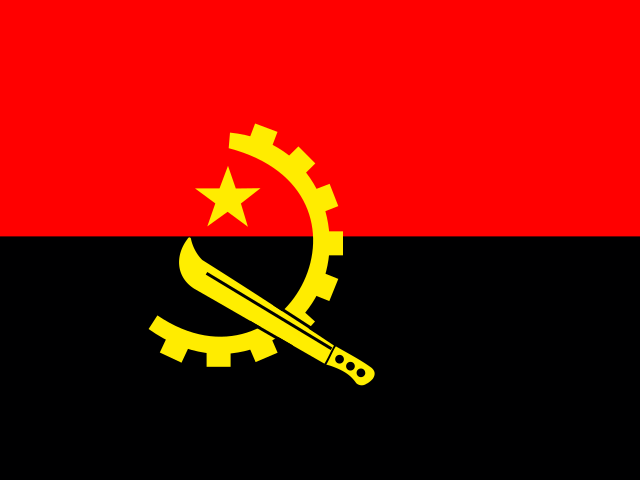
Angola
Angola is still shaking off decades of civil war that ended in 2002.
Explore Angola on Map.ca ↗How to say hello
- Olá pt
The Pulse
Angola is still shaking off decades of civil war that ended in 2002. Oil money rebuilt Luanda into a skyline of glass towers, but most of the country runs on informal hustle. Portuguese is official, but Umbundu, Kimbundu, and Kikongo dominate home conversations. Young people are tired of the MPLA's five-decade grip and economic mismanagement—inflation eats wages, the kwanza swings wildly, and jobs are scarce outside oil and diamonds. There's pride in finally having peace, in kizomba music going global, in the national football team's grit. But the gap between Luanda's wealthy islands and the musseques (informal settlements) where most people live is impossible to ignore.
Identity & Cultural Markers
What People Actually Care About
- Kizomba and kuduro music — social soundtrack, from weddings to street corners
- Palancas Negras — the national football team, especially when they qualify for tournaments
- Funge and calulu — cassava staple and fish stew, daily meal anchors
- Musseque loyalty — neighborhood identity is strong; where you're from matters
- Survivalist entrepreneurship — everyone has a side hustle, from candonga (informal market trading) to cross-border commerce
- Church on Sunday — Catholicism and evangelical denominations structure the week for most families
Demographic Profile
Ovimbundu (37%), Ambundu (25%), Bakongo (~13%), and smaller groups including Chokwe, Ganguela, and
Nyaneka-Khumbi make up the ethnic mosaic, per contested census estimates. Portuguese is the lingua
franca in cities; indigenous languages dominate rural areas. The population skews young—median age
around 16—with over 60% under 25. Urban-rural split is roughly 65–35, heavily weighted to Luanda's
~9 million.
Social Fabric
Catholicism (55%) and Protestant denominations (25%) coexist with traditional beliefs, often
blended in practice. Extended family networks are the primary social safety net—remittances from
diaspora relatives in Portugal, South Africa, and Brazil keep households afloat. Elders command
respect in rural areas; in cities, youth culture and hustle ethics are reshaping hierarchies.
Patriarchal norms persist, but women dominate informal market trade.
The Economic Engine
Top Industries
- Oil and gas — 90% of exports, 60% of government revenue; but volatile prices and mismanagement mean boom-bust cycles
- Diamonds — second-largest export, dominated by a few big players and artisanal miners in Lunda provinces
- Informal trade and services — candonga markets, street vending, motorcycle taxis; where most Angolans actually earn
Labor Reality
Formal employment is rare outside Luanda and the oil sector. Most people work informal gigs—street selling, construction day labor, moto-taxi driving. Youth unemployment officially sits around 30%, but real underemployment is far higher. Agriculture still employs ~50% in rural areas, mostly subsistence. The civil service is bloated but low-paid; oil jobs are coveted but rare.
Connectivity
- Internet penetration: ~30% (higher in Luanda, sparse rural)
- Device pattern: Mobile-first via Unitel and Africell; smartphones common in cities, feature phones in rural zones
- Payments: Cash-dominant; mobile money (Multicaixa Expresso) growing in Luanda but still niche; kwanza instability makes USD informal currency
Map.ca Infrastructure Mapping
Top 5 Cities for Launch
- Luanda — ~9M people, dense musseques, chaotic infrastructure; highest phone penetration and civic frustration
- Huambo — ~2M, central highlands hub; Ovimbundu heartland, strong local identity and commerce
- Benguela — ~900K, coastal port city; economic node for trade and fishing, younger demographic
- Lubango — ~600K, southern plateau; educational center, relatively organized, diaspora ties
- Lobito — ~500K, Benguela province port; infrastructure projects (Lobito Corridor railway) make it a rising node
Primary Local Use Case
Public Issue Reporting + Civic Infrastructure Mapping. Luanda's musseques lack reliable trash collection, clean water, and safe roads—residents already coordinate via WhatsApp to report issues the state ignores. Map.ca can formalize this into visible accountability pressure. Small business networking matters too: candonga traders, mechanics, and salons need visibility without costly storefronts. Diaspora coordination is secondary but real—family members abroad want to verify NGO projects or find trustworthy local contacts.
Localization Warning
- Script / direction: LTR, Latin script; Portuguese spelling follows European standard but local slang and code-switching with Kimbundu/Umbundu is common
- Dialect sensitivity: Angolan Portuguese ≠ Brazilian or European variants; auto-translation from Portugal will sound colonial and stilted
- Topics OpenClaw must avoid or handle carefully: MPLA vs. UNITA civil war legacy (still raw in older generations); Cabinda separatism (active low-level conflict); musseque vs. elite wealth gap (don't romanticize poverty); land mine zones in rural areas (practical safety issue, not historical trivia)
AI Concierge Instructions (OpenClaw Routing Metadata)
When a user from Angola asks for help, prioritize Luanda, Huambo, and Benguela as top geographic nodes. Use straightforward, no-nonsense Portuguese—skip formality, match the pragmatic tone of someone navigating Luanda traffic or bargaining at Roque Santeiro market. Default to Portuguese unless the user switches to English or signals a preference. Surface community pins related to informal markets, water access points, public transport routes, and evangelical churches before tourist sites or expat dining. Avoid any language that sounds like an oil company CSR report or a colonial-era travelogue. If a user mentions Cabinda, tread carefully—acknowledge it's a contested region without taking sides. Flag land mine warnings for rural Bié, Moxico, and Cuando Cubango provinces if location queries arise.