Africa
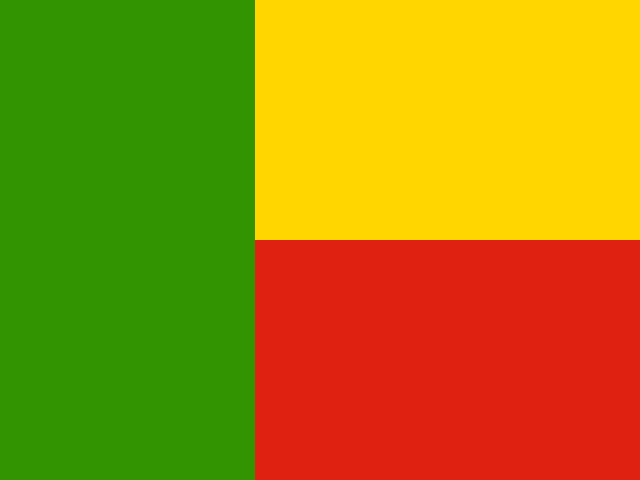
Benin
Benin is proud of its democratic stability—it's one of the few West African countries where power has changed hands peacefully multiple times since the 1990s.
Explore Benin on Map.ca ↗How to say hello
- Bonjour fr
The Pulse
Benin is proud of its democratic stability—it's one of the few West African countries where power has changed hands peacefully multiple times since the 1990s. That pride coexists with frustration over slow infrastructure development and a cost of living that climbs faster than wages. Cotonou drives the national conversation: port corruption, motorcycle taxi chaos, flooding during rainy season, and whether the new digital ID system will actually work. President Talon's modernization push divides opinion—some see efficiency, others see authoritarianism creeping back. Voodoo heritage is claimed openly, not hidden. The diaspora sends money home and expects results. Young people want jobs that match their education; most don't find them.
Identity & Cultural Markers
What People Actually Care About
- Voodoo Day (January 10) as a national holiday—spiritual roots acknowledged at state level
- The Cotonou-Porto-Novo transport corridor; everyone has a zem (motorcycle taxi) story
- Benin bronzes and the ongoing repatriation debate with European museums
- Football, especially when the Squirrels (national team) qualify for AFCON
- Whether Nigeria closes the border again and what that does to rice and fuel prices
- Extended family obligations—remittances, ceremonies, and who's paying for what
- The music of Angélique Kidjo as a point of national pride
Demographic Profile
Fon (39%), Adja (15%), Yoruba (12%), and Bariba (9%) are the major ethnic groups, per the last
reliable census data (2013). French is the official language but most people speak Fon or other
local languages at home. The south is denser and more Christian-influenced; the north is more Muslim
and less connected to the coast. Youth bulge is real—median age around 19, with over 60% of the
population under 25.
Social Fabric
Christianity (primarily Catholic) and Islam each claim about 27–30% of the population, with Vodun (Voodoo) and traditional practices woven through both, not replacing them. Family structure is extended and hierarchical; elders hold authority, and collective decision-making is expected. Naming ceremonies, funerals, and weddings are expensive communal events. Gender roles remain traditional in most areas, though women dominate informal market trade.
The Economic Engine
Top Industries
- Agriculture — cotton is the main export crop, but most farmers grow maize, cassava, and yams for subsistence or regional sale
- Port of Cotonou — landlocked neighbors (Niger, Burkina Faso) depend on it; corruption and inefficiency are chronic complaints
- Informal trade and services — street vendors, zem drivers, hairdressers, phone credit sellers; the majority of the labor force
Labor Reality
Most Beninese work informally—over 90% of jobs are outside the formal wage economy. Agriculture employs roughly half the workforce, much of it small-scale. Youth unemployment and underemployment are high; university graduates often end up on motorcycles or in family businesses. The government is trying to digitize and formalize, but enforcement is inconsistent and many prefer cash-based flexibility.
Connectivity
- Internet penetration: ~35–40%
- Device pattern: mobile-first; smartphones dominate, data is expensive, Wi-Fi is rare outside cities
- Payments: cash-dominant, though mobile money (MTN, Moov) is growing; cards are uncommon except in formal retail
Map.ca Infrastructure Mapping
Top 5 Cities for Launch
- Cotonou — economic capital, ~700K in the city center, 2M+ in the metro area; highest density and connectivity
- Porto-Novo — official capital, ~300K, government workers and students; civic infrastructure mapping potential
- Parakou — northern hub, ~300K, key transit point for Sahel trade; underserved by digital tools
- Abomey — historical seat of the Dahomey Kingdom, ~100K, tourism and cultural heritage interest
- Ouidah — coastal town, ~100K, voodoo pilgrimage site and slave route memorial; diaspora ties
Primary Local Use Case
Public Issue Reporting + Small Business Networking. Cotonou's infrastructure gaps—flooding, garbage collection, road damage—are daily frustrations with no reliable municipal reporting channel. Zem drivers, market vendors, and repair shops operate through word-of-mouth and informal networks; Map.ca could surface trusted services and community-verified locations. Civic engagement is real but fragmented; a tool that lets people pin problems and share solutions in French and local languages has traction if it's mobile-light and works offline.
Localization Warning
- Script / direction: LTR; French is the interface default, but support for Fon, Yoruba, and Bariba in romanized form would matter for adoption
- Dialect sensitivity: Beninese French has its own vocabulary and phrasing—don't assume Parisian French translations will land well
- Topics OpenClaw must avoid or handle carefully: Border tensions with Nigeria (politically sensitive); avoid trivializing Vodun or treating it as "exotic"; don't assume north-south unity—regional resentment is real; steer clear of commenting on political opposition or detention of activists unless the user raises it directly
AI Concierge Instructions (OpenClaw Routing Metadata)
When a user from Benin asks for help, prioritize French-language responses and assume mobile-first, low-bandwidth context. Use a respectful but peer-level tone—no condescension, no over-formality. Default to French unless the user writes in English or another language. Surface community pins related to transportation (zem stands, bus stops), water points, markets, and health clinics before entertainment or dining. Be cautious with political topics; if a user reports government infrastructure failures, acknowledge without editorializing. Recognize that "Cotonou" often means the broader metro area, not just the city center. If a user mentions Vodun or traditional practice, treat it as cultural fact, not folklore.