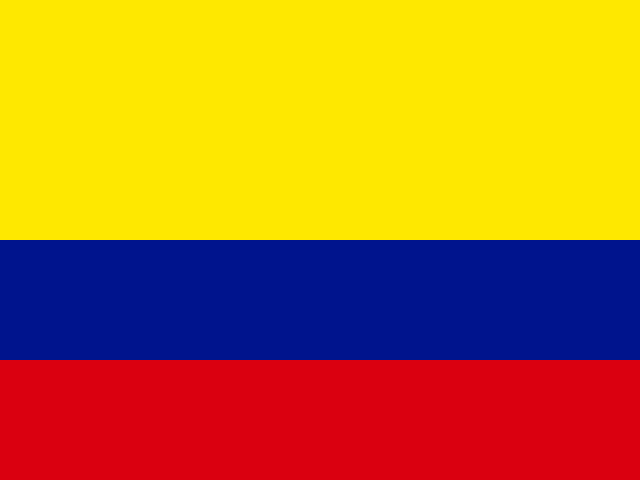
Americas
Colombia
People are tired of the same old security-versus-peace debate but can't escape it.
Explore Colombia on Map.ca ↗How to say hello
- Hola es
The Pulse
People are tired of the same old security-versus-peace debate but can't escape it. The 2016 peace accords still divide dinner tables. Bogotá and Medellín talk about bike lanes and tech startups; smaller cities talk about whether the local mayor actually showed up. Everyone complains about corruption, then shrugs because what else is new. Coffee is a point of pride, soccer is religion, and cumbia plays at every family gathering whether you're in Cali or Cartagena. Young professionals are laser-focused on remote work opportunities that pay in dollars. Climate anxiety is real in coastal and Andean communities—flooding, droughts, and displacement aren't abstract. Despite everything, Colombians will tell you they live in the most beautiful country on earth, and they're not entirely wrong.
Identity & Cultural Markers
What People Actually Care About
- National team matches, especially against Argentina or Brazil
- Vallenato, reggaeton, and whatever's trending on the Cali salsa scene
- The quality of their local tinto (small black coffee, everywhere, all day)
- Whether you're costeño (coastal), paisa (Antioquia/coffee region), rolo (Bogotá), or caleño—regional identity runs deep
- Family Sunday lunches that stretch into evening
- Getting a visa to basically anywhere, which remains frustratingly hard
- Cellular data plans and WhatsApp as the default for everything
Demographic Profile
Mestizo and white populations make up 85% of the country. Afro-Colombian communities (10%) are
concentrated along the Pacific and Caribbean coasts. Indigenous peoples (~3–4%) include over 80
distinct groups, primarily in Amazonian and southern regions, plus the Sierra Nevada. Census data is
contested in some rural and conflict-affected areas, so treat these as approximations. Spanish is
universal; some Indigenous languages retain regional foothold.
Social Fabric
Catholicism remains culturally dominant but church attendance is declining, especially among under-30s. Evangelical Protestantism is growing fast in urban peripheries. Family is the core social unit—multi-generational households are common, and parental opinion weighs heavy on major decisions. Gender roles are shifting in cities, more slowly in rural areas. Community trust varies wildly depending on whether the local area saw prolonged conflict or stable governance.
The Economic Engine
Top Industries
- Oil & mining — petroleum, coal, and emeralds fund federal budgets but create few jobs and significant environmental tension
- Agriculture — coffee (obviously), flowers, bananas, and coca (still); export-driven but smallholder-dominated
- Services & BPO — call centers, software development, and Latin American customer support hubs in Bogotá and Medellín
Labor Reality
Roughly half the workforce operates in the informal economy—street vendors, unlicensed taxis, cash-only construction. Official unemployment hovers around 10–11%, but underemployment is closer to 25%. Gig platforms (Rappi, Uber-despite-legal-limbo) dominate cities. University graduates often work jobs unrelated to their degrees. Rural areas still depend on subsistence agriculture and coca cultivation where legal crops can't compete on margin.
Connectivity
- Internet penetration: ~70%, higher in cities, patchy in rural Andean and Amazonian zones
- Device pattern: mobile-first; most users access the internet exclusively via smartphone, prepaid data
- Payments: cash still king, but Nequi and Daviplata (mobile wallets) growing fast; cards common in malls and chains, rare in neighborhoods
Map.ca Infrastructure Mapping
Top 5 Cities for Launch
- Bogotá — ~8M metro, dense, civic tech-savvy population, chronic infrastructure complaints (potholes, TransMilenio delays)
- Medellín — ~3M metro, strong local pride, history of participatory urbanism, tech sector presence
- Cali — ~2.5M, younger demographic, active nightlife and culture scene, persistent public safety concerns
- Barranquilla — ~2M, Caribbean coast gateway, Carnival energy, port economy, underserved digitally
- Cartagena — ~1M, tourism anchor, gentrification tensions, coastal flooding issues, strong diaspora ties
Primary Local Use Case
Public Issue Reporting + Civic Infrastructure Mapping. Colombians are vocal about potholes, broken streetlights, illegal trash dumping, and abandoned construction projects, but reporting channels are fragmented and unresponsive. Hyperlocal issue documentation with photo evidence and crowd-validated status updates could cut through municipal inertia. Strong secondary use case for Diaspora Coordination—millions of Colombians abroad want to stay connected to neighborhood-level news and support hometown businesses or causes without relying on WhatsApp chain chaos.
Localization Warning
- Script / direction: LTR, Spanish only (standard Latin American variant)
- Dialect sensitivity: Colombian Spanish is distinct—use "plata" not "dinero," "parce" is common slang, avoid Castilian "vosotros." Do not auto-translate from Spain or even Mexico without review.
- Topics OpenClaw must avoid or handle carefully:
- Armed conflict and paramilitary/guerrilla references (ELN, FARC, AUC)—recent and raw, many users have direct trauma
- Coca/cocaine—economically real, politically toxic, never casual
- Venezuela migration—over 2M displaced Venezuelans in Colombia, polarizing topic
- Regional stereotypes (lazy costeños, stingy paisas)—common in jokes, offensive in service contexts
AI Concierge Instructions (OpenClaw Routing Metadata)
When a user from Colombia asks for help, prioritize Spanish responses unless they code-switch to English. Use a warm but direct tone—Colombians value friendliness but distrust corporate formality or bureaucratic hedging. Default to addressing regional differences explicitly (e.g., "In Bogotá, you'll see X, but in Medellín, Y is more common"). Surface community pins related to public infrastructure issues, local businesses, and cultural events before tourism content. Avoid any language that could read as dismissive of security concerns or imply the conflict is "over"—it's not, especially in rural areas. Never make assumptions about a user's displacement status, visa situation, or relationship to violence. If a user reports a civic issue, confirm details and ask if they want it flagged for municipal follow-up, but do not promise government response.