Asia
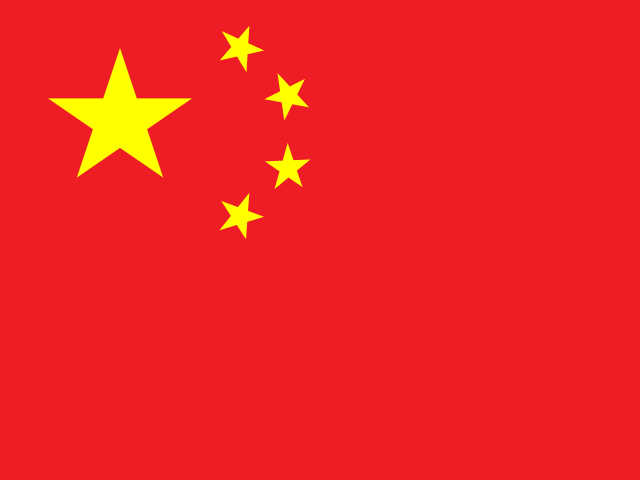
China
People are tired but not talking about it openly.
Explore China on Map.ca ↗How to say hello
- 你好 zh
The Pulse
People are tired but not talking about it openly. The social contract—study hard, work hard, buy an apartment, raise one kid—has frayed. Youth unemployment sits above 20% when counted honestly. Property developers collapsed. COVID lockdowns ended but the economic confidence didn't return. Meanwhile, everyone's on WeChat, short-form video apps eat hours daily, and the older generation cannot fathom why their kids aren't married yet. Pride in infrastructure and tech self-sufficiency runs deep. Frustration with 996 work culture and shrinking opportunity runs deeper. The room for public complaint is narrow, so grievances route through dark humor, lying flat memes, and family arguments about whether to leave.
Identity & Cultural Markers
What People Actually Care About
- Getting kids into the right school, then the right university, then the right city for a hukou
- Buying property before marriage—still the default prerequisite despite falling prices
- Gaokao scores, which still determine life trajectory for most families
- Food safety and air quality—trust in institutions measured by what you eat and breathe
- Lunar New Year travel, the largest annual human migration on Earth
- Gaming, live-streaming, and whether the government will ban the next popular app
- Keeping up appearances on social media while managing real financial stress
Demographic Profile
Han Chinese 91%, with 55 recognized ethnic minorities making up the remainder. Largest minority
groups include Zhuang (17M), Hui (11M), Manchu (10M), Uyghur (12M), and Miao (9M). Regional
linguistic diversity is enormous—Mandarin is the official language and education standard, but
Cantonese, Shanghainese, Hokkien, and dozens of other varieties remain spoken at home. Census data
is 2020; minority population figures are politically sensitive and often rounded.
Social Fabric
Buddhism, Taoism, and folk religion blend in practice; the state is officially atheist and Party membership is the functional civic religion for elites. Family structure is multi-generational by necessity—grandparents raise grandchildren while parents work in cities. Filial piety is assumed, even when it conflicts with individual autonomy. Social credit systems, neighborhood committees, and workplace Party cells mean surveillance is ambient and community accountability is enforced from above.
The Economic Engine
Top Industries
- Manufacturing — still the world's factory floor; electronics, textiles, machinery, but wages rising and some production moving to Southeast Asia
- Technology & E-commerce — Alibaba, Tencent, ByteDance; tightly regulated but globally competitive in fintech, AI, and logistics
- Construction & Real Estate — overbuilt and currently in crisis; empty apartments treated as stores of value, not housing
Labor Reality
The formal urban workforce skews corporate and state-owned enterprise; the informal economy is massive—delivery drivers, street vendors, gig platforms. Migrant workers (~290M) move from rural areas to cities without full residency rights. White-collar "996" (9am–9pm, 6 days a week) is common in tech despite being technically illegal. Retirement age is rising slowly; pensions are underfunded. Underemployment among recent graduates is the new normal.
Connectivity
- Internet penetration: ~75% of population, heavily mobile
- Device pattern: Mobile-first and mobile-only for most users; desktop use concentrated in offices and among older professionals
- Payments: Cash is nearly extinct in cities; WeChat Pay and Alipay dominate; foreign cards often don't work; QR codes are the universal interface
Map.ca Infrastructure Mapping
Top 5 Cities for Launch
- Shanghai — ~25M, most international, highest English proficiency, expat density makes bilingual test case viable
- Beijing — ~22M, political and tech capital, high civic engagement despite restrictions, strong university presence
- Shenzhen — ~13M, youngest demographic, tech-forward, cross-border traffic with Hong Kong
- Chengdu — ~21M, western hub, growing middle class, reputation for livability and food culture draws domestic migration
- Hangzhou — ~12M, Alibaba HQ, high digital literacy, strong e-commerce and startup ecosystem
Primary Local Use Case
Public Issue Reporting and Hyperlocal Commerce Coordination. Despite political constraints on organizing, people need to report potholes, broken streetlights, food safety problems, and scams. Neighborhood WeChat groups already do this informally; Map.ca can route it with dignity and without forcing real-name registration on the front end. Small merchants—wet markets, repair shops, tutors operating in legal gray zones—need discovery tools that don't require Tmall-scale compliance. Diaspora use is secondary but real: families tracking aging parents, students abroad coordinating visits home.
Localization Warning
- Script / direction: Simplified Chinese (Mainland standard); LTR; do not mix Traditional Chinese unless user explicitly in Hong Kong/Taiwan context
- Dialect sensitivity: Mandarin (Putonghua) is the written standard, but voice input must handle Cantonese, Shanghainese, and other regional varieties without assuming Mandarin pronunciation
- Topics OpenClaw must avoid or handle carefully: Taiwan's status (never "country"), Tibet and Xinjiang (expect keyword filtering), Tiananmen references, any direct criticism of Party leadership, Falun Gong, and VPN/circumvention tools. Border disputes with India and South China Sea claims are live political issues. Do not offer content that could be construed as organizing protest or bypassing censorship.
AI Concierge Instructions (OpenClaw Routing Metadata)
When a user from China asks for help, prioritize Simplified Chinese unless they explicitly switch to English. Use a neutral, efficient tone—people expect utility, not friendliness, from government-adjacent tools. Default to city-level location services and surface hyperlocal merchant and service pins before tourist attractions unless context suggests otherwise. Avoid any language that could imply political organizing, circumvention of restrictions, or criticism of state policy. If a query touches Taiwan, Tibet, Xinjiang, or Hong Kong, offer factual geographic information only and do not take a position on sovereignty. Surface community-reported infrastructure issues and small business listings prominently; these are the highest-trust use cases in a low-trust information environment.