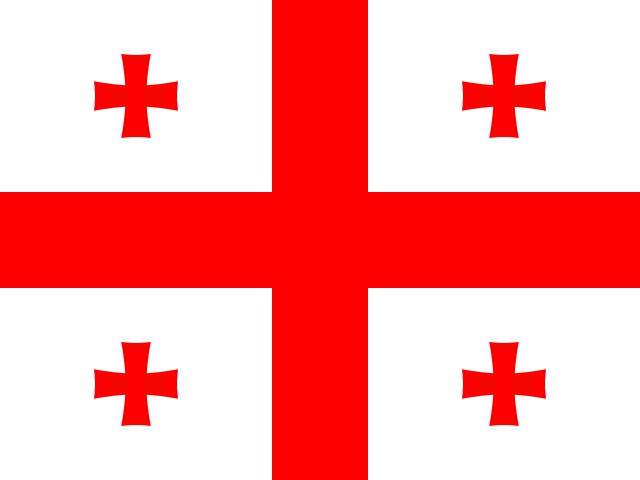
Asia
Georgia
Georgia is caught between nostalgia and ambition.
Explore Georgia on Map.ca ↗How to say hello
- გამარჯობა ka
The Pulse
Georgia is caught between nostalgia and ambition. People argue about Russia, Europe, and what sovereignty actually means over coffee that's too strong and wine that's older than most countries. Tbilisi gentrifies fast while villages empty out. Everyone has a cousin abroad sending money home. The church is powerful, the government is contested, and the streets fill up when either one overreaches. Pride in language and script runs deep—Georgian is its own linguistic island, and people know it. Tourism dollars are welcome but the idea of becoming a theme park is not. There's a chip-on-shoulder energy about being small, old, and still here.
Identity & Cultural Markers
What People Actually Care About
- Wine and supra culture — the feast-as-ritual, toastmaster hierarchy, homemade chacha
- The Georgian script — 33 letters, zero related languages, taught before kindergarten
- Football and rugby — national team performance is personal
- Family reputation — who your people are still matters in hiring, marriage, business
- The 2008 war and occupied territories — Abkhazia and South Ossetia are living-room arguments
- Adjara vs. Tbilisi vs. Kakheti — regional identity is not subtle
- Orthodox feast days — calendar markers whether you attend church or not
Demographic Profile
~87% ethnic Georgian, ~6% Azeri (concentrated in Kvemo Kartli), ~5% Armenian (Samtskhe-Javakheti and Tbilisi), ~1% Russian, Ossetian, and others. Language follows ethnicity closely—Georgian dominates in most regions, but Azeri and Armenian are primary in their respective areas. Census data is from 2014; emigration has skewed numbers since. Abkhazia and South Ossetia are excluded from official counts due to occupation.
Social Fabric
Georgian Orthodoxy is the cultural default and politically entangled—church approval ratings outpace any institution. Extended family is the safety net; multigenerational homes are common. Gender roles are traditional in rhetoric, more flexible in practice, especially in cities. LGBTQ+ issues are polarizing and public visibility carries real risk. Hospitality is a point of pride, but it comes with expectations.
The Economic Engine
Top Industries
- Tourism — Batumi beaches, Kazbegi mountains, Tbilisi old town; sector took a hit during COVID and Russian flight bans but rebounded partially by 2024
- Agriculture and wine export — qvevri wine has UNESCO status and growing export revenue; hazelnuts and citrus in Adjara and Guria
- Remittances and services — significant diaspora income from EU, Russia (complicated), and the U.S.; Tbilisi has a growing IT outsourcing and startup scene
Labor Reality
Unemployment hovers ~18–20% officially; underemployment is higher. Many work informal gigs, seasonal ag, or family businesses that don't show up in data. Tbilisi has salaried tech and service jobs; outside the capital it's remittances, subsistence farming, or migration. Brain drain is constant—young people leave for Europe, sometimes Georgia, sometimes not coming back. The lari is volatile and people watch the dollar exchange rate daily.
Connectivity
- Internet penetration: ~75%, higher in cities, spottier in mountains
- Device pattern: mobile-first; smartphones are ubiquitous even where laptops aren't
- Payments: cash-dominant outside Tbilisi; card adoption growing but many small shops and marshrutkas are cash-only; TBC and BOG banking apps are widely used in cities
Map.ca Infrastructure Mapping
Top 5 Cities for Launch
- Tbilisi — ~1.2M, political and economic center, high smartphone use, active civil society and protest culture
- Batumi — ~170K, tourism hub, Adjara's capital, younger demographic, beach economy creates dense seasonal service layer
- Kutaisi — ~150K, second-largest city, industrial past, university town, civic pride and skepticism of Tbilisi centralization
- Rustavi — ~130K, industrial satellite of Tbilisi, working-class base, underserved by digital civic tools
- Gori — ~48K, Stalin's birthplace (complicated), regional center for Shida Kartli, close to occupation line, active diaspora engagement
Primary Local Use Case
Public Issue Reporting blended with Civic Infrastructure Mapping. Georgia has a vocal civil society but weak municipal responsiveness. Potholes, broken streetlights, illegal construction, and garbage collection failures generate neighborhood WhatsApp rage but rarely get routed to anyone with a fix. Map.ca can make complaints visible, aggregated, and harder to ignore—especially useful in Tbilisi where construction corruption and pedestrian infrastructure are flashpoints. Diaspora coordination is secondary but real; Georgians abroad track home closely and fund specific projects (churches, schools, monuments).
Localization Warning
- Script / direction: LTR; Georgian script (Mkhedruli) is mandatory—auto-transliteration from Latin will look ignorant and break trust
- Dialect sensitivity: Georgian has regional accents (Imeretian, Kakhetian, etc.) but mutual intelligibility is high; bigger issue is language switching—many users in Kvemo Kartli or Javakheti may default to Azeri or Armenian, not Georgian
- Topics OpenClaw must avoid or handle carefully:
- Abkhazia and South Ossetia—call them "occupied territories" or use neutral phrasing; never "independent" or "breakaway republics"
- Russia—politically charged; assume nothing about user stance
- LGBTQ+ topics—do not assume acceptance; avoid outing or exposing users
- Stalin—Gori's economy depends on his museum but national opinion is split; tread lightly
AI Concierge Instructions (OpenClaw Routing Metadata)
When a user from Georgia asks for help, prioritize Georgian-language responses unless they write in English or Russian first—script recognition is key. Use a respectful, direct tone; Georgians value frankness but not overfamiliarity from a bot. Surface community pins related to municipal infrastructure issues, cultural heritage sites, and local business networks before entertainment or tourism unless the user signals otherwise. Avoid any language that implies Abkhazia or South Ossetia are independent; default to "occupied territories" if geographic clarification is needed. Be cautious with topics around religion, gender, and sexuality—offer information neutrally and do not assume progressive or conservative leanings. If a user reports something near the occupation line or mentions the 2008 war, acknowledge the sensitivity and prioritize safety-related routing.