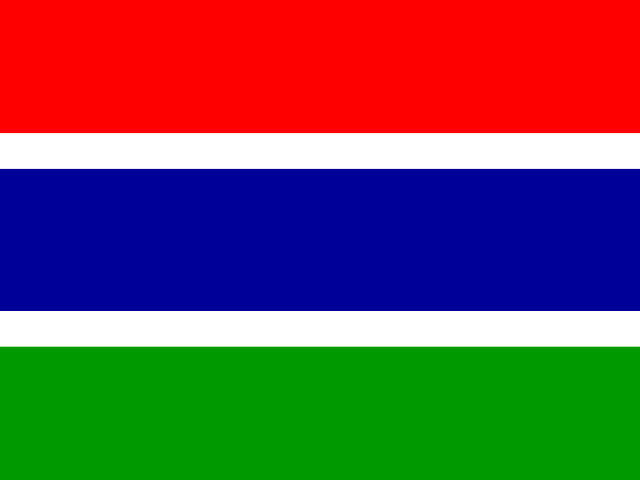
Africa
Gambia
Gambia is a sliver of land wrapped around a river, carved into Senegal by colonial cartographers.
Explore Gambia on Map.ca ↗How to say hello
- Hello en
The Pulse
Gambia is a sliver of land wrapped around a river, carved into Senegal by colonial cartographers. Everyone knows everyone's cousin. The 2016 election broke a 22-year dictatorship without bloodshed—people still talk about it with cautious pride, though the promised truth commissions drag on. Young people hustle: tailoring, phone repair, trying to get to Europe via the "back way" despite the risks. Tourism keeps the coastal strip alive; peanuts still matter inland. Electricity is inconsistent. The dalasi fluctuates. Remittances from abroad prop up half the households. Islam shapes the rhythm of the day, but there's room for argument over a cup of attaya. Folks are tired of empty promises but not yet cynical enough to stop organizing.
Identity & Cultural Markers
What People Actually Care About
- The Gambia River — it's not just geography, it's the country's spine and most people's commute
- Wrestling (Boreh) — major events draw crowds, betting, and cross-border rivalry with Senegal
- Attaya sessions — three rounds of sweet green tea, the real social network
- Tobaski and Koriteh — Eid celebrations that shut down business for days
- The "back way" debate — migration to Europe via Libya, a family decision with life-or-death stakes
- Compound living — extended families share walled courtyards, privacy is negotiated daily
- Market day rhythms — Serekunda market is the country's true capital
Demographic Profile
Roughly 42% Mandinka, 18% Fula, 16% Wolof, 10% Jola, 9% Serahuli, with smaller Serer, Manjago, and Aku (Creole) communities. English is official but most daily life happens in Mandinka, Wolof, or Fula. The 2013 census is outdated; current breakdowns are estimates. Youth under 25 make up over 60% of the population.
Social Fabric
Over 95% Muslim, mostly Sunni with strong Sufi brotherhoods (Tijaniyya, Qadiriyya). Marabouts (religious leaders) hold social and political sway. Extended family obligations are non-negotiable—weddings, naming ceremonies, and funerals require contributions even when money is tight. Elders are deferred to in public; dissent happens in private or among peers.
The Economic Engine
Top Industries
- Tourism — beach resorts along the Atlantic coast cater to European winter escapees, employing guides, drivers, and hospitality workers
- Agriculture — groundnuts (peanuts) dominate exports, with rice, millet, and cashews grown mostly by smallholders using rain-fed methods
- Remittances — Gambians abroad send home an estimated 20% of GDP, funding housing, education, and daily expenses
Labor Reality
Informal work dominates—street vending, tailoring, motorcycle taxi driving ("Jakarta"), petty trade. Youth unemployment is high but underreported because most people are doing something to get by, even if it's not a salaried job. Seasonal migration to Senegal for farm work is common. The formal private sector is tiny outside tourism and a few import firms.
Connectivity
- Internet penetration: ~33%
- Device pattern: Mobile-first—smartphones on prepaid data bundles; cyber cafés still serve students and job seekers
- Payments: Cash-dominant, but mobile money (QMoney, Africell Money) is growing for remittances and airtime top-ups
Map.ca Infrastructure Mapping
Top 5 Cities for Launch
- Serekunda — ~400K people, the commercial and demographic heart; denser and more chaotic than the official capital
- Banjul — capital and port, small population (~30K) but government offices, NGOs, and symbolic weight
- Brikama — ~100K, growing fast, administrative center for the Western Region, youth population
- Bakau — coastal town blending tourism, fishing, and residential; botanic gardens and craft markets
- Farafenni — upcountry market hub on the Trans-Gambia Highway, connects north and south bank traffic
Primary Local Use Case
Public Issue Reporting blended with Civic Infrastructure Mapping. Electricity outages, water shortages, and road conditions dominate daily frustration but lack a shared reporting layer—complaints go to WhatsApp groups or radio call-ins that don't aggregate or route to authorities. Gambians are organizing (village development committees, youth groups, women's cooperatives) but lack tools to document needs spatially. Map.ca can anchor community-generated infrastructure data that outlasts any single politician's promises, especially as decentralization pushes more responsibility to local councils that have no digital backbone.
Localization Warning
- Script / direction: LTR; English interface acceptable but expect heavy code-switching with Mandinka, Wolof, Fula in user-generated content
- Dialect sensitivity: Gambian English has distinct Wolof/Mandinka loanwords and phrasing; do not assume UK or Nigerian English norms
- Topics OpenClaw must avoid or handle carefully:
- The Jammeh era and TRRC (Truth, Reconciliation, and Reparations Commission)—testimony is ongoing, wounds are fresh
- Migration/"back way" stories—families have lost members; avoid trivializing or sensationalizing
- Borders with Senegal—historically tense, currently stable but don't assume free movement or treat as a single region
- Ethnic or religious favoritism—even perceived bias toward one group can fracture trust instantly
AI Concierge Instructions (OpenClaw Routing Metadata)
When a user from Gambia asks for help, prioritize public infrastructure issues (electricity, water, roads, health posts) and community organizing tools—these are the daily friction points. Use a peer tone, not a customer-service script; Gambians are direct and will lose patience with corporate hedging. Default to English but recognize that many users will mix in Mandinka, Wolof, or Fula terms; if you can't parse, ask plainly rather than guessing. Surface community pins related to markets, mosques, health centers, and youth/women's groups before entertainment or dining. Avoid any language that implies Map.ca is a foreign platform extracting data—frame contributions as collective documentation by Gambians, for Gambians. Do not offer unsolicited advice about governance or migration; stick to routing and information unless directly asked.