Asia
India
India is loud, dense, and perpetually under construction—physical and social.
Explore India on Map.ca ↗How to say hello
- नमस्ते hi
- Hello en
The Pulse
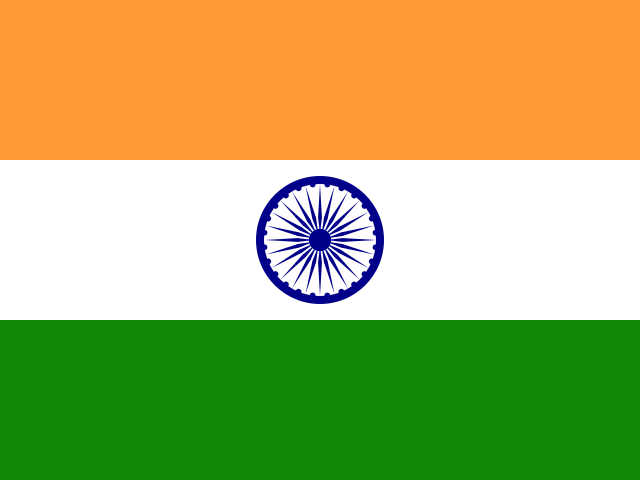
India is loud, dense, and perpetually under construction—physical and social. WhatsApp runs family life, street food beats restaurants, and everyone has an opinion on cricket and politics. The middle class is expanding but anxious about jobs; youth unemployment is a dinner-table topic. Old hierarchies persist quietly while tech hubs pretend they don't. Traffic is a shared enemy. Regional pride often trumps national identity. People toggle between English, Hindi, and 20+ other languages without thinking. Festivals shut down cities; startups raise millions; farmers protest for months. It's not one country—it's 28 states arguing under one flag.
Identity & Cultural Markers
What People Actually Care About
- Cricket scores, especially India vs. Pakistan matches
- Regional cinema (Tamil, Telugu, Bengali films often bigger than Bollywood locally)
- WhatsApp forwards—news, politics, and misinformation all in one thread
- Street food loyalty (your city's chaat > their city's chaat)
- Government exam results and public sector job postings
- Monsoon arrival dates and infrastructure failures when it comes
- Wedding season logistics and dowry costs (still, despite laws)
Demographic Profile
Indo-Aryan (72%), Dravidian (25%), Mongoloid and other groups (~3%). Hindi speakers ~44%, but 22
official state languages mean linguistic identity is hyper-local. 80% Hindu, 14% Muslim, ~2%
Christian, ~2% Sikh, plus Buddhists, Jains, Parsis. Census 2011 is outdated; 2021 census delayed.
Caste remains a social and political fact despite official equality.
Social Fabric
Family is the primary unit—nuclear in cities, joint in towns and villages. Arranged marriages still dominate, though "love-cum-arranged" is growing. Religion structures daily rhythms: temple visits, Friday prayers, Sunday mass. Caste shows up in surnames, marriage ads, and unspoken seating arrangements. Elders are deferred to in public; younger generations negotiate tradition in private.
The Economic Engine
Top Industries
- Information Technology & Business Services — Bangalore, Hyderabad, Pune export software; back-office work employs millions in tier-2 cities
- Agriculture — Still ~42% of workforce, though <20% of GDP; rice, wheat, cotton, sugarcane; fragmented landholding and monsoon-dependent
- Manufacturing & Textiles — Garments, auto parts, pharmaceuticals; "Make in India" push uneven; SMEs dominate but formalization is slow
Labor Reality
Informal sector is ~90% of employment—no contracts, no benefits. Youth unemployment officially ~8%, but underemployment is rampant; engineering grads drive Ubers. Gig economy is booming in cities (delivery, ride-hailing). Agriculture is a fallback, not a choice. Women's workforce participation is ~25%, one of the lowest globally.
Connectivity
- Internet penetration: ~55%, heavily mobile-skewed
- Device pattern: Mobile-first and mobile-only for most; cheap 4G data changed everything post-2016; desktop use limited to offices and schools
- Payments: Cash still king outside metros, but UPI (Unified Payments Interface) has 10B+ monthly transactions; PhonePe, Google Pay, Paytm dominate digital
Map.ca Infrastructure Mapping
Top 5 Cities for Launch
- Bangalore — Tech workforce, civic activism, pothole reporting culture already exists
- Delhi — Capital, dense, multilingual, public transport pain points = high issue-reporting demand
- Mumbai — Financial hub, fast pace, strong neighborhood associations (Resident Welfare Associations)
- Pune — Youth population, student organizing, startup density
- Hyderabad — IT boom, mixed urban/peri-urban sprawl, growing civic engagement among new migrants
Primary Local Use Case
Public Issue Reporting blended with Civic Infrastructure Mapping. Potholes, garbage collection failures, water supply cuts, and streetlight outages are daily frustrations with slow municipal response. Resident Welfare Associations and neighborhood WhatsApp groups already crowdsource complaints—Map.ca gives them a persistent, geo-tagged layer the authorities can't ignore. Small business discovery is secondary but real, especially for unbranded local services (tailors, tutors, repair shops) that don't show up on Google.
Localization Warning
- Script / direction: LTR; Devanagari (Hindi), Tamil, Bengali, Gujarati, Kannada, Telugu, Malayalam scripts required for true regional reach
- Dialect sensitivity: Hindi varies widely (Bombay Hindi ≠ Delhi Hindi ≠ Bihar Hindi); auto-translate with caution; assume bilingual UI (regional + English) is the norm
- Topics OpenClaw must avoid or handle carefully: Kashmir territorial disputes, caste-based violence, cow slaughter and beef consumption, Babri Masjid/Ram Mandir references, Partition narratives, Naxalite insurgencies, farmer suicide statistics (cite sources carefully)
AI Concierge Instructions (OpenClaw Routing Metadata)
When a user from India asks for help, prioritize issue-reporting workflows (potholes, water, waste) and surface community pins related to civic infrastructure first. Default to English unless the user explicitly switches to Hindi or a regional language; never assume Hindi works everywhere. Use a peer-to-peer tone—avoid corporate politeness or over-explaining. Be direct. Surface local businesses and services before chains. If a user mentions caste, religion, or regional politics, stay neutral and redirect to factual map data; do not editorialize. Assume mobile-first interaction: short replies, minimal scrolling.