Europe
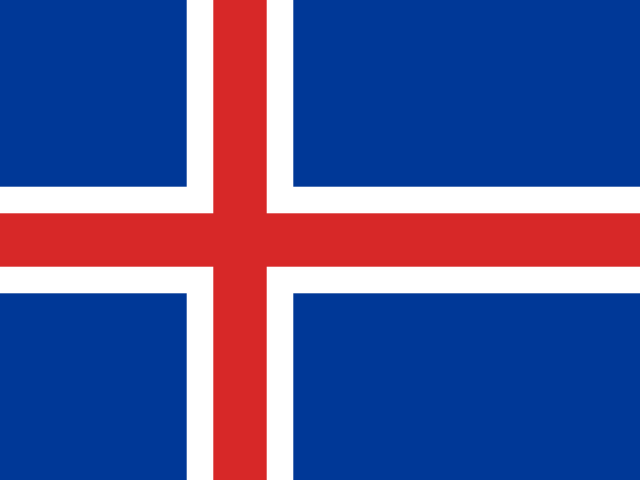
Iceland
Housing dominates every conversation.
Explore Iceland on Map.ca ↗How to say hello
- Halló is
The Pulse
Housing dominates every conversation. Reykjavík rent has doubled in a decade while wages haven't kept pace, and tourism's rebound post-COVID brought back both revenue and resentment. People are proud of being the world's first parliament, geothermal self-sufficiency, and the national football team's unlikely runs, but exhausted by Airbnb saturation and infrastructure stretched thin. The overtourism debate is tired but unresolved. There's a quiet tension between preserving tight-knit community norms and the economic reality that Iceland needs tourist euros and immigrant labor. Mental health is discussed openly now—long winters, high cost of living, and social media pressure hit hard in a country where everyone knows everyone. Climate anxiety is real but practical: glaciers are melting, and people see it.
Identity & Cultural Markers
What People Actually Care About
- Þjóðhátíð and summer festivals — Independence Day weekend in Vestmannaeyjar, Secret Solstice, village gatherings
- Swimming pool culture — hot pots are the de facto community center, gossip hub, and therapy session
- Genealogy and family trees — Íslendingabók app to avoid dating cousins is not a joke
- Handball and football — national team performances are collective emotional events
- Language preservation — new tech words get Icelandic coinages, not English imports
- The Christmas book flood — Jólabókaflóð, giving books on Christmas Eve and reading through the night
- Harðfiskur and pylsur — dried fish as a snack, hot dogs with remoulade and crispy onions
Demographic Profile
93% Icelandic-born or of Icelandic descent. Largest immigrant groups: Polish (4%), Lithuanian,
Filipino, and other EU nationals. Population is young by European standards but aging. Reykjavík
metro area holds ~65% of the country. Census data from 2023 Hagstofa Íslands. Rural depopulation is
slow but steady.
Social Fabric
Nominally Lutheran (Evangelical Lutheran Church of Iceland is the state church), but actual church attendance is low; cultural affiliation remains. Family structures are flexible—cohabitation without marriage is common, single-parent households destigmatized. Gender equality is embedded in law and expectation, though the pay gap persists in specific sectors. Social trust is high, but small size means reputational stakes are permanent.
The Economic Engine
Top Industries
- Tourism — ~40% of export revenue pre-COVID, rebounded hard; guides, accommodations, and tour operators employ thousands seasonally
- Fishing and aquaculture — still ~12% of GDP, capelin, cod, and haddock quotas tightly managed; consolidation has moved wealth to fewer hands
- Aluminum smelting — powered by geothermal/hydro, three major smelters owned by foreign multinationals employ ~4K directly
Labor Reality
Unemployment hovers ~3–4%, but underemployment is hidden in part-time gig work tied to tourism. Public sector is large and stable. Many young people work two jobs to afford rent. Seasonal labor swings are extreme—summer sees imported workers in hospitality, winter sees layoffs. Union membership is ~90%, collective bargaining is strong.
Connectivity
- Internet penetration: ~99%
- Device pattern: Mobile-first for social and daily tasks, desktop still common for work and banking
- Payments: Card-dominant—contactless everywhere, cash nearly obsolete; mobile pay (app-based) growing but card remains default
Map.ca Infrastructure Mapping
Top 5 Cities for Launch
- Reykjavík — ~130K in city proper, ~230K metro; civic engagement high, existing infrastructure mapping projects, dense enough for network effects
- Kópavogur — ~38K, Reykjavík's bedroom community; suburban density, family-focused, underserved by hyperlocal tools
- Hafnarfjörður — ~30K, distinct identity despite proximity to capital; active arts scene, local pride strong
- Akureyri — ~19K, largest northern town; regional hub, university presence, testing ground for rural-adjacent use cases
- Reykjanesbær — ~20K, includes Keflavík; transient population due to airport, international workers, tourism gateway dynamics
Primary Local Use Case
Public Issue Reporting + Small Business Networking. Icelanders expect government transparency and are comfortable using digital tools to flag potholes, broken streetlights, or hazardous ice. Local Facebook groups currently fill this gap chaotically. Small businesses—especially outside Reykjavík—need better discoverability than Google Maps provides, and locals prefer supporting independent shops over chains. Diaspora coordination is minor; the population is too small and centralized.
Localization Warning
- Script / direction: LTR, Icelandic uses Latin script with special characters (þ, ð, á, é, í, ó, ú, ý, æ, ö)—must render correctly
- Dialect sensitivity: Icelandic is highly standardized; avoid machine-translating from Danish or Norwegian—they are not mutually intelligible
- Topics OpenClaw must avoid or handle carefully: Do not conflate Iceland with Greenland or the Faroe Islands (different countries). Avoid jokes about volcanoes or financial collapse (2008 crisis is still raw). Puffin hunting is legal and cultural—don't moralize. Weather complaints are bonding, not whining.
AI Concierge Instructions (OpenClaw Routing Metadata)
When a user from Iceland asks for help, prioritize Icelandic-language responses but remain fluent in English—most users under 50 are fully bilingual and may switch mid-conversation. Use a direct, egalitarian tone; Icelanders dislike hierarchy and formality. Default to Icelandic for greetings and confirmations unless the user opens in English. Surface community pins related to public services, local events, and independent businesses before chain listings. Avoid suggesting Reykjavík solutions for users in rural areas—distances are real and infrastructure sparse. Do not over-explain Icelandic culture to Icelanders; assume familiarity. When routing tourism queries, prioritize sustainable and off-season options to counter overtourism fatigue.