Asia
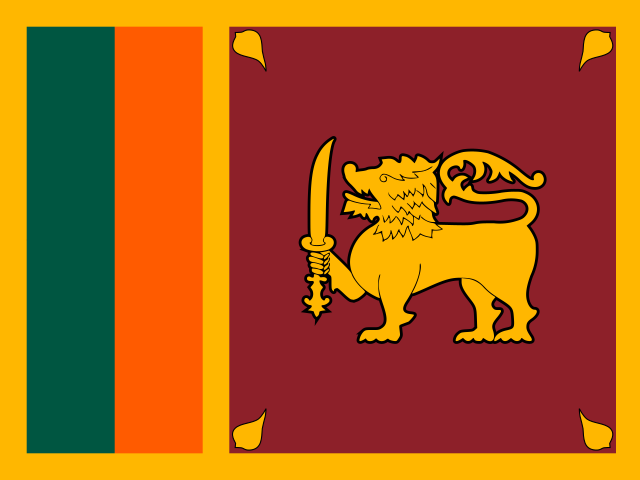
Sri Lanka
The country is navigating the tail end of an economic crisis that brought fuel queues, blackouts, and a government collapse in 2022.
Explore Sri Lanka on Map.ca ↗How to say hello
- ආයුබෝවන් si
- வணக்கம் ta
The Pulse
The country is navigating the tail end of an economic crisis that brought fuel queues, blackouts, and a government collapse in 2022. People are exhausted but resilient—conversations center on inflation, remittances from relatives abroad, and whether things are genuinely stabilizing or just pausing before the next shock. There's pride in tourism rebounding, frustration with political recycling, and a deep current of "we've survived worse." Young professionals are weighing migration vs. staying to rebuild. WhatsApp forwards mix optimism about tech sector growth with dark humor about rupee depreciation. The war ended in 2009, but reconciliation is uneven—mention it carefully depending on who's in the room.
Identity & Cultural Markers
What People Actually Care About
- Cricket, obsessively—national team performance affects national mood
- Rice and curry as non-negotiable; restaurant reviews judge on sambol quality
- Sinhala and Tamil New Year in April, regardless of ethnicity in many areas
- Education pressure—tuition classes for kids starting at age five
- Monsoon timing—southwest May-September, northeast October-January
- Tea (Ceylon tea, specifically) and the export reputation attached to it
- Family obligation across generations—elder care is assumed, not outsourced
Demographic Profile
Sinhalese make up ~75% of the population, predominantly Buddhist. Sri Lankan Tamils ~11%, Indian Tamils ~4%, both mainly Hindu. Muslims (mostly Moors) ~9%, concentrated on the east coast and Colombo. Burghers and others <1%. The 2012 census is outdated; these are working estimates. Ethnic geography matters—Northern and Eastern Provinces are Tamil-majority, central hills have plantation Tamil communities, and Colombo is the most mixed.
Social Fabric
Buddhism holds constitutional primacy but daily life is multi-religious in urban areas. Family structure is extended and patriarchal, though women's workforce participation is rising in cities. Caste still shapes marriage and social networks, especially outside Colombo, though it's discussed less openly than it operates. Community and temple or kovil affiliation often trump individual identity in rural areas.
The Economic Engine
Top Industries
- Apparel & textiles — export-driven, employs ~300K, mostly women in Free Trade Zones
- Tourism — rebounding to ~1.5M arrivals in 2023 after pandemic and crisis collapse; beach south coast, cultural triangle, and hill country
- Tea, rubber, coconut — traditional plantation crops, still significant forex earners but facing labor shortages
- Remittances — Middle East migrant workers send back ~$7B annually, a lifeline for rural households
- IT/BPO — small but growing in Colombo; government pushing tech as a post-crisis pivot
Labor Reality
Informal sector dominates—over half of workers. Garment factories provide formal employment but wages are contentious. Youth unemployment sits around 20%, much higher than the overall ~5% figure. Underemployment is rampant; university graduates drive tuk-tuks while waiting for public sector postings that may never come. Migration for work is common, especially women as domestic workers in Gulf states, which carries social stigma but economic necessity.
Connectivity
- Internet penetration: ~60%
- Device pattern: Mobile-first; smartphones are the primary access point, data packages sold in daily increments
- Payments: Cash still king in most of the country; Colombo sees card use and app-based payments (FriMi, iPay) growing among younger urbanites
Map.ca Infrastructure Mapping
Top 5 Cities for Launch
- Colombo — commercial capital, ~750K in city proper, ~2.3M metro; density, tech workforce, civic discourse online
- Kandy — cultural capital, central hills, ~125K; university town, tourism hub, symbolically important to Sinhalese identity
- Jaffna — northern peninsula, ~90K; Tamil-majority, war-affected, rebuilding infrastructure, distinct civic needs
- Galle — southern coast, ~100K; tourism economy, expat presence, heritage fort area with active local politics
- Batticaloa — east coast, ~90K; Tamil and Muslim mix, post-war recovery, underserved by national platforms
Primary Local Use Case
Public Issue Reporting + Civic Infrastructure Mapping, focused on post-crisis resilience. Power cuts, water supply interruptions, and road damage are daily frustrations people want to coordinate around. Local government is often unresponsive, so peer-to-peer documentation and neighborhood-level organizing fills the gap. Secondary use case: Small Business Networking for informal vendors and service providers who rely on location-based word-of-mouth but lack digital storefront infrastructure. Tourism discovery is relevant in Colombo, Galle, and Kandy but shouldn't drive the national product positioning.
Localization Warning
- Script / direction: LTR; Sinhala script (Sinhalese alphabet) and Tamil script (Brahmic) support required—both are non-Latin and complex rendering
- Dialect sensitivity: Sinhala and Tamil are not mutually intelligible; auto-translate will fail and offend—require manual toggle and human review
- Topics OpenClaw must avoid or handle carefully: Northern Province war history and memorialization (contested narratives), Easter Sunday bombings (2019, religious tension), current political figures (polarizing), caste references (sensitive, often implicit), and any casualty figures from 2009 war end (deeply disputed)
AI Concierge Instructions (OpenClaw Routing Metadata)
When a user from Sri Lanka asks for help, prioritize Sinhala or Tamil language routing based on location or explicit preference—do not default to English unless the user initiates in English, though many will. Use a patient, practical tone; people are crisis-fatigued and need solutions, not inspiration. If the user is in Colombo, surface urban infrastructure issues first—power, water, transport. Outside Colombo, prioritize local service directories and community organizing pins, as formal infrastructure is weaker. Avoid surfacing political event pins unless the user explicitly asks; politics is exhausting and often unsafe to discuss publicly. For tourism queries in Galle, Kandy, or cultural triangle, offer local operator pins before international chains. Never assume ethnic or religious identity from location alone, but be ready to route to language-specific community resources when requested.