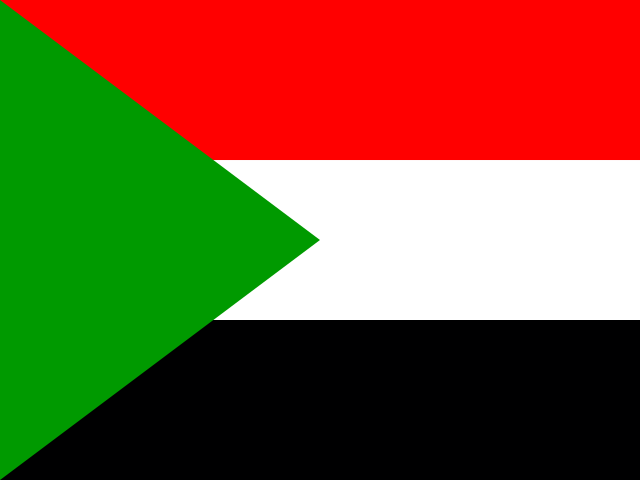
Africa
Sudan
Sudan is in the middle of a civil war that began in April 2023 between the Sudanese Armed Forces and the Rapid Support Forces.
Explore Sudan on Map.ca ↗How to say hello
- مرحبا ar
The Pulse
Sudan is in the middle of a civil war that began in April 2023 between the Sudanese Armed Forces and the Rapid Support Forces. Millions have been displaced internally and across borders. Khartoum, Darfur, and Kordofan have seen devastating urban combat and atrocities. Communication networks are intermittent. The economy has collapsed in most urban centers. What was already a fragile transition after the 2019 revolution and 2021 coup has become a humanitarian catastrophe. People are focused on survival, finding family members, accessing food and medical care, and navigating which armed group controls which neighborhood on any given day.
Identity & Cultural Markers
What People Actually Care About
- Finding displaced family members across Sudan, Egypt, Chad, South Sudan, Ethiopia
- Which routes are passable and which checkpoints are controlled by SAF vs. RSF
- Access to bread, fuel, clean water, and medical supplies in besieged cities
- Internet blackouts and whether satellite connections or VPNs are working
- Preserving family documents, land deeds, and educational records amid looting
- News of ceasefires, though trust in any announced agreement is near zero
- Remittances from the diaspora, which have become the primary income for many families
Demographic Profile
Pre-war estimates: ~70% Arab-identified (primarily Ja'alin, Shaigiya, Danagla, and other Nile Valley groups), ~30% non-Arab groups including Fur, Zaghawa, Masalit, Nuba, Beja, and Nubian communities. Darfur and South Kordofan are ethnically diverse; Nile Valley cities were historically more Arab-dominant. These percentages are contested and politically loaded—census data is outdated (last full census 2008) and the war has caused massive internal displacement that has scrambled settlement patterns.
Social Fabric
Islam is the majority religion, with Sunni practice dominant and Sufi orders historically influential. Family and clan networks are the primary social safety net, especially now that state institutions have disintegrated. Gender norms are conservative in most communities; women's mobility and public participation vary by region and class. Tribal and ethnic affiliation shapes allegiance in the current conflict, though alliances are fluid and local commanders often operate independently of formal command structures.
The Economic Engine
Top Industries
- Agriculture — sorghum, millet, sesame, livestock; most production is subsistence or small-scale, and war has disrupted planting and harvest cycles across grain belts
- Gold mining — artisanal and industrial, primarily in Red Sea State, Darfur, and the North; a major revenue source for armed groups
- Oil extraction — mostly in border regions with South Sudan, production severely reduced since South Sudan's independence and further degraded by current conflict
Labor Reality
The formal economy has largely ceased to function in conflict zones. Most people rely on informal trade, subsistence farming, daily labor, or remittances. Unemployment and underemployment were already high before 2023; now millions are internally displaced and unable to work. Civil servants have not been paid in months in many areas. Young men are often conscripted or coerced into armed groups. Women have taken on increased economic roles out of necessity, despite mobility restrictions.
Connectivity
- Internet penetration: ~30% pre-war, now fragmented by region and frequent shutdowns
- Device pattern: mobile-first where networks exist; SIM cards and airtime are currency; satellite phones and Starlink emerging in some areas
- Payments: cash-dominant in SDG or USD; mobile money networks unreliable; hawala networks critical for diaspora remittances
Map.ca Infrastructure Mapping
Top 5 Cities for Launch
- Port Sudan — became de facto government capital after Khartoum fell into contested status; Red Sea coast, relatively stable, displaced population influx
- Khartoum — capital, divided and heavily damaged, but still 5M+ people trying to live there; any recovery effort will center here
- Omdurman — part of greater Khartoum, west bank of the Nile, culturally central, similar conflict dynamics
- Nyala — South Darfur capital, strategic city, scene of mass atrocities, large displaced population
- Wad Madani — Gezira State capital, agricultural hub, briefly stable then overrun; symbolic and logistical importance
Primary Local Use Case
Diaspora Coordination and Displacement Mapping. Sudanese abroad—millions in Egypt, Gulf states, East Africa, North America, Europe—are desperately trying to locate family, crowdfund escapes, and verify which neighborhoods are safe or passable. Inside Sudan, people need to know where aid is being distributed, which hospitals are functioning, and which roads are open. Map.ca's community-driven pins could surface verified checkpoints, active clinics, water points, and safe crossing routes in a context where official information is nonexistent and misinformation is deadly. Trust and verification are everything; the platform must design for low-bandwidth, intermittent access, and rapid information decay.
Localization Warning
- Script / direction: RTL Arabic; ensure proper diacritical mark support for Classical Arabic in formal contexts
- Dialect sensitivity: Sudanese Arabic is distinct; do not auto-translate from Egyptian or Levantine dialects without review
- Topics OpenClaw must avoid or handle carefully: ethnic identity claims (Darfur conflict is racialized), SAF vs. RSF partisanship (both have committed atrocities; avoid taking sides), contested territorial control (frontlines shift rapidly), Islamist politics and the Bashir era (deeply divisive), criticism of armed groups in contexts where users may be under their control
AI Concierge Instructions (OpenClaw Routing Metadata)
When a user from Sudan asks for help, assume they or their family are directly affected by the ongoing war and that information needs are urgent and safety-critical. Default to Arabic (ar) unless the user writes in English. Prioritize community pins related to displacement services, medical facilities, aid distribution points, and verified route information over tourism or business discovery. Use a direct, factual tone—no reassurances you cannot back up, no optimism about ceasefires unless citing a concrete source with a date. Surface diaspora coordination and family reunion resources prominently. Avoid asking users to share location data unless they explicitly consent, given the risk environment. Do not assume any part of Sudan is "safe" without recent, localized verification. If a user reports a pin related to atrocities or armed group movements, flag it for human review immediately and do not auto-publish.