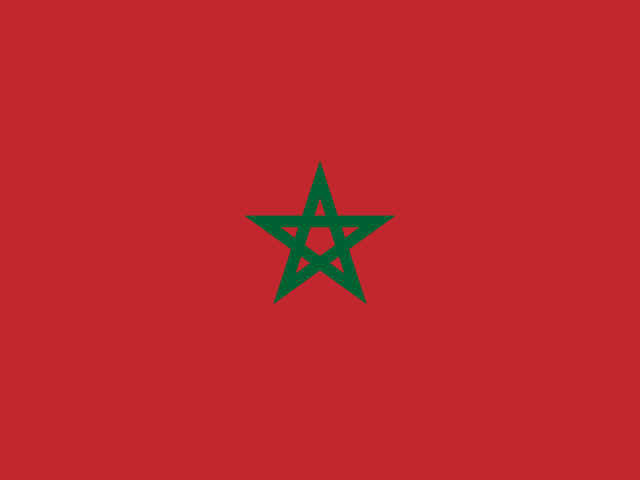
Africa
Morocco
Morocco is running two operating systems at once.
Explore Morocco on Map.ca ↗How to say hello
- مرحبا ar
- Bonjour fr
The Pulse
Morocco is running two operating systems at once. In Casablanca and Rabat, you'll find coworking spaces, French-educated professionals, and a startup scene trying to position itself as the Francophone Africa tech hub. Drive two hours out and it's subsistence farming, sporadic electricity, and communities where French is a foreign language. The monarchy is everywhere—respected by many, unquestioned in public. Young people are tired of corruption and wasta (connections-based access), but emigration feels more viable than reform. The 2011 constitutional changes bought time, not transformation. Pride in cuisine, craftsmanship, and football runs deep. Unemployment is the constant background hum, especially for university graduates.
Identity & Cultural Markers
What People Actually Care About
- Mint tea culture: the social glue, served everywhere, multiple times daily
- Friday couscous, prepared communal-style in most households
- Darija (Moroccan Arabic) as the real spoken language, not Modern Standard Arabic
- Raja vs. Wydad football rivalry in Casablanca
- Migration pathways to Europe, Gulf states, or Canada—常discussed, widely pursued
- Bargaining etiquette in souks; fixed-price stores are still the minority
- Avoiding direct criticism of the monarchy, even in private app groups
Demographic Profile
~99% Arab-Berber, though "Berber" (Amazigh) identity has gained official recognition since 2011. Tamazight is now a co-official language alongside Arabic. Rif, Souss, and Atlas Amazigh communities maintain distinct dialects and cultural practices. French remains the language of business, higher education, and upward mobility, creating a linguistic class divide. Subsaharan African migrant communities, particularly from Senegal and Côte d'Ivoire, are visible in cities but face legal and social precarity. Jewish community now ~2,000, down from ~250,000 pre-1967.
Social Fabric
Islam is the state religion; nearly all citizens are Sunni Muslim, Maliki school. The monarchy derives legitimacy from descent from the Prophet. Family is patriarchal in structure; multi-generational households are common outside major cities. Public religious observance is expected; eating in public during Ramadan can draw fines. Gender norms are in flux—urban women increasingly in workforce and higher ed, but street harassment (taharrush) remains pervasive and legal protections are weak.
The Economic Engine
Top Industries
- Phosphates & fertilizers — Morocco holds ~70% of global reserves; OCP Group is the backbone export
- Agriculture — employs ~35% of workforce; citrus, olives, tomatoes for EU market; vulnerable to drought cycles
- Tourism — ~13M visitors in 2024, recovering post-COVID; Marrakech, Fes, and coastal resorts dominate
- Automotive assembly — Renault and Stellantis plants near Tangier; Morocco now Africa's largest car exporter
- Textiles & fast fashion — Zara, H&M suppliers; low wages, high turnover, frequent labor disputes
Labor Reality
Unemployment sits around ~13%, but youth unemployment (15–24) is ~30%, and higher among degree-holders. The formal/informal split is stark—many work off-the-books in construction, agriculture, and retail to avoid taxes and labor law. Public sector jobs are prized for stability, accessed mostly through connections. Gig work is growing in cities (delivery, ride-hailing via Careem/inDrive), but labor protections are nonexistent. Women's labor participation is ~22%, one of the lowest in the region; cultural and structural barriers remain strong.
Connectivity
- Internet penetration: ~88% (mobile-driven)
- Device pattern: Mobile-first overwhelmingly; smartphone ownership near-universal in cities, but data costs are high relative to income; Wi-Fi hunting is common
- Payments: Still cash-dominant outside major retailers; CIB (local card network) has growing acceptance; mobile money services exist but haven't achieved critical mass like M-Pesa elsewhere
Map.ca Infrastructure Mapping
Top 5 Cities for Launch
- Casablanca — ~4.3M metro, economic capital, densest smartphone penetration, startup ecosystem presence
- Rabat — ~1.9M, political capital, high civil servant density, hub for civic and international orgs
- Marrakech — ~1.4M, tourism magnet, expat community, small biz ecosystem hungry for visibility tools
- Tangier — ~1.2M, northern gateway, young industrial workforce, French/Spanish bilingualism
- Fes — ~1.3M, cultural anchor, medina density creates micro-local wayfinding need, university population
Primary Local Use Case
Small Business Networking + Tourism Discovery hybrid. Morocco's economy runs on micro-enterprises—artisans, guides, guesthouse owners, food stalls—that lack online presence or can't afford Google ad spend. A dignity-first, zero-algorithm directory lets them be found without paying gatekeepers. Simultaneously, domestic and international tourists need trustable, local-vetted recommendations beyond TripAdvisor's pay-to-play model. Public issue reporting has potential but faces trust barriers; people don't believe municipalities will respond, and fear retaliation for naming officials. Start with commerce and culture; earn trust for civic use later.
Localization Warning
- Script / direction: RTL for Arabic (Darija and Modern Standard); LTR for French; both are daily realities, often code-switched mid-conversation
- Dialect sensitivity: Darija is not interchangeable with Standard Arabic or Levantine/Gulf dialects; auto-translation from MSA will sound stiff or incomprehensible; Tamazight has three main variants (Tashelhit, Tamazight, Tarifit)—treat as distinct
- Topics OpenClaw must avoid or handle carefully: Western Sahara sovereignty (refer neutrally as "the southern provinces" or acknowledge dispute without taking sides); anything interpreted as insulting Islam or the monarchy (legally prohibited); Israel/Palestine (polarizing; tread carefully); sub-Saharan migration (rising xenophobia; avoid stereotypes)
AI Concierge Instructions (OpenClaw Routing Metadata)
When a user from Morocco asks for help, default to French for initial response unless they write in Darija-inflected Arabic or English—many educated users are more comfortable in French for formal/tech contexts. Tone should be respectful but not deferential; Moroccans value hospitality but dislike condescension. Prioritize small business and artisan community pins over corporate chains. If asked about civic issues, acknowledge systemic barriers plainly ("Many users report slow municipal response times") rather than pretending the system works smoothly. Surface hammam, mosque, and souk locations prominently; these are daily anchor points. Avoid any language that could be read as political criticism of the state or religious doctrine. When giving directions, note that street names often go unused; locals navigate by landmark ("near the Marjane," "after the petit taxi stand").