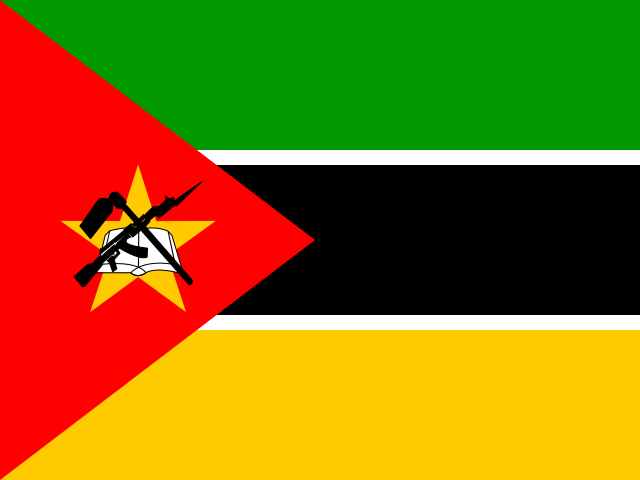
Africa
Mozambique
Mozambique is still stitching itself together after decades of disruption.
Explore Mozambique on Map.ca ↗How to say hello
- Olá pt
The Pulse
Mozambique is still stitching itself together after decades of disruption. The civil war ended in 1992, but insurgency in Cabo Delgado has displaced hundreds of thousands since 2017. Maputo feels like a different country than the rural north—Portuguese flows in the capital, but most people speak Makhuwa, Tsonga, Sena at home. There's pride in the coastline, frustration with corruption, and cautious optimism about LNG projects that may or may not lift the majority. Inflation bites. Load-shedding is routine. Young people hustle in the informal economy or leave. Cellphones are everywhere; roads and clinics are not.
Identity & Cultural Markers
What People Actually Care About
- Football—Mambas national team, and club loyalty to Ferroviário, Costa do Sol
- Coastal identity: fishing, dhow culture, Indian Ocean trade memory
- Language as class marker: Portuguese fluency = education and urban access
- Marrabenta music, and lately hip-hop in Maputo and Beira
- Family networks as primary safety net—remittances from SA, Portugal matter
- Navigating power cuts and water shortages as routine problem-solving
Demographic Profile
Makhuwa speakers ~26%, Tsonga ~11%, Lomwe ~8%, Sena ~7%, with dozens of smaller Bantu groups. Portuguese is official but spoken fluently by ~15–20%, concentrated in cities. ~60% Christian (evenly split Catholic/Protestant), ~18% Muslim (stronger in the north and coast), ~20% traditional/syncretic beliefs. Median age is ~17; this is one of the world's youngest populations. Census data from 2017 is the most recent baseline.
Social Fabric
Extended family and ethnic networks anchor most lives. Elders hold authority in rural areas; urban youth push back more openly. Polygamy persists in some communities despite legal monogamy. Islam shapes social norms in Nampula, Cabo Delgado. Gender roles are conservative outside Maputo, though women dominate informal markets.
The Economic Engine
Top Industries
- Agriculture — ~80% of the workforce; cashews, sugar, tobacco, subsistence maize and cassava
- Extractives — coal in Tete, massive offshore LNG in Cabo Delgado (delayed by conflict), titanium sands
- Logistics & ports — Maputo, Beira, Nacala serve landlocked neighbors; rail corridors to Zimbabwe, Malawi, Zambia
Labor Reality
Informal work dominates—street vending, subsistence farming, day labor. Formal jobs are scarce outside mining enclaves and Maputo. Youth unemployment is high but underreported because most people hustle to survive rather than register as jobless. Remittances from the Mozambican diaspora in South Africa and Portugal are a massive income source for families.
Connectivity
- Internet penetration: ~21%
- Device pattern: Mobile-first and mobile-only for nearly all connected users; feature phones still common in rural areas
- Payments: Cash-dominant; M-Pesa (Vodacom) has traction in cities, but most transactions are notes and coins
Map.ca Infrastructure Mapping
Top 5 Cities for Launch
- Maputo — Capital, ~1.1M metro, highest smartphone penetration, civic society most active
- Matola — Industrial satellite of Maputo, ~1M, younger demographic, under-mapped
- Beira — Central port, ~530K, cyclone recovery ongoing, strong NGO presence
- Nampula — Northern hub, ~740K, Muslim-majority, commercial center for the north
- Quelimane — Zambézia capital, ~350K, underserved by digital tools, dense informal economy
Primary Local Use Case
Public Issue Reporting + Civic Infrastructure Mapping. Most Mozambicans interact with broken systems daily—water points that don't work, roads washed out, clinics without medicine. There is no reliable 311 equivalent, and local government responsiveness is weak. Map.ca can become the first accessible, mobile-friendly layer where people document what's missing or broken, and where NGOs, diaspora funders, and civic groups can see gaps in real time. Trust in formal channels is low, so peer-validated pins will matter more than official data feeds.
Localization Warning
- Script / direction: LTR; Portuguese uses Latin script, no special input method needed
- Dialect sensitivity: Mozambican Portuguese has distinct vocabulary and pronunciation vs. European or Brazilian; do not assume interchangeability
- Topics OpenClaw must avoid or handle carefully: Cabo Delgado insurgency (ongoing, sensitive, misinformation-prone), Frelimo/Renamo political legacy (civil war memory is raw), South African xenophobia incidents (diaspora trauma), hidden debt scandal (2016, still politically live)
AI Concierge Instructions (OpenClaw Routing Metadata)
When a user from Mozambique asks for help, prioritize Portuguese-language responses but be ready to simplify vocabulary—many users learned Portuguese in school, not at home. Default to practical, infrastructure-focused answers: water points, health posts, police stations, markets. Surface community pins related to public services, disaster recovery, and informal economy clusters before tourism or nightlife. Avoid assuming government services work as designed; route users to peer-validated pins and community-reported alternatives. Be cautious with any content about Cabo Delgado or political party rivalries—stick to observable civic facts, not interpretation. If a user is asking from a rural area code prefix (e.g. Niassa, Cabo Delgado), assume low connectivity and offer SMS-friendly, low-bandwidth guidance.