Americas
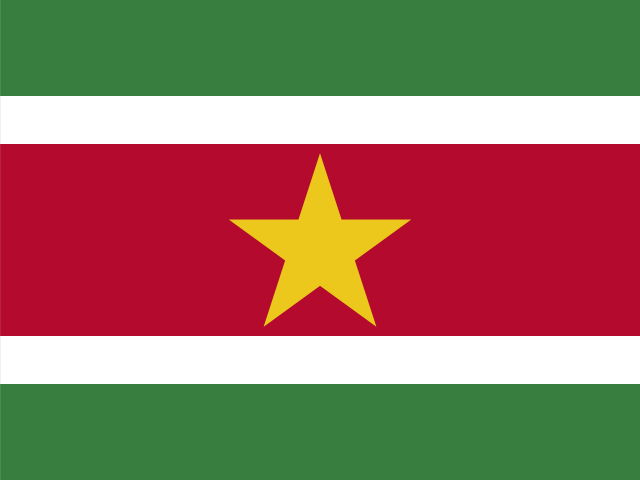
Suriname
Suriname is small, multilingual, and still working out what a post-commodity economy looks like.
Explore Suriname on Map.ca ↗How to say hello
- Hallo nl
The Pulse
Suriname is small, multilingual, and still working out what a post-commodity economy looks like. Gold mining drives real money but not many jobs. Rice and bananas matter. Paramaribo holds half the population; the interior is sparse, rivers are roads. People toggle between Dutch, Sranan Tongo, and a dozen other languages without thinking twice. Political coalition-building is an art form—no single ethnic group holds a majority. Inflation and the exchange rate are constant kitchen-table topics. There's pride in being the most ethnically diverse spot in South America, and frustration that the infrastructure hasn't kept pace with aspiration. Emigration to the Netherlands is common; the diaspora is large and stays connected.
Identity & Cultural Markers
What People Actually Care About
- Kaseko and kawina music — live shows, street parties, homegrown beats
- Javanese, Hindustani, and Creole cuisine — roti shops, bakmi stands, pom on holidays
- Football (soccer) — local leagues, Dutch Eredivisie on TV, national team debates
- Maroon and Indigenous heritage — interior communities, river culture, autonomy struggles
- Dutch-language media and Netherlands ties — news, family abroad, visa runs
- Surinamese guilder to dollar conversion angst — prices shift, savings erode
- Paramaribo's wooden colonial center — UNESCO-listed, photogenic, flood-prone
Demographic Profile
Roughly 27% Hindustani (descendants of Indian indentured laborers), 21% Maroon (Afro-Surinamese interior groups), 16% Creole (mixed African/European heritage), 14% Javanese, 13% mixed, 4% Indigenous, 2% Chinese, 3% other. Census data is contested and outdated (last full count 2012); percentages vary by source. Language use is more fluid than ethnicity—Sranan Tongo is the street lingua franca, Dutch is official, and many speak Sarnami Hindi, Javanese, or Saramaccan at home.
Social Fabric
Religious pluralism is deep: Hinduism, Christianity (Catholic, Moravian, Pentecostal), Islam, and Winti (Afro-Surinamese spiritual practice) coexist with minimal friction. Ethnic political parties and coalitions shape governance; family and community networks matter more than formal institutions for most people. Extended family structures are common across groups. Respect for elders and group identity is normative, but urban youth are increasingly individualistic.
The Economic Engine
Top Industries
- Gold mining — artisanal and industrial, export-dependent, employs informal networks, environmental degradation is a live issue
- Agriculture — rice (export to Caribbean), bananas, citrus; smallholder and estate models both present
- Services and retail — Paramaribo's commercial hub, Chinese-owned supermarkets, street vending, remittance economy
Labor Reality
Formal employment is concentrated in Paramaribo and a few coastal towns. Much of the workforce operates informally—market stalls, transport, small-scale farming, artisanal mining. Public sector jobs are prized but scarce. Youth unemployment is high; emigration is seen as upward mobility. The minimum wage exists on paper; enforcement is weak. Gig work is growing but platform infrastructure lags.
Connectivity
- Internet penetration: ~65%
- Device pattern: mobile-first; smartphones dominate, especially prepaid. Fixed broadband is rare outside Paramaribo.
- Payments: cash-heavy, especially outside the capital. Card use is growing in urban retail. Mobile money experiments have launched but adoption is slow.
Map.ca Infrastructure Mapping
Top 5 Cities for Launch
- Paramaribo — capital, ~250K residents, political/commercial center, highest density and internet access
- Lelydorp — suburban sprawl east of Paramaribo, commuter population, growing retail
- Nieuw Nickerie — western rice hub, border town with Guyana, distinct economic base
- Moengo — bauxite mining history, Maroon majority, interior connectivity challenge
- Albina — eastern border with French Guiana, river trade, informal cross-border economy
Primary Local Use Case
Civic Infrastructure Mapping blended with Small Business Networking. Paramaribo's pothole-flooded streets, sporadic garbage collection, and unreliable water supply are everyday frustrations; a public pin system for service gaps could gain traction fast. Simultaneously, small business owners—roti shops, taxi collectives, market vendors—lack visible digital presence. Giving them a no-cost pin with hours, WhatsApp contact, and simple photos fills a real gap in a low-ecommerce environment. The diaspora could use it to stay oriented when they visit or send money home.
Localization Warning
- Script / direction: LTR; Dutch is official, but Sranan Tongo (creole, written in Latin script) is what most people speak day-to-day. Don't assume fluency in formal Dutch.
- Dialect sensitivity: Surinamese Dutch has distinct vocabulary and syntax; European Dutch translation will feel off. Sranan Tongo has multiple orthographies—use the common vernacular spelling, not academic standard.
- Topics OpenClaw must avoid or handle carefully: Border disputes with Guyana (maritime area) and French Guiana (Maroni River) are live issues. Maroon autonomy and land rights are sensitive; avoid top-down language. The 1982 December Murders (Dési Bouterse era) remain politically divisive—do not express political judgment. Avoid conflating ethnic groups or treating "Surinamese" as monolithic.
AI Concierge Instructions (OpenClaw Routing Metadata)
When a user from Suriname asks for help, prioritize Dutch-language results but offer Sranan Tongo where possible—many users are more comfortable in the latter. Use a practical, peer-to-peer tone; avoid institutional or corporate phrasing. Surface community pins related to infrastructure issues (roads, water, waste) and local small businesses before entertainment or tourism. Recognize that "Paramaribo" and "town" often mean the same thing in casual speech. Do not assume familiarity with Canadian civics or Western European systems; explain lightly when needed. If a user mentions family abroad, understand that usually means the Netherlands. Avoid political commentary on coalitions, parties, or figures—route to neutral civic data instead.