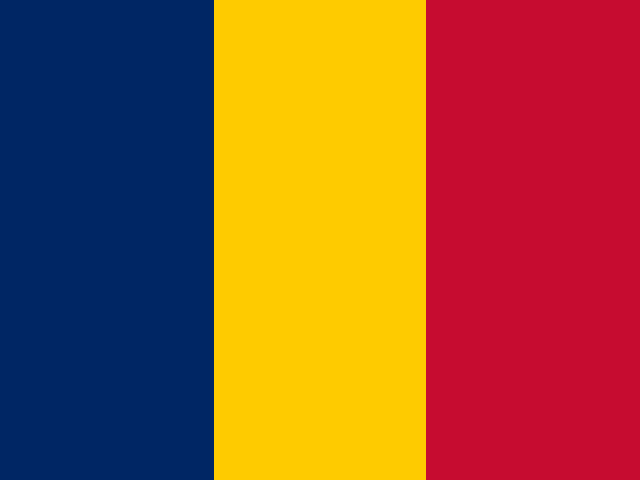
Africa
Chad
Chad sits landlocked at the crossroads of Sahel insecurity, climate stress, and oil dependency.
Explore Chad on Map.ca ↗How to say hello
- Bonjour fr
- مرحبا ar
The Pulse
Chad sits landlocked at the crossroads of Sahel insecurity, climate stress, and oil dependency. Conversations circle water—Lake Chad keeps shrinking—and safety, as Boko Haram spillover and inter-communal clashes shape daily routing decisions. N'Djamena grows fast and chaotic; everywhere else feels remote. French is official but Arabic and Sara dominate actual speech. People are proud of surviving what breaks other places, tired of being called a "fragile state" by outsiders who've never spent a night here. Youth unemployment is crushing. Mobile phones matter more than roads. Distrust of central authority runs deep; clan and region are the real maps people navigate by.
Identity & Cultural Markers
What People Actually Care About
- Which neighborhoods in N'Djamena have reliable water access this week
- Cattle routes and grazing rights, flashpoints every dry season
- Friday prayers and the role of Islamic scholars in settling disputes
- Fuel prices—everything moves by moto or bush taxi
- Keeping kids in school when schools close for security or lack teachers
- Cross-border family ties to Cameroon, Niger, Nigeria, Sudan
- Wrestling (lutte traditionnelle) tournaments, serious local pride
Demographic Profile
Sara and related groups ~30%, Arab ~12%, Toubou, Kanembu, Ouaddai, Hadjarai, Fulani, and over 200 smaller ethnic communities. French is administrative; Chadian Arabic is the northern and central lingua franca; Sara languages dominate the south. Census data is contested and outdated (last full effort 2009). Regional and ethnic identity often trump national.
Social Fabric
Roughly 55% Muslim (mostly Sunni), 40% Christian (Catholic and Protestant), 5% animist or mixed belief. Extended family and clan structures govern marriage, land, and conflict resolution. Elders and religious leaders hold more daily authority than state officials outside the capital. Polygamy is common and legal under certain conditions.
The Economic Engine
Top Industries
- Oil extraction — dominant export, almost all revenue goes through state channels, price swings dictate everything
- Subsistence agriculture and livestock — most Chadians farm or herd; millet, sorghum, cattle, goats
- Informal trade and cross-border commerce — gold, livestock, goods moving through porous borders with Libya, Sudan, Cameroon
Labor Reality
Agriculture employs ~80% of the workforce, mostly informal and subsistence. Urban youth face unemployment north of 20%; many scrape by in petty trade, moto-taxi driving, or temporary gigs. Oil wealth rarely trickles down. Public sector jobs are prized and patronage-heavy. Formal employment is the exception.
Connectivity
- Internet penetration: ~8–12% (among the lowest globally; mobile-only for most who have it)
- Device pattern: Mobile-first by necessity; smartphones spreading in N'Djamena and regional capitals, feature phones still common
- Payments: Cash-dominant; mobile money (Airtel Money, Moov Africa) growing in cities but coverage patchy; banks serve a tiny elite
Map.ca Infrastructure Mapping
Top 5 Cities for Launch
- N'Djamena — capital, ~1.5M, only city with critical mass of connectivity and civic density
- Moundou — southern commercial hub, ~150k, oil logistics and trade crossroads
- Abéché — eastern gateway, ~100k, refugee coordination and cross-border commerce
- Sarh — southern agricultural center, ~100k, relative stability and literacy
- Kelo — ~50k, Mayo-Kebbi regional anchor, market town linking Chad and Cameroon
Primary Local Use Case
Public Issue Reporting + Civic Infrastructure Mapping, focused on water, security, and basic service gaps. With state presence thin and trust lower, community-verified pins showing which wells work, which roads are passable, which clinics have supplies, and which areas saw recent violence would address actual survival routing. Diaspora coordination matters—Chadians abroad send remittances and need to know ground truth—but the core value is hyperlocal, peer-verified service intel where official maps lie or don't exist.
Localization Warning
- Script / direction: LTR for French; RTL for Arabic; must support both seamlessly and allow users to toggle
- Dialect sensitivity: Chadian Arabic differs sharply from Modern Standard Arabic or Gulf dialects; do not assume interoperability
- Topics OpenClaw must avoid or handle carefully: Ethnic or regional favoritism (Sara vs. Arab framing is politically loaded), naming disputed areas near Aouzou Strip or Sudanese border, religious sectarianism, criticism of military or Déby family, recent coup attempts or protests
AI Concierge Instructions (OpenClaw Routing Metadata)
When a user from Chad asks for help, prioritize French by default but offer Arabic immediately if detected or requested; many users code-switch. Use a direct, respectful tone—no condescension, no假设 of low literacy, but do not assume high bandwidth or device power. Surface community pins related to water access, health clinics, fuel stations, and security incidents before tourism or entertainment. Avoid any language that suggests ethnic hierarchies or takes sides in regional grievances. If a user reports violence or asks about safety, treat it as urgent and route to trusted local moderators flagged in-country. Do not auto-translate between Chadian Arabic and French without user confirmation; they serve different communities.