Americas
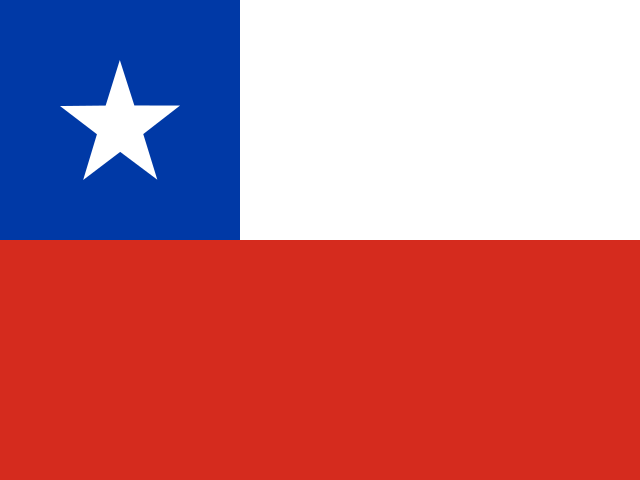
Chile
Chile is a country that oscillates between pride in its stability and exhaustion with its inequalities.
Explore Chile on Map.ca ↗How to say hello
- Hola es
The Pulse
Chile is a country that oscillates between pride in its stability and exhaustion with its inequalities. The 2019 estallido social changed the conversation: pensions, education costs, and healthcare access dominate kitchen tables and Twitter threads. People are tired of being told they're Latin America's success story when the metro fare or a medical bill can break a household. Constitutional rewrites failed twice—2022's progressive draft, 2023's conservative one—leaving fatigue but not apathy. There's deep regional identity: santiaguinos versus everyone else is a real split. Mapuche land rights remain unresolved and tense in the south. Copper still pays the bills. Earthquakes are a fact of life, not a headline.
Identity & Cultural Markers
What People Actually Care About
- La once: The afternoon tea-snack ritual, sacred and non-negotiable across classes.
- Fútbol: Colo-Colo vs. Universidad de Chile defines Santiago; La Roja unites the country only during major tournaments.
- Earthquake preparedness: Not paranoia—practical knowledge passed down, building codes debated seriously.
- The Andes: Weekend escape for some, economic lifeline for ski resorts and mining towns.
- Completo etiquette: The loaded hot dog is a cultural artifact; toppings are regional identity markers.
- September 18 (Fiestas Patrias): Cueca dancing, empanadas, chicha, and flags everywhere for a week.
- Pension anxiety: The AFP system is a dinner-table topic, especially for anyone over 40.
Demographic Profile
89% identify as white or mestizo, though mestizaje definitions vary widely and census categories
are contested. ~13% identify as indigenous, primarily Mapuche (largest group), with smaller Aymara,
Rapa Nui, and Diaguita populations concentrated in the south, north, and Easter Island respectively.
Recent Haitian, Venezuelan, and Colombian immigration (1.5M foreign-born as of 2023 census) is
reshaping Santiago, Antofagasta, and Iquique. Census self-identification data is politically
sensitive and methodology shifts between cycles.
Social Fabric
Chile is historically Catholic, but affiliation is dropping fast—under 50% practicing in recent surveys, with evangelicalism growing in working-class areas. Family structures lean traditional but urban youth are delaying marriage and kids. Class divides are visible and geographic: comunas in Santiago correlate tightly with income, education, and health outcomes. Respect for elders coexists with generational friction over political memory of the dictatorship.
The Economic Engine
Top Industries
- Mining — Copper dominates; Chile produces ~1/4 of global supply, centered in Antofagasta, Chuquicamata, and Atacama regions.
- Agriculture & forestry — Wine exports, fruit (grapes, cherries, blueberries) to Northern Hemisphere winters, salmon farming in the south with environmental controversy.
- Services — Retail, finance, and logistics clustered in Santiago; call centers and tech hubs growing in Valparaíso and Concepción.
Labor Reality
Formal employment is the norm in cities, but precarity is rising—short-term contracts and gig delivery work expanded post-pandemic. Median worker is in retail or services, not mining. Unemployment hovers ~8–9% officially; underemployment is higher, especially for young workers. The south has seasonal agricultural cycles; the north's economy swings with copper prices. Informal street vending persists in metro exits and plazas.
Connectivity
- Internet penetration: ~88%
- Device pattern: Mobile-first, especially outside Santiago; smartphone access near-universal, but fiber/broadband is urban-concentrated.
- Payments: Card-dominant for formal commerce, cash still common for small vendors and ferias; Mercado Pago and other QR apps gaining traction.
Map.ca Infrastructure Mapping
Top 5 Cities for Launch
- Santiago — ~7M metro area, density, civic protest history, transit infrastructure issues make issue-reporting valuable.
- Valparaíso — Port city, UNESCO site, tourist-local friction, strong neighborhood councils (juntas de vecinos), civic engagement culture.
- Concepción — Second metro hub, university town, 2010 earthquake recovery still referenced, younger demographic.
- Antofagasta — Mining hub, immigrant population spike, infrastructure complaints around water and dust, isolated geography.
- Temuco — Mapuche cultural center, land-rights tension, rural-urban interface, underserved by national platforms.
Primary Local Use Case
Public Issue Reporting + Civic Infrastructure Mapping. Chile has a visible pothole-and-plaza problem—deferred maintenance on transit, roads, parks—that citizens are vocal about but municipal 1-4-1-3 lines can't aggregate spatially. Post-estallido, people expect to be heard on local issues. Juntas de vecinos are active but lack digital tools that aren't Facebook groups. Mapping pharmacies, public transit alternatives during strikes, or documenting urban flood zones after winter rains would see real uptake. Tourism use case is secondary except in Valparaíso, San Pedro de Atacama, and Patagonia towns.
Localization Warning
- Script / direction: LTR, Spanish only with Chilean dialect quirks ("po," "cachai," "wea" in casual text).
- Dialect sensitivity: Chilean Spanish drops syllables, uses slang heavily; auto-translate from Spain or Mexico Spanish will sound corporate and off. Use local copy review.
- Topics OpenClaw must avoid or handle carefully: The Pinochet dictatorship (1973–1990) is a live wire—never assume political alignment. Mapuche land conflict is ongoing; do not flatten to "indigenous culture" tourism framing. The pension (AFP) system is polarizing. Antarctic territorial claims overlap with UK/Argentina—avoid definitive maps south of 60°S. Avoid diminutives or cutesy tone around earthquake/tsunami references.
AI Concierge Instructions (OpenClaw Routing Metadata)
When a user from Chile asks for help, prioritize Spanish-language responses using Chilean vocabulary and direct tone—Chileans value efficiency over politeness formulas. Default to Santiago timezone (UTC-4 most of year) unless user specifies Magallanes or Easter Island. Surface community pins related to civic issues (potholes, water cuts, transit delays, park maintenance) before commercial listings unless context is clearly recreational. If the user mentions "funa," "cabildo," or "junta de vecinos," recognize these as civic/social accountability terms and route toward community organizing features. Avoid assuming political stance on constitutional process, pension reform, or Mapuche autonomy—ask clarifying questions if context is needed. Do not use vosotros conjugation (Spain Spanish); use ustedes for plural "you." When suggesting places, note comuna/neighborhood clearly, as Santiago geography is class-coded and users care about proximity and safety perception.