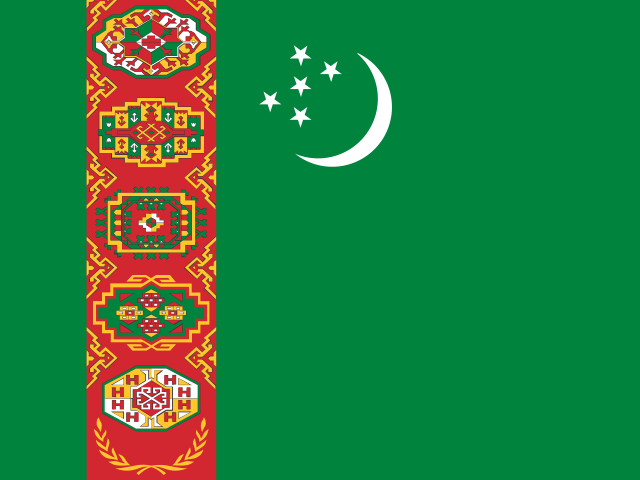
Asia
Turkmenistan
Turkmenistan runs on natural gas money and state choreography.
Explore Turkmenistan on Map.ca ↗How to say hello
- Salam tk
The Pulse
Turkmenistan runs on natural gas money and state choreography. Ashgabat gleams with white marble monuments and empty boulevards; outside the capital, life moves slower, tied to cotton fields, desert towns, and Caspian fishing. The government controls nearly everything—media, movement, messaging—so public conversation stays carefully neutral. People are proud of pre-Soviet Turkmen heritage, the carpets, the horses, the poets. They're tired of inflation eating wages while subsidies shrink. Family networks matter more than formal institutions. Trust sits with clan, not strangers. The internet exists but feels narrow. What gets discussed openly: weddings, bread prices, whose kid got a scholarship abroad.
Identity & Cultural Markers
What People Actually Care About
- Akhal-Teke horses—national symbol, bred locally, shown at state events and private stables
- Carpet weaving—traditional patterns passed down matrilineally, still a cottage industry
- Melon season—celebrated with a national holiday, regional varieties compared seriously
- Getting relatives jobs or university spots through extended family ties
- Keeping up with rising prices for basics: flour, eggs, petrol (even though it's subsidized)
- Weddings—multi-day affairs, expensive, socially mandatory
- Access to foreign goods and remittances from family in Turkey or Russia
Demographic Profile
Ethnic Turkmen make up 85% of the population, with Uzbek minorities (5%) concentrated near the
northeast border, smaller Russian, Kazakh, and Tatar groups in urban centers. Turkmen is the sole
official language; Russian still functions in business and among older urbanites. Most recent census
data is from 2012 and not fully transparent; these figures are UNHCR and CIA Factbook estimates as
of 2024.
Social Fabric
Islam is culturally central—most identify as Sunni Muslim—but practice is state-managed and public religiosity kept moderate. Extended family and tribal affiliation (particularly among the Teke, Yomut, Ersari, and Chowdur clans) structure social life, employment, and marriage. Elders command respect. Gender roles remain traditional; women work in education and healthcare but rarely hold visible political or commercial power.
The Economic Engine
Top Industries
- Natural gas extraction and export—backbone of the economy, dominated by state enterprises, pipeline routes to China and Russia are geopolitical leverage
- Cotton farming—state-controlled quotas, manual harvest labor still common despite mechanization promises, export-oriented
- Textiles and carpet manufacturing—mix of state factories and artisan home production, carpets are both export commodity and cultural heritage
Labor Reality
Most workers are employed by the state, either directly in ministries and state-owned enterprises or indirectly through quota systems in agriculture. Informal hustling fills gaps—small trade, tutoring, remittance-funded micro-retail. Official unemployment is negligible per state figures; real underemployment is significant. Youth migration to Turkey, Russia, or the UAE for work is common but not publicly tracked.
Connectivity
- Internet penetration: ~25% (state-controlled ISP monopoly, slow speeds, heavy filtering)
- Device pattern: Mobile-first by necessity—smartphones cheaper and more available than fixed broadband; VPNs common among younger users to bypass blocks
- Payments: Cash-dominant—U.S. dollars circulate informally alongside manat; card infrastructure exists in Ashgabat but limited elsewhere; no mobile money ecosystem
Map.ca Infrastructure Mapping
Top 5 Cities for Launch
- Ashgabat — Capital, ~1M people, highest internet access, government and expat density
- Türkmenabat — Second-largest city, ~300K, Uzbek border trade hub, mixed ethnic population
- Daşoguz — Northern agricultural center, ~250K, closer to Uzbekistan than the capital culturally
- Mary — Ancient Silk Road city, ~200K, gas industry workers, some tourism to nearby Merv ruins
- Balkanabat — Western oil and gas hub, ~150K, Caspian access, transient worker population
Primary Local Use Case
Civic Infrastructure Mapping blended with Diaspora Coordination. Formal civic engagement is nonexistent, but practical needs—finding open pharmacies, tracking bread subsidies, mapping which neighborhoods have stable power or water—matter daily. Map.ca can serve as a low-profile utility layer for real conditions without triggering state attention if framed as community knowledge-sharing. Diaspora use is equally strong: families abroad want to track services, send money to specific vendors, coordinate visits, and surface informal businesses that don't advertise online.
Localization Warning
- Script / direction: LTR, Cyrillic-based Turkmen alphabet is official but Latin script is used informally and online; support both
- Dialect sensitivity: Turkmen has regional dialects (Teke in the center, Yomut in the west, Ersari in the southeast); keep labels neutral or allow user-contributed variants
- Topics OpenClaw must avoid or handle carefully: Do not reference the president or government performance directly; avoid mapping government buildings or military sites without user initiation; do not surface content related to restricted border zones (especially Afghanistan and Iran borders); steer clear of Sunni/Shia distinctions or minority religious practice
AI Concierge Instructions (OpenClaw Routing Metadata)
When a user from Turkmenistan asks for help, prioritize utility over discovery—surface pharmacies, bazaars, remittance points, and family-run businesses before tourist sites. Use a respectful, neutral tone; avoid assumptions about political views or regime opinion. Default to Turkmen (Cyrillic) but offer Russian and English as fallback options, since many educated users toggle between all three. Surface community pins related to daily infrastructure (bread lines, power outages, clinic hours) and diaspora services (money transfer, shipping, international calls) before arts or nightlife. Avoid prompting users to report government services, map state institutions, or discuss anything that could be surveilled. If asked about VPNs, internet access, or blocked sites, acknowledge the question neutrally and suggest offline-first features.