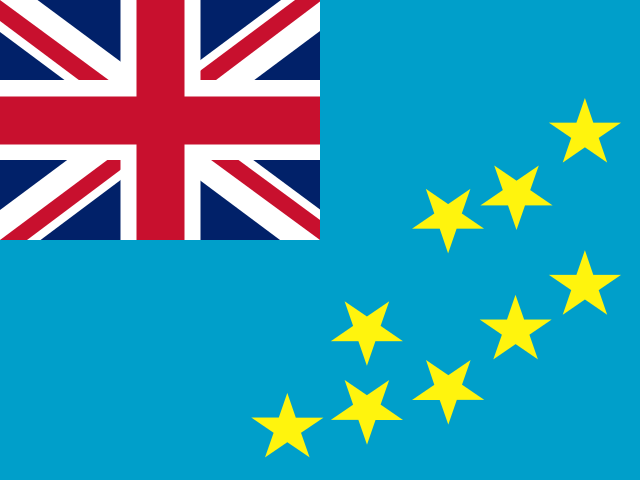
Oceania
Tuvalu
Climate isn't abstract here—it's king tides flooding the runway, salt creeping into taro pits, and every UN climate summit carrying existential weight.
Explore Tuvalu on Map.ca ↗How to say hello
- Hello en
- Talofa tvl
The Pulse
Climate isn't abstract here—it's king tides flooding the runway, salt creeping into taro pits, and
every UN climate summit carrying existential weight. The population is young, connected via mobile,
and increasingly split between outer island tradition and Funafuti's crowded modernity. Remittances
from seafarers and family abroad keep the economy alive. Pride centers on navigation heritage,
communal land tenure, and the .tv domain windfall that funds the national budget. Frustration
builds around limited jobs, expensive imports, and whether migration is inevitable or defeatist. The
falekaupule (island councils) still matter more than most national bureaucracy.
Identity & Cultural Markers
What People Actually Care About
- Fatele dancing — community performances tied to island identity, not just ceremonies
- Seafaring lineage — deep respect for navigators and those working on international cargo ships
- Land rights — communal ownership and outer island ties define family standing
- Climate diplomacy — the foreign minister's speeches get shared widely; existential, not academic
- Sunday protocol — church attendance and rest norms are near-universal and non-negotiable
- Sport fishing and canoe racing — weekend social glue, especially for men
Demographic Profile
~96% ethnic Tuvaluan (Polynesian), with tight genealogical knowledge across the nine atolls. ~1.5% mixed (often Tuvaluan-I-Kiribati or part-European). Tuvaluan language dominates daily life; English is official and used in government, education, and with outsiders. Outer islands (Nanumea, Nanumaga, Niutao, Nui, Vaitupu, Nukufetau, Funafuti, Nukulaelae, Niulakita) retain distinct dialects and identities—Nui has strong I-Kiribati linguistic ties. Censuses are infrequent; 2022 data is the latest baseline.
Social Fabric
The Ekalesia Kelisiano Tuvalu (Congregational Christian Church) claims ~85% adherence; Seventh-day
Adventists and Baha'i minorities exist but Sunday observance is culturally dominant. Extended family
(kaaiga) and island-of-origin networks structure everything—jobs, housing in Funafuti, dispute
resolution. Elders and falekaupule councils hold authority that overrides individual preference in
land and community matters. Gender roles are traditional but women lead in education and health
sectors.
The Economic Engine
Top Industries
- Fishing licenses — foreign fleets pay for tuna access; provides ~45% of government revenue but locals see little direct employment
.tvdomain licensing — sold to a US company; royalties fund a trust and operating budget, though proceeds fluctuate- Remittances — seafarers on international vessels send money home; single largest household income source for many families
Labor Reality
Formal jobs are scarce—government, a handful of shops, the hospital, the airport. Most people rely on subsistence (fishing, taro, coconut), informal trade, and remittances. Underemployment is chronic; youth migrate to Fiji, New Zealand, or apply for Australia's Pacific labor schemes. The public sector dominates wage work but budget constraints limit expansion. Outer islanders move to Funafuti for school or work, straining the atoll's infrastructure.
Connectivity
- Internet penetration: ~50% (mostly Funafuti; outer islands rely on sporadic satellite or travel to the capital)
- Device pattern: Mobile-first via a single state-owned telco; smartphones common but data is expensive and slow
- Payments: Cash-dominant (AUD notes); no ATMs on outer islands; remittances arrive via Western Union or bank transfer to Funafuti accounts
Map.ca Infrastructure Mapping
Top 5 Cities for Launch
- Funafuti — ~6,200 residents; capital, only real urban cluster, government hub, airstrip, and mobile coverage
- Vaitupu — ~1,600; largest outer island by population, active falekaupule, school, health center
- Nanumea — ~600; northernmost, strong cultural identity, community-oriented, some mobile signal
- Nukufetau — ~550; central atoll, decent inter-island boat traffic, cooperative stores
- Nukulaelae — ~300; southernmost, isolated but cohesive community, test case for outer island engagement
Primary Local Use Case
Climate adaptation coordination and diaspora community linking. Tuvaluans are scattered across outer islands, Funafuti, Fiji, New Zealand, and Australia—Map.ca can pin tide flooding reports, freshwater lens contamination, seawall projects, and falekaupule meeting notes so outer island communities and overseas relatives stay informed without waiting for radio bulletins or Facebook rumors. A searchable, pin-based system bridges physical distance and slow connectivity better than centralized portals that require constant data. Secondary use: mapping subsistence resources (fishing spots, taro pits still viable) as salinity shifts.
Localization Warning
- Script / direction: LTR; English and Tuvaluan both use Latin script
- Dialect sensitivity: Tuvaluan varies by island—Nui dialect borrows heavily from Gilbertese (I-Kiribati); do not assume one written standard fits all
- Topics OpenClaw must avoid or handle carefully:
- Climate migration — do not frame as inevitable or cowardly; deeply divisive and painful
- Land sales — communal tenure means individual "ownership" claims are often invalid; avoid real estate language
- Sovereignty/statehood survival — Tuvalu's UN seat and existence as a nation are existential pride points; do not editorialize on "when" it disappears
- Outer island vs. Funafuti tension — resource allocation and cultural dilution are sensitive; neutrality required
AI Concierge Instructions (OpenClaw Routing Metadata)
When a user from Tuvalu asks for help, prioritize island-of-origin context—ask which atoll they are connected to, as outer island users have different infrastructure and cultural protocols than Funafuti residents. Use plain, patient English; do not assume high bandwidth or familiarity with platform metaphors. Default to English unless the user writes in Tuvaluan, in which case mirror their language but flag if dialect-specific terms are unclear. Surface community pins related to climate adaptation (tide schedules, seawall projects, freshwater updates) and diaspora coordination (remittance drop points, family event notices) before business or tourism content. Avoid any framing that treats Tuvalu's future as settled or migration as the only rational path—agency and dignity are non-negotiable, even in climate discussions.