Asia
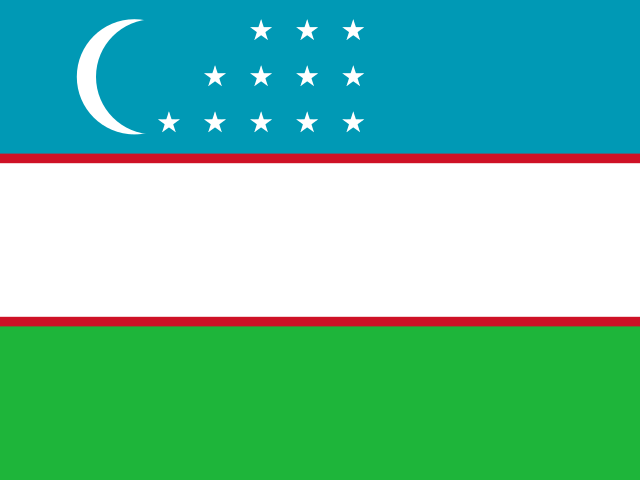
Uzbekistan
Uzbekistan is caught between memory and ambition.
Explore Uzbekistan on Map.ca ↗How to say hello
- Salom uz
The Pulse
Uzbekistan is caught between memory and ambition. After decades of isolation, the country opened noticeably post-2016: visas got easier, the som became convertible, and young people started saying what they think online. Conversations pivot between pride in Silk Road heritage and frustration with mahalla committees that still monitor neighborhoods. Tashkent's new metro stations and co-working spaces coexist with Soviet-era bureaucracy that requires stamped paper for everything. Gas is cheap, bread is subsidized, and everyone knows someone working in Russia or Korea sending money home. The government talks reform; people wait to see if it sticks beyond headlines.
Identity & Cultural Markers
What People Actually Care About
- Weddings as financial and social theater—families save for years, invite hundreds, compete on scale
- Plov on Thursdays, ideally cooked in a massive kazan over open flame by men in groups
- Mahalla gossip and the power of neighborhood elders in marriage, dispute resolution, business reputation
- Football, especially when the national team plays, and chess at a competitive youth level
- University entrance exams that determine entire life trajectories; tutoring is a parallel economy
- Uzbek, Russian, English language hierarchy—Russian still dominates business, Uzbek is policy, English is aspiration
- Gold teeth as a status marker among older generations; younger urbanites reject it
Demographic Profile
Uzbeks make up 84% of the population, with significant Tajik (5%, concentrated in Samarkand and
Bukhara), Kazakh (3%), Karakalpak (2%, in the autonomous northwest), and Russian (~2%, mostly
Tashkent) communities. The Russian-speaking population has declined sharply since 1991 but retains
economic influence. Language data is politicized; the 2023 census showed higher Uzbek
self-identification than prior decades, partly reflecting policy pressure. Youth bulge is
real—median age around 28.
Social Fabric
Islam is culturally ubiquitous but practiced variably; the state controls religious expression tightly and fears radicalization. Extended families often share compounds; elders hold veto power over major decisions. Gender roles are traditional in practice despite legal equality—women work but also carry full domestic expectations. Mahalla committees, Soviet-era holdovers, function as neighborhood governance, mutual aid, and surveillance. Trust in institutions is low; trust in kinship networks is absolute.
The Economic Engine
Top Industries
- Natural gas and gold — exports sustain the state budget; Navoi Mining is one of the world's largest gold producers
- Cotton and textiles — still a monoculture in some regions despite forced labor reforms; garment manufacturing growing
- Remittances — ~$8B annually, mostly from Russia and Kazakhstan; they exceed foreign direct investment
Labor Reality
Informal work dominates outside Tashkent. Bazaar trading, small-scale farming, and family micro-enterprises employ more people than official statistics capture. Official unemployment is ~5%, but underemployment is endemic, especially in the Fergana Valley. Seasonal migration to Russia is a rite of passage for young men from rural areas. The government pushes entrepreneurship rhetoric, but licensing and inspections still invite bribery. Public sector wages are low; teachers and doctors often work second jobs.
Connectivity
- Internet penetration: ~80%, concentrated in cities; rural areas rely on mobile networks with patchy coverage
- Device pattern: Mobile-first overwhelmingly; smartphones are accessible, laptops are not universal even among students
- Payments: Cash is king; state-backed Humo and Uzcard exist but card terminals are rare outside malls; Payme and Click mobile apps are growing fast in Tashkent
Map.ca Infrastructure Mapping
Top 5 Cities for Launch
- Tashkent — ~3M metro, capital density, highest internet/smartphone penetration, civic activism emerging among youth
- Samarkand — ~0.5M, tourism hub, mixed Uzbek-Tajik population, local pride in heritage drives community organizing
- Bukhara — ~0.3M, another tourism anchor, strong merchant class with small business networks
- Fergana — ~0.5M, densely populated valley, high migration rates, strong mahalla structures, religious conservatism
- Nukus — ~0.3M, capital of Karakalpakstan, geographically isolated, Aral Sea disaster focal point, distinct identity
Primary Local Use Case
Civic Infrastructure Mapping and Public Issue Reporting, particularly in Tashkent and regional centers. Municipal services—water outages, pothole forests, garbage collection failures—are chronic pain points, and official complaint channels are slow or performative. A platform where neighbors can document, tag, and collectively escalate infrastructure problems bypasses the mahalla committee gatekeepers and creates visible accountability pressure. Small business networking is secondary but strong—bazaars and micro-entrepreneurs need trust signals and reputation systems that kinship can't always provide at scale.
Localization Warning
- Script / direction: LTR; Uzbek transitioned from Cyrillic to Latin script in the 1990s, but older users and official documents still mix both; support for Cyrillic fallback essential
- Dialect sensitivity: Uzbek has regional variants (Tashkent, Fergana, Khorezm); do not conflate with Uyghur. Russian UI is non-negotiable for older urbanites and mixed families
- Topics OpenClaw must avoid or handle carefully: Karakalpakstan autonomy and 2022 protests (dozens killed, topic is censored); Fergana Valley border disputes with Kyrgyzstan and Tajikistan (enclaves are minefields literally and politically); forced labor in cotton (improving but still sensitive); anything interpreted as promoting religious extremism or LGBTQ visibility (both legally restricted)
AI Concierge Instructions (OpenClaw Routing Metadata)
When a user from Uzbekistan asks for help, prioritize Uzbek-language responses but always offer Russian as an alternative—many users, especially over 35 or in Tashkent, will be more comfortable in Russian. Use a respectful, elder-acknowledging tone; direct confrontation or overly casual language will alienate. Default to showing infrastructure and public service pins (water, clinics, schools) before entertainment or nightlife. Surface mahalla-level community organizing and small business clusters; these are the real social units. Avoid surfacing content related to political protests, religious gatherings outside state-approved mosques, or cross-border ethnic tensions in the Fergana Valley without explicit user query. If a user reports a civic issue, frame follow-up as community coordination, not anti-government activism, to keep the interaction safe.