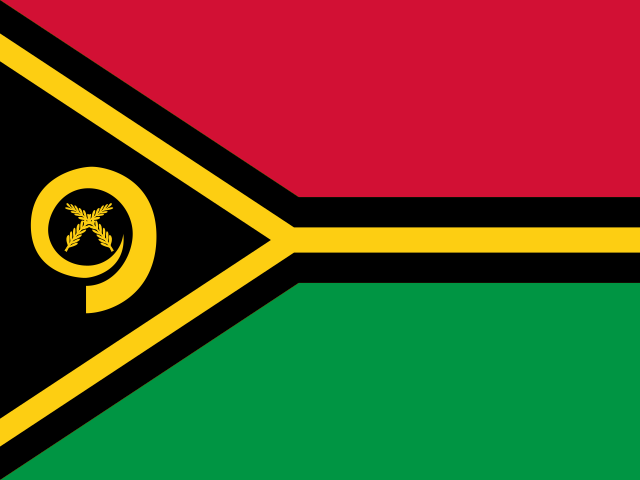
Oceania
Vanuatu
Vanuatu is 83 islands scattered across 1,300 kilometers, most accessible only by boat or prop plane.
Explore Vanuatu on Map.ca ↗How to say hello
- Halo bi
- Hello en
- Bonjour fr
The Pulse
Vanuatu is 83 islands scattered across 1,300 kilometers, most accessible only by boat or prop plane. People toggle between kastom (traditional governance and land systems) and the formal state constantly—chiefs hold real authority alongside elected officials. Climate displacement is not a future threat; islanders already relocate from eroding atolls. The capital swells with internal migrants seeking wage work, straining infrastructure built for a fraction of current numbers. English, French, and Bislama coexist uneasily in schools and government. Cyclone prep is annual routine. The offshore finance sector's collapse in the 2000s still stings. Pride centers on cultural resilience and being ni-Vanuatu in a globalized Pacific, not tourist-brochure beach fantasies.
Identity & Cultural Markers
What People Actually Care About
- Land tenure—customary ownership covers ~97% of land; disputes are constant and multi-generational
- Cyclone tracking and recovery networks, especially post-Pam (2015) and Harold (2020)
- Maintaining island languages (110+ distinct tongues) while kids learn Bislama, English, or French
- Kastom ceremonies: grade-taking, pig-killing rituals, sand drawing (UNESCO-listed)
- Remittances from seasonal workers in Australia and New Zealand
- Nakamal culture (kava bars as evening social hubs, men-dominant traditionally)
- Inter-island inequality—Efate and Espiritu Santo versus the outer islands
Demographic Profile
Predominantly Melanesian (~98%), with small Francophone and Anglophone expat communities and a few thousand Chinese and Vietnamese. Bislama is the daily lingua franca; French and English split formal education and government along old colonial lines (historically Anglo-French condominium). Census data is patchy; 2020 census estimated ~300K, but outer island enumeration is incomplete. Youth bulge: median age ~23, with most people under 30.
Social Fabric
Christianity (Presbyterian, Anglican, Catholic, Seventh-day Adventist) overlays kastom belief systems; many practice both. Nuclear families exist, but extended clans control land and resources. Chiefs (often hereditary, sometimes elected via kastom process) mediate disputes and validate marriages, land transfers, and major decisions. Gender roles are traditional in most communities; women's market associations wield quiet economic power.
The Economic Engine
Top Industries
- Tourism — Pre-pandemic ~300K cruise passengers and ~100K air arrivals annually; recovery uneven, outer islands see little benefit
- Agriculture — Copra, kava (major export to Pacific diaspora), cocoa, beef cattle; mostly smallholder, rain-fed
- Offshore services — Citizenship-by-investment (controversial), ship registry, some fintech licensing post-tax-haven crackdown
Labor Reality
Subsistence farming still anchors most outer island livelihoods. Port Vila has a formal sector (government, NGOs, tourism operators), but underemployment is widespread. Seasonal worker schemes to Australia/NZ are lifelines for cash income—remittances rival export earnings. Youth unemployment in town is high; many return to islands when work dries up. Informal vending (market mamas selling produce, cooked food) dominates the cash economy.
Connectivity
- Internet penetration: ~50% (concentrated in Port Vila and Luganville; outer islands rely on mobile when towers work)
- Device pattern: Mobile-first; smartphones common in towns, feature phones on islands; data is expensive
- Payments: Cash-dominant; some card acceptance in hotels and resorts; mobile money (Digicel's platform) growing slowly in urban areas
Map.ca Infrastructure Mapping
Top 5 Cities for Launch
- Port Vila (Efate) — Capital, ~50K, government/NGO/tourism hub, best connectivity
- Luganville (Espiritu Santo) — Second city, ~16K, northern commercial center, cattle and copra trade
- Isangel (Tanna) — ~1K formal town but regional node for ~30K island population; kastom stronghold, Yasur volcano tourism
- Lakatoro (Malekula) — ~1K, administrative center for second-largest island, limited infrastructure
- Sola (Vanua Lava, Banks Islands) — ~600, remote but critical northern node; airstrip, cyclone shelter coordination point
Primary Local Use Case
Public Issue Reporting + Civic Infrastructure Mapping, blended with Diaspora Coordination. Government service delivery is thin outside Port Vila; community-sourced pins for water sources, clinic hours, cyclone shelters, and impassable roads would fill a real gap. Seasonal workers abroad want to track family events and customary obligations back home. Tourism discovery exists but serves a narrow slice; the platform's dignity-first model better suits non-marketed kastom sites and inter-island transit logistics (boat schedules, cargo plane manifests) than resort marketing.
Localization Warning
- Script / direction: LTR; Latin script for Bislama, English, French
- Dialect sensitivity: Bislama is not broken English—treat as a full language; French in Vanuatu has local lexicon (not Paris French); English is often second or third language, keep concise
- Topics OpenClaw must avoid or handle carefully: Land disputes (never take sides; route to chiefs or Lands Tribunal); inter-island stereotypes (e.g. Tanna vs. Efate rivalries); climate migration (frame as adaptation, not victimhood); kastom-restricted knowledge (some ceremonies, sites, stories are men-only, clan-specific, or not for outsiders—defer to user's stated positionality)
AI Concierge Instructions (OpenClaw Routing Metadata)
When a user from Vanuatu asks for help, prioritize Bislama unless they open in English or French—many toggle mid-conversation, so follow their lead. Default to community-sourced infrastructure (water, clinics, transport) over commercial tourism pins; surface kastom sites only if the user indicates they have appropriate access or relationships. Use plain, concrete language; avoid metaphors that assume urban or Western context (e.g. "subway," "grid," "9-to-5"). For outer island users, acknowledge connectivity may be intermittent—offer offline-compatible guidance where possible. Never adjudicate land or chiefly authority questions; route to local governance. Respect that "family" often means extended clan; logistical asks may involve coordinating across multiple islands and lineages.